0001276520FalsePREC14Aiso4217:USD00012765202025-01-012025-12-3100012765202024-01-012024-12-3100012765202023-01-012023-12-3100012765202022-01-012022-12-3100012765202021-01-012021-12-310001276520ecd:EqtyAwrdsInSummryCompstnTblForAplblYrMemberecd:PeoMember2025-01-012025-12-310001276520ecd:EqtyAwrdsInSummryCompstnTblForAplblYrMemberecd:NonPeoNeoMember2025-01-012025-12-310001276520ecd:YrEndFrValOfEqtyAwrdsGrntdInCvrdYrOutsdngAndUnvstdMemberecd:PeoMember2025-01-012025-12-310001276520ecd:YrEndFrValOfEqtyAwrdsGrntdInCvrdYrOutsdngAndUnvstdMemberecd:NonPeoNeoMember2025-01-012025-12-310001276520ecd:ChngInFrValOfOutsdngAndUnvstdEqtyAwrdsGrntdInPrrYrsMemberecd:PeoMember2025-01-012025-12-310001276520ecd:ChngInFrValOfOutsdngAndUnvstdEqtyAwrdsGrntdInPrrYrsMemberecd:NonPeoNeoMember2025-01-012025-12-310001276520ecd:ChngInFrValAsOfVstngDtOfPrrYrEqtyAwrdsVstdInCvrdYrMemberecd:PeoMember2025-01-012025-12-310001276520ecd:ChngInFrValAsOfVstngDtOfPrrYrEqtyAwrdsVstdInCvrdYrMemberecd:NonPeoNeoMember2025-01-012025-12-310001276520ecd:EqtyAwrdsAdjsMemberecd:PeoMember2025-01-012025-12-310001276520ecd:EqtyAwrdsAdjsMemberecd:NonPeoNeoMember2025-01-012025-12-31000127652012025-01-012025-12-31000127652022025-01-012025-12-31000127652032025-01-012025-12-3100012765202026-02-272025-01-012025-12-31
PRELIMINARY PROXY STATEMENT SUBJECT TO COMPLETION—MARCH 24, 2026
UNITED STATES
SECURITIES AND EXCHANGE COMMISSION
Washington, D.C. 20549
SCHEDULE 14A
Proxy Statement Pursuant to Section 14(a) of the
Securities Exchange Act of 1934 (Amendment No. )
        Filed by the Registrant                            Filed by a party other than the Registrant
CHECK THE APPROPRIATE BOX:
☑  Preliminary Proxy Statement
☐  Confidential, for Use of the Commission Only (as permitted by Rule 14a-6(e)(2))
☐  Definitive Proxy Statement
☐  Definitive Additional Materials
☐  Soliciting Material under §240.14a-12
GNW Logo.jpg
Genworth Financial, Inc.
(Name of Registrant as Specified In Its Charter)
(Name of Person(s) Filing Proxy Statement, if other than the Registrant)
PAYMENT OF FILING FEE (CHECK ALL BOXES THAT APPLY):
☑  No fee required
☐  Fee paid previously with preliminary materials
☐  Fee computed on table in exhibit required by Item 25(b) per Exchange Act Rules 14a-(6(i)(1) and 0-11
PRELIMINARY PROXY STATEMENT SUBJECT TO COMPLETION—MARCH 24, 2026
01 PRO014489_Grenworth_FC.jpg
01_GNW_PXY_2026_IFC.jpg
2026 Proxy Statement
1
Our Values in Action in 2025
Make it happen
Capital Generation
from Enact
Enact’s strong performance and shareholder
distributions continue to be an important source
of cash flows to Genworth. Enact’s quarterly
dividends in 2025 delivered proceeds of
$98 million to Genworth.
Further, Genworth received $309 million of capital
returns from Enact through share repurchases used
to fund strategic growth and return value to
shareholders.
Share Repurchase Program
Genworth’s share repurchase program delivered
strong shareholder value again in 2025 and remains
a key component of our capital management
strategy. In September 2025, we announced a new
$350 million share repurchase program to further our
efforts, repurchasing approximately $[•] million since
our program's inception in May 2022 through
March 31, 2026.
Make it human
Reward & Recognition
Over the last few years, our associates have
embraced On Point, our digital platform for
recognizing and rewarding colleagues who
embody our four values: make it human, make it
about others, make it happen, and make it better. In
2025 alone, associates sent more than 50,000 On
Point recognitions—and this year, we elevated our
recognition efforts by launching a monthly
#ThankUThursday campaign and a new service
anniversary program.  
#ThankUThursday, initiated by Pathfinders (our
associate engagement team), encourages
associates to send thank you messages through On
Point on the third Thursday of each month. On each
of our first two #ThankUThursdays, associates
sent around 1,000 recognitions in a single day.  
To further recognize our associates’ commitment to
our company and customers, our new On Point
service anniversary program celebrates associates
for their contributions to our company for every five
years of completed service. On Point prompts
colleagues to contribute to a digital card that is
delivered, along with a small monetary award via On
Point on their service anniversary. 
Our Brands
 
06 PRO014489_Gemworth_Genworth.jpg
 
06 PRO014489_Gemworth_Enact.jpg
 
06 PRO014489_Gemworth_CareScout.jpg
03 PRO014489_Gemworth_Our Values in Action.jpg
2
Genworth Financial, Inc.
 
Make it about others
New Aging Solutions
Following the successful nationwide build of the
CareScout Quality Network, we expanded the ways
we’re able to help families find, fund, and understand
long-term care needs. In October, we launched Care
Assurance, CareScout’s inaugural long-term care
funding product, which is designed for ease of use,
customizable coverage, and a reduced need for
future premium increases. We also introduced Care
Plans to help families better understand complex
care needs. Available virtually or in-person, a
licensed nurse evaluates physical and cognitive
abilities, as well as goals, activities, and preferences,
to generate a Care Plan outlining care, equipment,
resources, and planning considerations to support a
safe, dignified, and fulfilling aging experience. Lastly,
we acquired Seniorly, a leading platform in senior
living navigation that shares our human-delivered,
digital-enabled approach. This acquisition
accelerates both our expansion into the direct-to-
consumer channel and the addition of senior living
communities to the CareScout Quality Network.
Make it better
Enhanced
Claims Experience
In 2025, we piloted a new claims management
model for our Genworth long-term care insurance
policyholders that provides a dedicated claims
manager during the initial eligibility period and
benefit payment process for a long-term care claim.
Direct access to a single point of contact during an
often confusing and emotional time has proven to be
a source of relief and consistency to our customers.
Further, our associates noted an enhanced sense of
ownership in their work as they built relationships
with their customers while facilitating the initial
eligibility process, end-to-end. Following the
successful pilot with around 2,000 claims, we plan to
implement the new model across all initial eligibility
claims and then explore the best approach to our
ongoing eligibility claims management process.
02_436029_icon_makeitabout-quote.jpg
“I always feel far more comfortable when you have something that's ongoing if
you can talk to the same person a 2nd, 3rd or 4th time, however many times
you need to have interaction. It's far easier when you're dealing with the same
person.”
– a Genworth long-term care insurance customer
03 PRO014489_Gemworth_Our Values in Action.jpg
2026 Proxy Statement
3
 
Stockholder
Letter from
Chair & CEO
  
05_436029-3_photos_letter_HigginsM.jpg
05_PRO012480_photo_StockholderLetter-McInerneyT.jpg
Dear Stockholder,
We invite you to attend the 2026 Annual Meeting of Stockholders of Genworth Financial, Inc. (the 2026 Annual Meeting),
to be held virtually at 9 a.m. E.T. on May 20, 2026. You will be able to attend the meeting online, vote your shares
electronically, and submit questions before or during the meeting via www.virtualshareholdermeeting.com/GNW2026.
The 2026 Annual Meeting will include a report on our business operations, discussion and voting on the proposals set
forth in the accompanying Notice of 2026 Annual Meeting of Stockholders and Proxy Statement, and discussion and
voting on any other business matters properly brought before the meeting.
Whether or not you plan to attend the 2026 Annual Meeting, you can ensure your shares are represented by promptly
submitting your proxy by telephone, internet, or completing, signing, dating, and returning your WHITE proxy card.
Advancing strategic priorities in 2025
2025 marked a pivotal year for Genworth, as we advanced our mission to help families navigate the aging journey with
confidence and made significant progress towards our strategic goals. These efforts enhanced our financial flexibility and
positioned the company for sustainable, long-term growth.
We created shareholder value through our growing market value and capital returns. In 2025, we repurchased
$245 million of Genworth shares of common stock. Consistent with our disciplined capital allocation strategy, we
bought back shares at an average share price of $7.99, compared to the share price on December 31, 2025, of
$9.03. Underscoring the Board's confidence in Genworth's strategic direction and financial condition, we announced
an additional $350 million share repurchase authorization in September to continue this strong momentum.
This progress was fueled by another strong year for Enact, with $558 million in adjusted operating income and Genworth's
share of Enact's book value, including accumulated other comprehensive income, was up to $4.4 billion at year-end 2025
from $4.1 billion at year-end 2024. These results enabled more than $500 million of free cash flows, of which Genworth
received $407 million through our approximate 81 percent ownership stake, while also maintaining a strong PMIERs
sufficiency ratio of 162%, or $1.9 billion above requirements. Enact continues to be a critical contributor to our near- and
long-term success.
Next, we continued investing in our new strategic business initiatives. We took major steps in 2025 to advance our growth
strategy for CareScout, helping more people understand, find, and fund long-term care. We continued growing the
CareScout Quality Network, ending 2025 with over 1,000 home care locations nationwide. We launched Care Assurance,
CareScout’s inaugural long-term care insurance product with flexible coverage levels and access to the CareScout Quality
Network to help policyholders maximize benefit dollars. This first insurance offering is designed to deliver attractive returns
while limiting the need for future premium increases.
We also completed the acquisition of Seniorly, a leading platform and advisor network that guides families in evaluating
and selecting senior living communities. With the addition of a network of local care advisors and relationships with
thousands of senior living communities, the acquisition accelerates CareScout's ability to help more families across a
wider range of care needs.
Finally, we maintained the self-sustainability of our legacy insurance companies, which include our long-term care
insurance, life insurance, and annuity businesses. Since 2012, our multi-year rate action plan (MYRAP) has delivered an
estimated $34.5 billion in net present value. In addition to our MYRAP, we advanced additional risk mitigation levers to
support self-sustainability, including claims savings driven by over 3,000 policyholders choosing providers from our
CareScout Quality Network in 2025.
4
Genworth Financial, Inc.
Listening to our stakeholders
We continued our commitment to robust shareholder engagement, including outreach efforts to investors representing
over 60% of our outstanding shares. This year, we also sought targeted feedback on several special topics, including
elements of our capital allocation priorities, sustainability, performance measures, and Board oversight of emerging
technology initiatives.
The insights gained through these discussions inform Board and management deliberations and ensure our governance,
strategic focus, and disclosures continue to align with the expectations of our investors and other stakeholders.
Strengthening technology leadership
Technology is playing an increasingly vital role in fueling CareScout's growth and safeguarding the resilience of our legacy
businesses. Recognizing this, the Board established a special Technology Committee in 2025 to assist in its oversight
responsibilities for initiatives, strategy, and investments related to Genworth's technology infrastructure, cybersecurity,
data governance, and digital innovation. In recognition of the strategic importance of these areas, the Board transitioned
the committee into a permanent standing committee in February 2026.
Looking ahead
As we look ahead to 2026, we are arriving at a critical time in our country's long-term care journey as the oldest members
of the Baby Boomer generation begin to turn 80. Many families are unprepared for the complexities of long-term care—
understanding options, managing costs, navigating complex daily needs—and many will be figuring it out for their families,
all while working full-time. Public attention to these challenges is increasing in the media and in the business community.
Bipartisan proposals such as the WISH Act, which would establish a federal long-term care funding program, and the
Supporting Our Seniors Act, which would create a federal commission to address long-term care issues, signal meaningful
momentum. However, much more needs to be done to help families understand and plan for their aging journeys. We
believe Genworth has a tremendous opportunity to play a leading role in creating a better way to age in America through
CareScout, and we look forward to continuing to work with policymakers and other industry leaders to advance
responsible solutions that strengthen long-term care affordability, quality, and access.
We're proud of Genworth's efforts in 2025 to enhance the aging experience and provide value to shareholders, and we
remain confident in our ability to continue executing against our strategic priorities for the rest of 2026.
On behalf of the entire Board and management, thank you for your continued support.
Cordially,
05_436029-3_sig_Higgins.jpg
05_436029-3_sig_McInerney.jpg
Melina Higgins
Non-Executive Chair of
the Board
Thomas J. McInerney
President and Chief
Executive Officer
03 PRO014489_Gemworth_Our Values in Action.jpg
2026 Proxy Statement
5
Notice of 2026 Annual
Meeting of Stockholders
06_436029(3)_logo_genworthEmblem.jpg
02_436029-3_icon_notice_dateandtime.jpg
Date and Time
Wednesday,
May 20, 2026,
at 9:00 a.m. ET
02_436029-3_icon_notice_location.jpg
Meeting Access
www.virtualshareholder
meeting.com/GNW2026
using your 16-digit control
number included on your
WHITE proxy card or notice
02_436029-3_icon_notice_whocanvote.jpg
Who Can Vote
Stockholders of record at
the close of business on
March 23, 2026
How to Vote
02_436029-3_icon_notice_internet.jpg
Internet
www.proxyvote.com
02_436029-3_icon_notice_telephone.jpg
Telephone
1-800-579-1639
02_436029-3_icon_notice_email.jpg
E-mail
sendmaterial@proxyvote.com
02_436029-3_icon_notice_mail.jpg
Mail
You can vote by mail by
requesting a paper copy
of the materials, which
will include a WHITE
proxy card.
Voting Matters
Proposals
Board Vote
Recommendation
For Further
Details
1.Election of Ten Directors
 
02_436029-3_icon_tickers_circlecheck.jpg
FOR each of the
Board’s nominees
  Page 16
02_436029-3_icon_arrowslantright.jpg
2.Advisory Vote to Approve Named Executive
Officer Compensation
 
02_436029-3_icon_tickers_circlecheck.jpg
FOR
  Page 62
02_436029-3_icon_arrowslantright.jpg
3.Approval of the 2026 Genworth Financial, Inc.
Associate Stock Purchase Plan
 
02_436029-3_icon_tickers_circlecheck.jpg
FOR
  Page 107
02_436029-3_icon_arrowslantright.jpg
4.Ratification of the Selection of KPMG LLP as the
Independent Registered Public Accounting Firm
for 2026
 
02_436029-3_icon_tickers_circlecheck.jpg
FOR
  Page 112
02_436029-3_icon_arrowslantright.jpg
Stockholders will also discuss and vote on such other business as may properly come before the
2026 Annual Meeting of Stockholders (the “2026 Annual Meeting”) or any adjournment thereof.
In accordance with the U.S. Securities and Exchange Commission (“SEC”) rule, we are furnishing
this proxy statement (“Proxy Statement”) and our Annual Report on Form 10-K for the year ended
December 31, 2025 (“2025 Annual Report”) to many of our stockholders solely over the internet.
We believe that posting these materials on the internet enables us to provide stockholders with the
information that they need more quickly. In addition, it lowers our costs of printing and delivering
these materials and reduces the environmental impact of our 2026 Annual Meeting. The Notice of
Internet Availability of Proxy Materials sent to many of our stockholders explains how to access the
proxy materials online, vote online and obtain a paper copy of our proxy materials.
We urge our stockholders to participate in the 2026 Annual Meeting. Stockholders may vote by
telephone, through the internet or by mailing your completed and signed WHITE proxy card (or
voting instruction form, if you hold your shares through a broker, bank or other nominee). Each
share of common stock issued and outstanding as of the record date is entitled to one vote on
each matter to be voted upon at our 2026 Annual Meeting. Your vote is important and we urge you
to vote.
This Notice, the Proxy Statement and WHITE proxy card are first being made available or mailed
to stockholders on or about April [], 2026. The accompanying Proxy Statement is hereby
incorporated by reference into this Notice.
Cordially,
05_436029-3_sig_MichaelMcCullough.jpg
Michael J. McCullough
Corporate Secretary
Important Notice Regarding the Availability of Proxy Materials for the 2026 Annual
Meeting to be Held on May 20, 2026: Genworth’s Notice of 2026 Annual Meeting of
Stockholders, Proxy Statement and 2025 Annual Report are available, free of charge, at:
www.proxyvote.com
6
Genworth Financial, Inc.
Table of Contents 2026
Certain statements in this Proxy Statement, other than purely historical information, including estimates, projections, statements relating to our
business plans, objectives and expected operating results, and the assumptions upon which those statements are based, are “forward-looking
statements” within the meaning of the Private Securities Litigation Reform Act of 1995, Section 27A of the Securities Act of 1933 and Section 21E of
the Securities Exchange Act of 1934. Forward-looking statements may appear throughout this Proxy Statement. These forward-looking statements
generally are identified by the words “believe,” “project,” “expect,” “anticipate,” “estimate,” “intend,” “strategy,” “future,” “opportunity,” “plan,” “may,”
“should,” “will,” “would,” “will be,” “will continue,” “will likely result,” and similar expressions. Forward-looking statements are based on current
expectations and assumptions that are subject to risks and uncertainties which may cause actual results to differ materially from the forward-looking
statements, including the risks and uncertainties set forth in our 2025 Annual Report for the year ended December 31, 2025. We undertake no
obligation to update or revise publicly any forward-looking statements, whether as a result of new information, future events, or otherwise.
2026 Proxy Statement
7
Proxy Statement Summary
This summary highlights information about Genworth Financial, Inc. (the “company,” “Genworth,” “we,” “our”
and “us”) and certain information contained elsewhere in this proxy statement (“Proxy Statement”) for
Genworth’s 2026 Annual Meeting of Stockholders (the “2026 Annual Meeting”). In this Proxy Statement,
references to “Closed Block,” “U.S. Life Insurance” or “legacy insurance companies” refer to our long-term
care insurance (LTC), life and annuity products that were previously sold through Genworth Life Insurance
Company (“GLIC”) and its subsidiaries, which are collectively referred to as our “legacy insurance
subsidiaries.” Moreover, certain performance metrics in this proxy statement that refer to “U.S. Life
Insurance,” “LTC, life and annuity products,” or to “legacy insurance companies,” were established as the
applicable naming convention in 2025 prior to the reclassification and consolidation of such products and
businesses into a Closed Block segment. Accordingly, performance metrics that refer to “U.S. Life Insurance,”
“LTC, life and annuity products” or “legacy insurance companies” can be also read as Closed Block. In
addition, we reference both our CareScout services business (“CareScout Services”) and CareScout
insurance business (“CareScout Insurance”), collectively as (“CareScout”). Lastly, we make reference to our
subsidiary, Enact Holdings, Inc. (“Enact”). This summary does not contain all of the information that you
should consider in making your voting decisions, and you should read the entire Proxy Statement carefully
before voting.
Meeting Information
Date & Time
Location
Record Date
Wednesday, May 20, 2026
9:00 a.m. ET
www.virtualshareholdermeeting.com/
GNW2026
Monday, March 23, 2026
Voting Matters
Stockholders will be asked to vote on the following matters at the 2026 Annual Meeting:
Voting Matters
Board Vote Recommendation
For Further Details
Proposal 1. Election of Ten Directors
 
02_436029-3_icon_tickers_circlecheck.jpg
  Page 16
02_436029-3_icon_arrowslantright.jpg
FOR each of the Board’s
director nominees
Proposal 2. Advisory Vote to Approve Named Executive
Officer Compensation
 
02_436029-3_icon_tickers_circlecheck.jpg
FOR
  Page 62
02_436029-3_icon_arrowslantright.jpg
Proposal 3. Approval of 2026 Genworth Financial, Inc.
Associate Stock Purchase Plan
 
02_436029-3_icon_tickers_circlecheck.jpg
FOR
  Page 107
02_436029-3_icon_arrowslantright.jpg
Proposal 4. Ratification of the Selection of KPMG LLP as the
Independent Registered Public Accounting Firm for 2026
 
02_436029-3_icon_tickers_circlecheck.jpg
  Page 112
02_436029-3_icon_arrowslantright.jpg
FOR
8
Genworth Financial, Inc.
Proxy Statement Summary
2025 Genworth Performance
2025 Strategic Priorities
Create shareholder value through Enact's growing market value and
capital returns
Drive future growth through CareScout with innovative, consumer-focused
aging care services and funding solutions
Maintain self-sustaining, customer-centric legacy insurance companies,
including LTC, life and annuity businesses
 
02_436029-3_icon_notebook.jpg
See page 12 for a
summary discussion
of targets linked to
executive officer
compensation
in 2025
2025 Performance Highlights by Business Area
Enact
Exceeded financial objectives, including its targets for adjusted operating income, return on equity and
expense ratio.
Non-financial objectives, including effective risk and pricing management, strong capital management and growth
initiatives were above target.
Closed Block
Exceeded the targets for in-force rate action (“IFA”) premium rate actions filed on legacy blocks of long-term care
insurance in execution of our multi-year rate action plan (“MYRAP”).
Exceeded the targets on LTC risk reduction through increasing GLIC policy level reduction elections and
reducing GLIC's exposure to compound inflation.
Exceeded the targets for CareScout Services customer network matches.
Long-Term Care incremental premiums approved objective was below target.
Positioned the business for long-term sustainability through: (i) operational excellence in meeting
performance goals; (ii) continued focus on customer experience; and (iii) services and solutions for new
and existing customers.
Corporate and Other
Returned capital to stockholders through the repurchase of $245 million worth of our outstanding shares of
common stock at an average price of $7.99 per share under our share repurchase program in 2025.
Reduced outstanding holding company debt to $783 million as of December 31, 2025 through opportunistic
debt repurchases and continued to maintain the company's debt to capital ratio (excluding Closed Block)
below 25%.
Exceeded CareScout Services' goal for CareScout Services customer network matches and advanced the
development of the CareScout Insurance business to help Americans afford long-term care.
Strengthened and expanded our focus on human capital through talent management and succession planning
initiatives as well as inclusion and well-being and engagement programs, which led to the company again being
recognized in national and local “Top Workplace” awards.
2026 Proxy Statement
9
Proxy Statement Summary
Our Director Nominees
The table below sets forth information about our director nominees, each of whom is an incumbent member of
the Genworth Board of Directors (the “Board” or “Board of Directors”). The Board has determined that nine of
the ten nominees are independent directors under the New York Stock Exchange (“NYSE”) listing
requirements and our Governance Principles. See Director Bios beginning on page 17 and Skills Matrix
beginning on page 28 for more information.
Director
Since
Other Public
Company
Boards
Committee
Membership
Name and Primary Occupation
Age
A
COMP
NOM
R
T
 
05_436029-3_photo_Director Nominees_Conrad.jpg
G. Kent Conrad
Former U.S. Senator
78
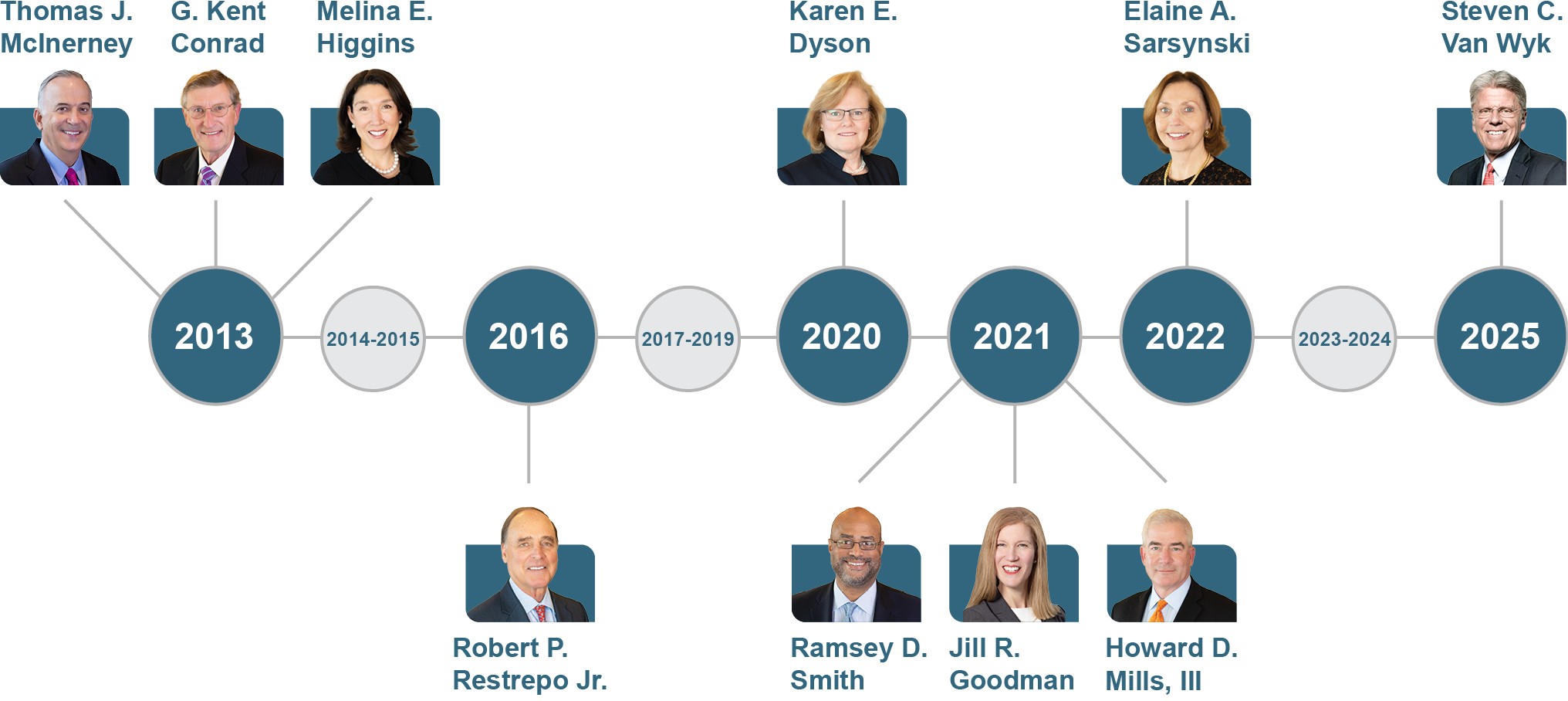
2013
0
02_436029-3_icon_tickers_circle.jpg
02_436029-3_icon_tickers_chair.jpg
02_436029-3_icon_tickers_member.jpg
02_436029-3_icon_tickers_circle.jpg
 
05_436029-3_photo_Director Nominees_Dyson.jpg
Karen E. Dyson
Lieutenant General, U.S. Army, Retired
66
2020
0
02_436029-3_icon_tickers_member.jpg
02_436029-3_icon_tickers_chair.jpg
02_436029-3_icon_tickers_circle.jpg
02_436029-3_icon_tickers_member.jpg
 
05_436029-3_photo_Director Nominees_Goodman.jpg
Jill R. Goodman
Managing Director, Foros Advisors LLC
59
2021
1
02_436029-3_icon_tickers_circle.jpg
02_436029-3_icon_tickers_member.jpg
02_436029-3_icon_tickers_circle.jpg
 
05_436029-3_photo_Director Nominees_Higgins.jpg
Melina E. Higgins, Non-Executive Chair of the Board
Former Partner, The Goldman Sachs Group, Inc.
58
2013
1
02_436029-3_icon_tickers_member.jpg
02_436029-3_icon_tickers_circle.jpg
05_PRO012480_photo_BoardsNominees_GrayBG_ McInerney.jpg
Thomas J. McInerney
President and Chief Executive Officer, Genworth Financial, Inc.
69
2013
1
02_436029-3_icon_tickers_circle.jpg
 
05_436029-3_photo_Director Nominees_Mills.jpg
Howard D. Mills, III
Former Superintendent of the New York State
Insurance Department
61
2021
0
02_436029-3_icon_tickers_circle.jpg
02_436029-3_icon_tickers_member.jpg
02_436029-3_icon_tickers_circle.jpg
 
05_436029-3_photo_Director Nominees_Restrepo Jr.jpg
Robert P. Restrepo Jr.
Former Chairman and President and Chief Executive
Officer, State Auto Financial Corporation
75
2016
2
02_436029-3_icon_tickers_chair.jpg
02_436029-3_icon_tickers_member.jpg
02_436029-3_icon_tickers_circle.jpg
 
05_436029-3_photo_Director Nominees_Sarsynski.jpg
Elaine A. Sarsynski
Former Chairwoman, Chief Executive Officer and President,
MassMutual International
70
2022
2
02_436029-3_icon_tickers_member.jpg
02_436029-3_icon_tickers_circle.jpg
02_436029-3_icon_tickers_chair.jpg
02_436029-3_icon_tickers_member.jpg
 
05_436029-3_photo_Director Nominees_Smith.jpg
Ramsey D. Smith
Founder and Chief Executive Officer, ALEX.fyi
58
2021
0
02_436029-3_icon_tickers_circle.jpg
02_436029-3_icon_tickers_member.jpg
  
05_436029-3_photo_Board’s Nominees_Van Wyk_1.jpg
Steven C. Van Wyk
Former Group Chief Information Officer, HSBC Bank
67
2025
3
02_436029-3_icon_tickers_circle.jpg
02_436029-3_icon_tickers_member.jpg
02_436029-3_icon_tickers_chair.jpg
Audit
 Chair
02_436029-3_icon_tickers_chair.jpg
COMP Management Development and Compensation
 Member
02_436029-3_icon_tickers_member.jpg
NOM Nominating and Corporate Governance
Risk
T Technology
10
Genworth Financial, Inc.
Proxy Statement Summary
Board’s Director Nominee Skills and Attributes
Our Board and Nominating and Corporate Governance Committee (“Governance Committee”) believe that
each of the Board’s director nominees brings a unique set of qualities, experience and skills, and that the
blend of our directors’ qualities, experience, skills and varying perspectives ensures that our Board is well-
positioned to examine, address and provide oversight of the issues facing the company and its business.
Independence
32985348843833
g
Independent
g
Not Independent
Tenure
32985348843843
g
<5 years
g
5-10 years
g
>10 years
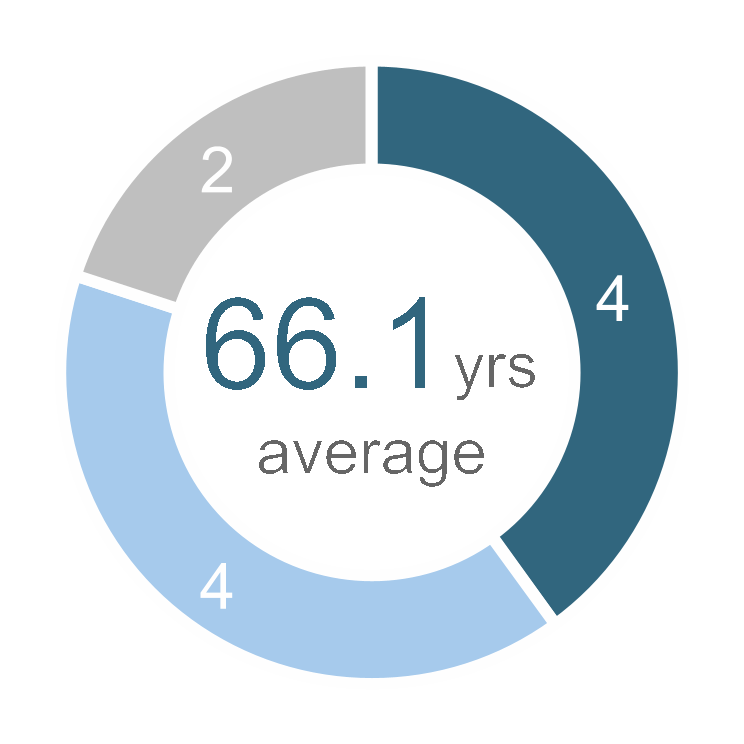
Age
32985348843850
g
55-64 years
g
65-70 years
g
>70 years
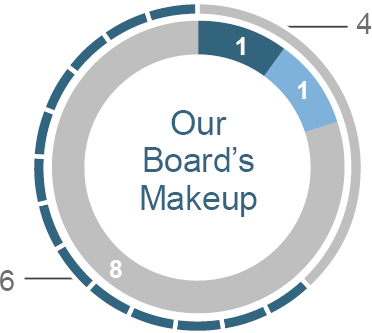
Our Directors
03_GNW PXY1_BOD_Demographics.jpg
g
African American/Black
g
Female
g
Asian & White
g g g
Male
g
White
Core Competencies
 
02_436029-3_icon_skills_ceohead.jpg
CEO/
Business Head
2326
 
02_436029-3_icon_skills_financial.jpg
Financial/
Investment
2330
 
02_436029-3_icon_skills_riskmanage.jpg
Risk Management
2334
 
02_436029-3_icon_skills_corpgovt.jpg
Corporate
Governance/Public
Company Board
2338
Strategic Skills
 
02_436029-3_icon_skills_industry.jpg
Industry
2361
 
02_436029-3_icon_skills_healthcare.jpg
Healthcare/Medical
2365
 
02_436029-3_icon_skills_marketing.jpg
Marketing
2369
 
02_436029-3_icon_skills_publicpolicy.jpg
Public Policy/
Regulatory
2373
 
02_436029-3_icon_skills_technology.jpg
Technology/
Information &
Cybersecurity
2379
 
02_436029-3_icon_skills_restructuring.jpg
Mergers &
Acquisitions/
Restructuring
2383
02_436029-3_icon_skills_international.jpg
International
Business
Experience
2387
For more information on our directors’ skills, what these skills mean to Genworth and why they are important
to the Board and Genworth’s business, please see Skills Matrix beginning on page 28.
2026 Proxy Statement
11
Proxy Statement Summary
Corporate Governance Highlights
Our corporate governance practices are designed to help advance the interests of our stockholders, provide
for strong Board and management oversight and accountability and establish guidelines for responsible
decision-making. Some of our key governance principles and practices are set forth below. More information
can be found in the Corporate Governance at Genworth section of this Proxy Statement.
02_436029-3_icon_Corporate Governance Highlights_Board Independence.jpg
02_436029-3_icon_Corporate Governance Highlights_Board Performance.jpg
Board Independence and Composition
  Board committees consist entirely of
02_436029-3_icon_Corporate Governance Highlights_checkmark_Board Independence.jpg
independent directors
  Separate Independent Chair and CEO
02_436029-3_icon_Corporate Governance Highlights_checkmark_Board Independence.jpg
  Established a Board Technology Committee
02_436029-3_icon_Corporate Governance Highlights_checkmark_Board Independence.jpg
Board Performance
  All directors attended at least 75% of meetings
02_436029-3_icon_Corporate Governance Highlights_checkmark_Board Performance.jpg
held in 2025 and the 2025 Annual Meeting
of Stockholders
  Independent directors meet regularly in
02_436029-3_icon_check_Check.jpg
executive session
  Annual Board and committee self-evaluations
02_436029-3_icon_check_Check.jpg
icon_Stockholder Opt1.jpg
02_436029-3_icon_Corporate Governance Highlights_Policies.jpg
Stockholder Rights
  Annual election of all directors
icon_checkmark_Stockholder opt1.jpg
  Majority voting for directors in
icon_checkmark_Stockholder opt1.jpg
uncontested elections
  Stockholder ability to call special meeting
icon_checkmark_Stockholder opt1.jpg
  No poison pill
icon_checkmark_Stockholder opt1.jpg
Policies, Programs and Guidelines
  Code of Ethics with annual associate
02_436029-3_icon_Corporate Governance Highlights_checkmark_Policies.jpg
acknowledgement
  Stock ownership requirements for directors and
02_436029-3_icon_Corporate Governance Highlights_checkmark_Policies.jpg
executive officers
  Anti-hedging and anti-pledging policies for
02_436029-3_icon_Corporate Governance Highlights_checkmark_Policies.jpg
directors and executive officers
  See “Sustainability” section of our corporate
02_436029-3_icon_Corporate Governance Highlights_checkmark_Policies.jpg
website and annual Sustainability Report
12
Genworth Financial, Inc.
Proxy Statement Summary
Executive Compensation Highlights
Compensation Program Features
Our 2025 annual executive compensation program consisted of the following key elements: base salary,
annual incentive, and annual long-term incentive grants (which includes performance stock units (“PSUs”)
and restricted stock units (“RSUs”)). A significant portion of target executive compensation is completely
at risk.
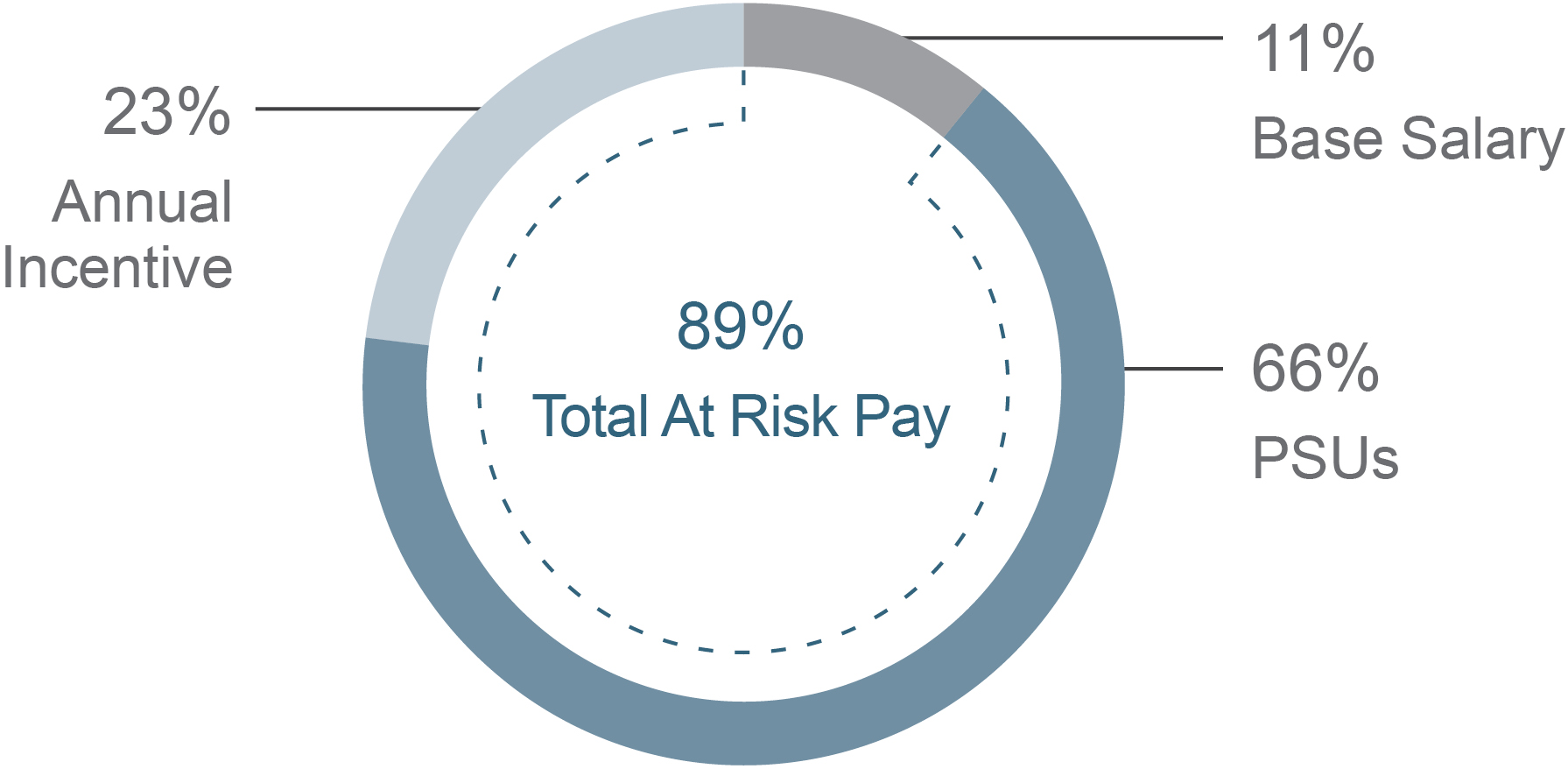
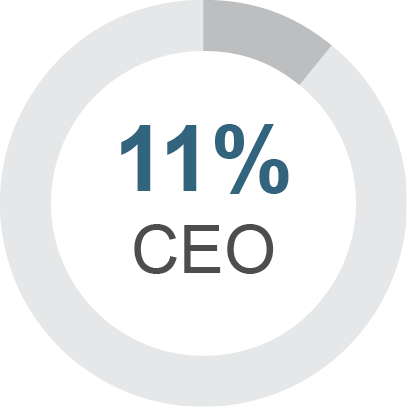
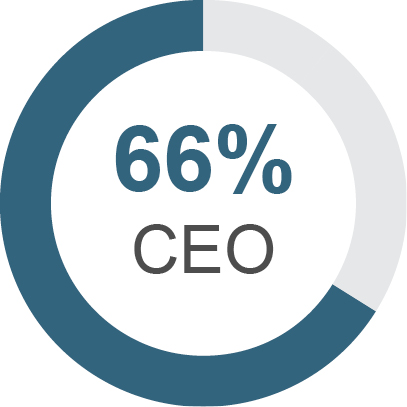
2025 CEO Target Compensation
03_GNW_PXY_2025_CEO.jpg
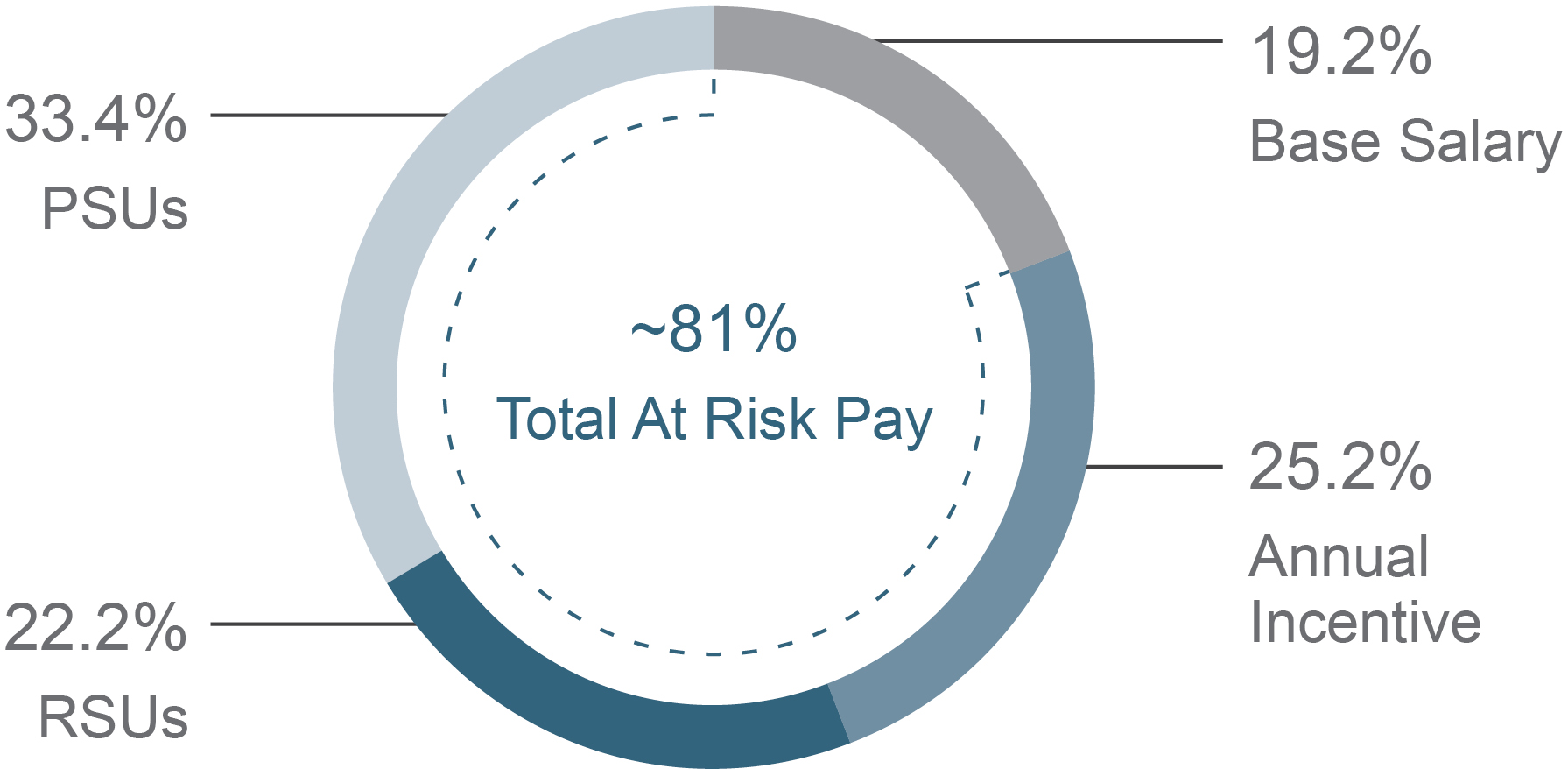
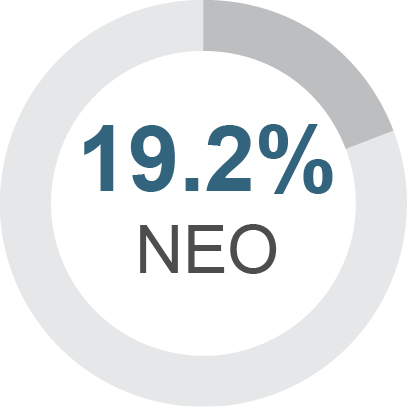
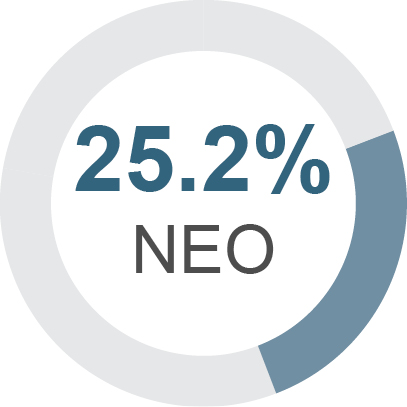
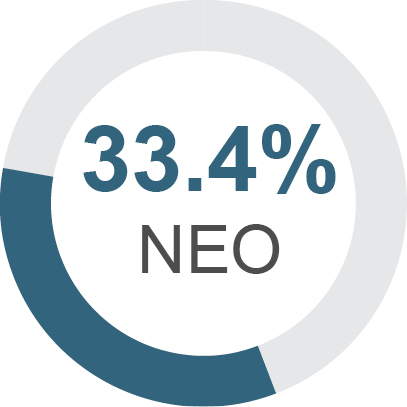
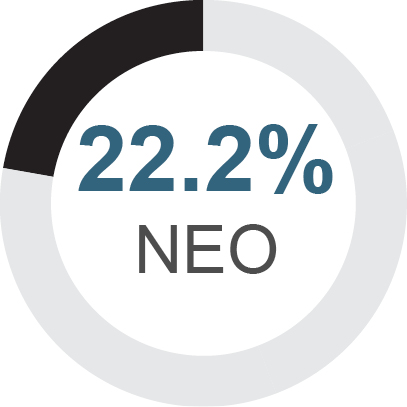
2025 Other NEO Target Compensation
03_GNW_PXY_2025_NEO.jpg
Funding Outcomes for Incentive Pay Programs
Payout Funding
Results Summary
Key Annual
Incentive Financial
Objectives
 
02_436029-3_icon_arrowup.jpg
Above
Target
Enact exceeded financial objectives, including its targets return on
equity and expense ratio.
Adjusted operating income excluding LTC, Life & Annuities
businesses exceeded target.
U.S. Life Insurance exceeded the targets for IFA actions filed on the
legacy blocks of long-term care insurance in execution of our
multi-year rate action plan MYRAP.
CareScout Services exceeded its goal for CareScout Services
customer network matches.
Key Annual
Incentive
Non-Financial
Objectives
 
02_436029-3_icon_arrowup.jpg
Above
Target
We returned capital to stockholders through share buybacks,
opportunistically repurchased debt, and managed the company’s
leverage ratio below 25%, attributing no equity value to U.S.
Life Insurance.
We strengthened and expanded the focus on human capital through
talent management and succession planning initiatives as well as
inclusion and well-being and engagement programs, which led to the
company again being recognized in national and local “Top
Workplace” Awards.
Long-Term
Financial
Objectives
02_436029-3_icon_payoutarrow_down.jpg
 
Below
Target
Our 2023-2025 PSU awards payout was below target driven by U.S.
Life Insurance's Statutory Net Income. Enact's Adjusted Operating
Income and Total Shareholder Return (“TSR”) did exceed target.
2026 Proxy Statement
13
Proxy Statement Summary
Stockholder Engagement
Our Board and management value the insights and feedback from our stockholders. We regularly
communicate with our stockholders through a variety of channels, including quarterly earnings calls, investor
meetings, and conferences. We also actively engage in direct dialogue with interested stockholders
throughout the year to discuss matters significant to our business. We seek our stockholders’ input on a
variety of matters, including corporate governance, executive compensation and sustainability, among other
matters. Over the last year, based on feedback we received from stockholders, we have enhanced our
supplemental discretionary clawback policy to incorporate time-based equity compensation.
Stockholder engagement usually involves a cross-functional team, representing investor relations,
sustainability, corporate governance and compensation and benefits experts, to ensure key topics are
addressed. Management provides regular updates to the Board throughout the year on stockholder
engagement, including insights and feedback received from our stockholders.
The following sets forth a general summary of our year-round stockholder engagement.
FEBRUARY – APRIL
Ahead of annual meeting, conduct
engagement with stockholders,
including those that have
expressed any concerns or
questions over ballot items and
proxy statement, and finalize
Sustainability Report
 
04_436029-3_gfx_year-round engagement.jpg
MAY – AUGUST
Review and summarize
feedback from annual meeting,
identify potential areas of focus
and track governance trends
DECEMBER JANUARY
Enhance proxy statement and
annual report content based
on feedback, and address
stockholder concerns
SEPTEMBER – NOVEMBER
Conduct general off-season
engagement outreach with
stockholders
During 2025, we engaged in a stockholder outreach campaign to understand our key investors’ views on our
strategy, performance, governance practices, Board composition and oversight, compensation programs,
sustainability initiatives, executive succession planning, engagement preferences, and technology, among
other topics. Our outreach campaign focused on our largest stockholders representing approximately 60% of
the shares outstanding.
Through our stockholder engagement, we strive to be responsive to our stockholders and use the input
received to help inform our strategies and priorities.
Outreach to our Stockholders Representing Approximately 60% of Shares Outstanding
Discussed the following key topics:
Company Strategy and Performance
Compensation Programs and
Performance Measures
Corporate Governance and Sustainability
Approach to Technology
Board of Directors Qualifications and Skills
Executive Succession Planning
Stockholder Engagement Preferences
14
Genworth Financial, Inc.
Proxy Statement Summary
Sustainable Compassion & Care
We strive to create a sustainable future built on compassion and care. Informed by a materiality assessment
to understand the issues most important to our businesses and key stakeholders, we have adopted a
sustainability strategy oriented around fostering sound corporate governance; caring for our people,
customers and communities; and building the foundation for a better future.
We believe our sustainability efforts contribute meaningfully to our success as a company, and we remain
committed to continuing to integrate sustainability considerations into our business strategy. We invite you to
review our 2025 Sustainability Report, which is available on our website: investor.genworth.com/
sustainability.
Our Sustainability Pillars
 
02_GNW_PXY_2026_SCC_Fostering.jpg
Fostering Sound
Corporate Governance
 
02_GNW PXY1_OSP_Caring.jpg
Caring for Our People,
Customers &
Communities
We make it happen by doing the right
things in the right ways.
We do this through our focus on:
Strong Corporate Governance
Ethical Business Activities
Sustainability Oversight
Business Continuity
We make it about others because our
people, customers, and communities and
their passions are the foundation of our
ability to make a positive impact on the
world around us.
We do this through our focus on:
Corporate Philanthropy
Talent Development & Benefits
Human Rights & Compassion
Solutions to Help Navigate the Aging
Journey with Confidence
 
02_GNW_PXY_2026_SCC_Building.jpg
Building the Foundation
for a Better Future
We make it better by understanding that
the decisions we make now shape the
future, and we are committed to leaving
things better than we found them.
We do this through our focus on:
Customer-Centric Culture
Data Privacy & Security
Investing Responsibly
Managing Our Climate Impact
2026 Proxy Statement
15
Proxy Statement Summary
02_436029-3_icon_compassion&care_boaroversight.jpg
Our Board Oversight of Sustainability
We believe that effective corporate governance helps promote the long-term interests of our
stockholders and strengthens Board and management oversight and accountability. We have
created a governance framework that ensures we have a culture of management accountability,
which helps us to uphold Genworth’s commitment to corporate responsibility and protects the
interests of our stakeholders.
Governance Committee
The Governance Committee has general oversight of our sustainability platform, including
reviewing, on a periodic basis, activities related to environmental, social and governance matters
of significance to the company and its stakeholders. In addition, this committee has specific
oversight responsibilities over our:
Political contributions and expenditures, including periodically reviewing the nature and amount
of the company’s political contributions and expenditures, the operations of the company’s
Political Action Committee and the company’s public disclosure regarding such activities;
Philanthropic programs and financial and other support of charitable, educational and cultural
organizations as well as the company’s community volunteer activities; and
Environmental policy and practices.
This committee received updates on the company's sustainability strategy and initiatives.
Compensation Committee
The Management Development
and Compensation Committee
(the “Compensation Committee”)
has oversight responsibility
relating to executive
compensation and succession
planning. In addition, this
committee oversees matters
related to Genworth’s human
capital management and
oversees our Human Rights
Policy, among other things. This
committee also receives updates
on talent initiatives, retention, and
engagement of our associates.
Risk Committee
The Risk Committee is
responsible for assisting the
Board in its oversight of the
company's enterprise risk
management policy and the
related risk profile, and our
investment portfolio and strategy,
among other things. This
committee considers climate-
related risks in its assessments
of standard operational risks,
including risks related to the
regulatory environment,
technology, data and
cybersecurity, and Genworth’s
reputation. This committee also
discusses emerging risks
including artificial intelligence
(“AI”) and the potential impact of
climate risk.
Technology Committee
The Technology Committee is
responsible for assisting the
Board in its oversight
responsibilities relating to the
company's technology initiatives,
strategy, investments and
innovation, and Data Security
and Cybersecurity Program
(“DSCP”). This committee
receives reports on key
technology and AI programs,
reviews new and emerging
technologies, and also receives
regular updates related to data
security and cybersecurity
matters, among other things.
16
Genworth Financial, Inc.
Genworth Board of Directors
Proposal 1
Election of Ten Directors
At the 2026 Annual Meeting, ten directors are to be elected to hold office until the 2027 Annual Meeting of
Stockholders and until their successors have been duly elected and qualified or until the earlier of their
resignation or removal in a manner provided for in our Bylaws. Our Board has nominated Sen. Conrad,
Lt. Gen. Dyson, Ms. Goodman, Ms. Higgins, Mr. McInerney, Mr. Mills, Mr. Restrepo, Ms. Sarsynski, Mr. Smith
and Mr. Van Wyk to be elected by the holders of our common stock at the 2026 Annual Meeting. Each of the
Board’s ten director nominees currently serves on our Board. We are not aware of any reason why any Board
nominee would be unable to serve as a director. If a nominee is unable to serve, the shares represented by all
valid proxies will be voted for the election of any other person that our Board may nominate as a substitute.
The Board’s ten nominees for election at the 2026 Annual Meeting are individuals with diverse experience at
policy-making levels in business and government and in other areas that are relevant to our company. In
addition, our Board believes that a range of tenures helps foster different viewpoints and experience as
longer-tenured directors provide continuity and important historical insights into the company and its
operations, while newer directors bring fresh perspectives. As discussed in the following pages, each of the
Board’s director nominees was nominated on the basis of the unique set of qualities, experience and skills he
or she brings to the Board, as well as how those qualities, experience and skills blend with those of the other
directors on the Board as a whole. The combination of these nominees’ different qualities, experience and
skills ensures that issues facing our company are examined and addressed with the benefit of a broad array
of perspectives, expertise and tenure. The Board has determined that nine of the ten nominees are
independent directors under the NYSE listing requirements and our Governance Principles, which are
discussed below under Corporate Governance Policies and Procedures.
02_436029-3_icon_tickers_checkbluebg.jpg
The Board recommends that stockholders vote FOR the election of Sen. Conrad,
Lt. Gen. Dyson, Ms. Goodman, Ms. Higgins, Mr. McInerney, Mr. Mills, Mr. Restrepo, Ms.
Sarsynski, Mr. Smith and Mr. Van Wyk.
2026 Proxy Statement
17
Genworth Board of Directors
Board’s Nominees
Director Bios
G. Kent Conrad, 78, Independent Director
Former U.S. Senator
05_436029-3_photo_Board’s Nominees_Conrad.jpg
Committees:
Nominating and
Corporate
Governance
(Chair)
Risk
Director Since:
March 2013
QUALIFICATIONS
Sen. Conrad brings to the Board extensive knowledge of and insights into
public policy, fiscal affairs, government relations and regulatory affairs through
his 26 years serving as a U.S. Senator for North Dakota. During his service as
a United States senator, Sen. Conrad successfully negotiated the budget for
the United States as Chairman of the Senate Budget Committee, oversaw
Social Security and Medicare programs and U.S. tax policy as a Senior
Member of the Senate Finance Committee, and helped oversee the
Intelligence function of the United States as a member of the Senate Select
Committee on Intelligence.
We believe that Sen. Conrad’s formidable experience in both Federal and
State government positions brings significant leadership experience and
a valuable perspective to his role as Chair of the Nominating and
Corporate Governance Committee, as well as the Board’s handling of
governance, risk, and regulatory issues, and the company’s engagement
with regulators on certain public policy issues.
SKILLS
02_436029-3_icon_skills_riskmanage.jpg
Risk Management
02_436029-3_icon_skills_corpgovt.jpg
Corporate Governance/
Public Company Board
02_436029-3_icon_skills_healthcare.jpg
Healthcare/
Medical
02_436029-3_icon_skills_publicpolicy.jpg
Public Policy/
Regulatory
02_436029-3_icon_skills_technology.jpg
Technology/Information &
Cybersecurity
02_436029-3_icon_skills_international.jpg
International
Business
Experience
PROFESSIONAL EXPERIENCE
Strategic advisor to Molina Healthcare, Inc. since 2014
Advisor to the CEO of the Baltimore Orioles from January 2020 to December 2024
U.S. Senator representing the State of North Dakota from January 1987 to January 2013
Chairman or Ranking Member of the Senate Budget Committee for 12 years, Senior Member of the
Senate Finance Committee and Member of the Senate Select Committee on Intelligence
Tax Commissioner for the State of North Dakota from 1981 to 1986 and Assistant to the Tax
Commissioner from 1974 to 1980
OTHER PUBLIC COMPANY BOARDS
None
ADDITIONAL BOARD OR LEADERSHIP POSITIONS
Co-chair of the Economic Advisory Board for The American Edge Project since 2022
Member of the board of directors of the Committee for a Responsible Federal Budget since 2014
Senior Fellow for the Bipartisan Policy Center since 2014
18
Genworth Financial, Inc.
Genworth Board of Directors
Karen E. Dyson, 66, Independent Director
Lieutenant General, U.S. Army, Retired
05_436029-3_photo_Board’s Nominees_Dyson.jpg
Committees:
Audit
Management
Development and
Compensation (Chair)
Technology
Director Since:
December 2020
QUALIFICATIONS
Lt. Gen. Karen Dyson is a qualified financial expert, whose distinguished
military career spanned more than 35 years. During her career, she led efforts
building, executing and reporting on the Army’s multi-appropriation budget;
commanded units and led troops in war operations; and led strategic
transformation initiatives. Lt. Gen. Dyson is a strategic leader with corporate
governance, risk oversight and management development and
compensation experience.
We believe that Lt. Gen. Dyson's extensive financial management and
board experience also provide the Board with critical insight into
corporate financials, macroeconomic trends and risk mitigation. Her
background in financial oversight, talent development and succession
planning in the U.S. Army, along with her development of the framework
for the Army’s first ever financial statements audit, position her well to
chair the Management Development and Compensation Committee and
serve on the Audit Committee.
SKILLS
02_436029-3_icon_skills_financial.jpg
Financial/
Investment
02_436029-3_icon_skills_riskmanage.jpg
Risk Management
02_436029-3_icon_skills_corpgovt.jpg
Corporate Governance/
Public Company Board
02_436029-3_icon_skills_publicpolicy.jpg
Public Policy/
Regulatory
02_436029-3_icon_skills_technology.jpg
Technology/
Information &
Cybersecurity
02_436029-3_icon_skills_international.jpg
International Business
Experience
PROFESSIONAL EXPERIENCE
Military Deputy to the Assistant Secretary of the Army for Financial Management and Comptroller from
August 2014 to August 2017
First female finance officer to achieve three-star general officer rank in August 2014
National Association of Corporate Directors (NACD) Directorship Certified
Carnegie Mellon CERT Certificate in Cybersecurity Oversight (NACD)
OTHER PUBLIC COMPANY BOARDS
None
ADDITIONAL BOARD OR LEADERSHIP POSITIONS
Director of USAA Federal Savings Bank since October 2017 (serving as nominations and governance
committee chair, vice chair of the finance and audit committee and member of compensation and
workforce committee)
Director of CALIBRE Systems, Inc. since October 2018 (serving as audit committee chair and member of
the compensation and governance committee)
Director of Army Emergency Relief Organization since 2020
2026 Proxy Statement
19
Genworth Board of Directors
Jill R. Goodman, 59, Independent Director
Managing Director, Foros Advisors LLC
05_436029-3_photo_Board’s Nominees_Goodman.jpg
Committees:
Management
Development and
Compensation
Nominating and
Corporate
Governance
Director Since:
March 2021
QUALIFICATIONS
Ms. Goodman has a distinguished background in strategic advisory work, with
more than 25 years of experience advising corporations on mergers and
acquisitions, including issues related to capital structure and financing. As a
result of these experiences, she has a sharp understanding of how to assess
organic business plans and create and execute concrete plans to enhance
long-term value creation.
As a former corporate and securities lawyer, we believe that Ms.
Goodman brings important insights into those areas to the Board. Given
her particular expertise in complex corporate governance matters and
long history in the boardroom as both a director and advisor, she is a
valuable member of both the Nominating and Corporate Governance and
Management Development and Compensation Committees.
SKILLS
02_436029-3_icon_skills_ceohead.jpg
CEO/Business
Head
02_436029-3_icon_skills_financial.jpg
Financial/Investment
02_436029-3_icon_skills_riskmanage.jpg
Risk
Management
02_436029-3_icon_skills_corpgovt.jpg
Corporate
Governance/Public
Company Board
02_436029-3_icon_skills_healthcare.jpg
Healthcare/ Medical
02_436029-3_icon_skills_restructuring.jpg
Mergers and
Acquisitions/
Restructuring
PROFESSIONAL EXPERIENCE
Managing Director of Foros Advisors LLC, a strategic financial and mergers and acquisitions advisory firm,
since November 2013
Managing Director and Head, Special Committee and Fiduciary Practice—U.S. at Rothschild & Co. from
2010 to October 2013
Managing Director in the Mergers & Acquisitions and Strategic Advisory Group of, and various prior
positions with, Lazard from 1998 to 2010
OTHER PUBLIC COMPANY BOARDS
Director of Cboe Global Markets, Inc. (BATS: CBOE), a leading provider of trading, clearing and
investment solutions to market participants around the world, since 2012 (serving as finance and strategy
committee chair and as a member of the executive committee and nominating and
governance committee)
ADDITIONAL BOARD OR LEADERSHIP POSITIONS
Director of Cover Genius Pty Ltd, a private global insurance technology company, since
February 2022 (serving as audit committee chair and risk committee chair and as a member of
the compensation committee)
20
Genworth Financial, Inc.
Genworth Board of Directors
Melina E. Higgins, 58, Non-Executive Chair of the Board
Former Partner, The Goldman Sachs Group, Inc.
05_436029-3_photo_Board’s Nominees_Higgins.jpg
Committees:
Audit
Management
Development and
Compensation
Director Since:
September 2013
QUALIFICATIONS
Ms. Higgins is a qualified financial expert and has extensive financial services
and investment experience. Having spent nearly 20 years building and leading
a successful investment business at Goldman Sachs, Ms. Higgins is
well-versed in portfolio management, assessing market risks and
building businesses. 
We believe that Ms. Higgins’ skills, extensive experience on numerous
public and private companies’ boards, are valuable in her role as Board
Chair and as a member of the Audit and Management Development and
Compensation Committees.
SKILLS
02_436029-3_icon_skills_ceohead.jpg
CEO/
Business
Head
02_436029-3_icon_skills_financial.jpg
Financial/
Investment
02_436029-3_icon_skills_riskmanage.jpg
Risk
Management
02_436029-3_icon_skills_corpgovt.jpg
Corporate
Governance/
Public
Company
Board
02_436029-3_icon_skills_healthcare.jpg
Healthcare/
Medical
02_436029-3_icon_skills_restructuring.jpg
Mergers and
Acquisitions/
Restructuring
02_436029-3_icon_skills_international.jpg
International
Business
Experience
PROFESSIONAL EXPERIENCE
Retired in 2010 from a nearly 20-year career in various positions at The Goldman Sachs Group, Inc.,
where she served as Managing Director from 2001 and as Partner from 2002
Other notable positions during her tenure include Head of the Americas for Private Debt; Co-Chairperson
of the Investment Advisory Committee for the GS Mezzanine Partners funds; and a member of the
Investment Committee for the Principal Investment Area (one of the largest alternative asset managers in
the world), which oversaw and approved global private equity and private debt investments
OTHER PUBLIC COMPANY BOARDS
Director of Viatris Inc. (Nasdaq: VTRS) since November 2020 (serving as non-executive chair and chair of
the finance committee and executive committee)
Former director of NextGen Acquisition Corp. II (Nasdaq: NGCA) from March 2021 to December 2021
ADDITIONAL BOARD OR LEADERSHIP POSITIONS
Non-executive chair of the Board of Antares Capital Management LLC since January 2026 and Antares
Midco, Inc. from January 2016 to December 2025
Member of the Women’s Leadership Board of Harvard University’s John F. Kennedy School of
Government since March 2015
2026 Proxy Statement
21
Genworth Board of Directors
Thomas J. McInerney, 69
President and Chief Executive Officer, Genworth Financial, Inc.
05_PRO012480_photo_BoardsNominees_McInerneyT-sharpcurvebox.jpg
Committees: None
Director Since:
January 2013
QUALIFICATIONS
Mr. McInerney brings to his role extensive knowledge of the insurance and
financial services industries and risk management within those industries
through his more than 45 years of experience, including previous leadership
roles at ING Groep NV, Aetna and Boston Consulting Group, Inc.
We believe that Mr. McInerney’s broad operating experience over many
decades leading complex global insurance businesses provides
Genworth with important, well-informed insights into navigating market
dynamics, establishing new business lines and leading organizations
through significant change.
SKILLS
02_436029-3_icon_skills_ceohead.jpg
CEO/
Business
Head
02_436029-3_icon_skills_financial.jpg
Financial/
Investment
02_436029-3_icon_skills_riskmanage.jpg
Risk
Management
02_436029-3_icon_skills_corpgovt.jpg
Corporate
Governance/
Public
Company
Board
02_436029-3_icon_skills_industry.jpg
Industry
02_436029-3_icon_skills_healthcare.jpg
Healthcare/
Medical
02_436029-3_icon_skills_marketing.jpg
Marketing
02_436029-3_icon_skills_publicpolicy.jpg
Public
Policy/
Regulatory
02_436029-3_icon_skills_technology.jpg
Technology/
Information &
Cybersecurity
02_436029-3_icon_skills_restructuring.jpg
Mergers and
Acquisitions/
Restructuring
02_436029-3_icon_skills_international.jpg
International
Business
Experience
PROFESSIONAL EXPERIENCE
President and Chief Executive Officer of Genworth since January 2013
Senior Advisor to the Boston Consulting Group, Inc. from June 2011 to December 2012, providing
consulting and advisory services to leading insurance and financial services companies in the United
States and Canada
Member of ING Groep NV’s Management Board for Insurance from October 2009 to December 2010,
where he was the Chief Operating Officer of ING Groep NV’s insurance and investment management
business worldwide
Variety of senior roles with ING Groep NV and leadership positions with Aetna Inc., where he began his
career as an insurance underwriter in June 1978
OTHER PUBLIC COMPANY BOARDS
Director of Enact Holdings, Inc. (Nasdaq: ACT), a majority-owned subsidiary of Genworth, since its IPO in
September 2021
ADDITIONAL BOARD OR LEADERSHIP POSITIONS
Director of The Conference Board and on its Committee on Economic Development since 2024
Vice Chair of United Way Worldwide since 2023
Director of the Global Research Institute at the College of William & Mary since 2021
Trustee of the Foundation Board at William & Mary since 2025
Trustee of the U.S. Ski and Snowboard Foundation since 2020
Member of the American Council of Life Insurers since 1995 and serves, and has served, on its CEO
Steering Committees and Board
Member of Irish Arts Council
22
Genworth Financial, Inc.
Genworth Board of Directors
Howard D. Mills, III, 61, Independent Director
Former Superintendent of the New York State Insurance Department
05_436029-3_photo_Board’s Nominees_Mills.jpg
Committees:
Nominating and
Corporate
Governance
Risk
Director Since:
March 2021
QUALIFICATIONS
Mr. Mills has extensive experience leading global insurance regulatory functions for
both private and government entities, including at Deloitte LLP as Global Insurance
Regulatory Leader and as Superintendent of the New York State Insurance
Department. During his tenure as Superintendent, Mr. Mills worked closely with
insurance companies to advance critical regulations and led the New York
Department’s transition to risk-based examinations.
During his 17-year management consulting career, Mr. Mills advised boards
and executives on regulatory and reputational risk, Enterprise Risk
Management, executive positioning, strategy, financial communications,
crisis management, mergers and acquisitions and public policy, which we
believe allows him to provide significant insights to the Board on these
topics. Mr. Mills also brings to the Nominating and Corporate Governance
and Risk Committees a keen understanding of state insurance regulatory
frameworks and agencies, as well as various aspects of risk preparedness,
including enterprise risk and strategic risk.
SKILLS
02_436029-3_icon_skills_financial.jpg
Financial/
Investment
02_436029-3_icon_skills_riskmanage.jpg
Risk
Management
02_436029-3_icon_skills_corpgovt.jpg
Corporate
Governance/
Public
Company
Board
02_436029-3_icon_skills_industry.jpg
Industry
02_436029-3_icon_skills_healthcare.jpg
Healthcare/
Medical
02_436029-3_icon_skills_marketing.jpg
Marketing
02_436029-3_icon_skills_publicpolicy.jpg
Public Policy/
Regulatory
02_436029-3_icon_skills_technology.jpg
Technology/
Information &
Cybersecurity
02_436029-3_icon_skills_international.jpg
International
Business
Experience
PROFESSIONAL EXPERIENCE
Partner of Pavement Management Group, a roadway infrastructure consultancy, since 2024
Executive Vice President of Business Development and External Affairs of beeXact, a geospatial data
management/EngineeringTech company, from February 2023 to June 2024
Senior Advisor to McKinsey & Company from October 2021 to October 2024
Managing Director and Global Insurance Regulatory Leader at Deloitte LLP from 2007 to May 2019, serving
Deloitte LLP’s largest U.S. and global insurance clients
Superintendent of the New York State Insurance Department from 2005 to 2006
Served three terms in the New York State Assembly from 1999 to 2004, where he was Deputy Minority Leader
and a member of the National Council of Insurance Legislators
NACD Governance Fellow
OTHER PUBLIC COMPANY BOARDS
None
ADDITIONAL BOARD OR LEADERSHIP POSITIONS
Director of The Doctors Company Group since May 2019, the largest physician-owned medical liability insurer
in the U.S. (serving as a member of the audit committee, finance and risk committee and technology and cyber
risk committee)
President and Director of the Insurance Federation of New York since 2020
Former Trustee of The Institutes Griffith Insurance Education Foundation from 2011 to 2026
Former director of Ensight, a SaaS insurance sales platform, from June 2019 to January 2022
2026 Proxy Statement
23
Genworth Board of Directors
Robert P. Restrepo Jr., 75, Independent Director
Former Chairman and President and Chief Executive Officer, State Auto Financial Corporation
05_436029-3_photo_Board’s Nominees_Restrepo Jr.jpg
Committees:
Audit (Chair)
Management
Development and
Compensation
Director Since:
December 2016
QUALIFICATION
Mr. Restrepo is a qualified financial expert and has more than 40 years of
insurance, finance and risk management experience after serving as the
Chairman, President and Chief Executive Officer of State Auto Financial
Corporation and holding other roles at several of the country’s leading insurers.
We believe that Mr. Restrepo brings to the Board deep knowledge of and
perspective on leading corporate governance, organizational
management, strategic planning and risk mitigation. His extensive
experience leading large insurance companies is vital to his role as Chair
of the Audit Committee and his service on the Management Development
and Compensation Committee.
SKILLS
02_436029-3_icon_skills_ceohead.jpg
CEO/
Business
Head
02_436029-3_icon_skills_financial.jpg
Financial/
Investment
02_436029-3_icon_skills_riskmanage.jpg
Risk
Management
02_436029-3_icon_skills_corpgovt.jpg
Corporate
Governance/
Public
Company
Board
02_436029-3_icon_skills_industry.jpg
Industry
02_436029-3_icon_skills_marketing.jpg
Marketing
02_436029-3_icon_skills_publicpolicy.jpg
Public Policy/
Regulatory
02_436029-3_icon_skills_technology.jpg
Technology/
Information &
Cybersecurity
02_436029-3_icon_skills_restructuring.jpg
Mergers and
Acquisitions/
Restructuring
PROFESSIONAL EXPERIENCE
Retired from State Auto Financial Corporation in 2015, having served as its Chairman from 2006 to
December 2015 and as its President and Chief Executive Officer from 2006 to May 2015
Over 40 years of insurance industry experience, having held executive roles at Main Street America
Group, Inc., The Hanover Insurance Group Inc. (formerly Allmerica Financial Corp.), The Travelers
Companies, Inc. and Aetna Inc.
OTHER PUBLIC COMPANY BOARDS
Director of RLI Corp. (NYSE: RLI), a property and casualty insurance company, since July 2016
(serving as chair of the nominating/governance committee)
Director of Enact Holdings, Inc. (Nasdaq: ACT), a majority-owned subsidiary of Genworth, since its IPO in
September 2021 (serving as a member of the audit and nominating and corporate
governance committees)
ADDITIONAL BOARD OR LEADERSHIP POSITIONS
Director of The Larry H. Miller Group of Companies since November 2015 (serving on the audit
committee, investments committee and the nominating and governance committee)
Former director of Majesco, a provider of insurance software and consulting services, from August 2015 to
September 2020
24
Genworth Financial, Inc.
Genworth Board of Directors
Elaine A. Sarsynski, 70, Independent Director
Former Chairwoman, Chief Executive Officer and President, MassMutual International
05_436029-3_photo_Board’s Nominees_Sarsynski.jpg
Committees:
Audit
Risk (Chair)
Technology
Director Since:
March 2022
QUALIFICATIONS
Ms. Sarsynski is a qualified financial expert and has extensive experience as
both an executive and director at certain of the nation’s largest insurance
companies, including MassMutual and Aetna. In her decades of service at both
public and private companies, she has led strategic turnarounds for global
businesses and overseen significant growth and risks across business units
and geographies.
We believe that Ms. Sarsynski provides the Board with strong experience
in financial services, insurance, compliance, risk management,
operations, investments and real estate. These experiences position her
well to chair the Risk Committee and serve on the Audit Committee.
SKILLS
02_436029-3_icon_skills_ceohead.jpg
CEO/
Business
Head
02_436029-3_icon_skills_financial.jpg
Financial/
Investment
02_436029-3_icon_skills_riskmanage.jpg
Risk
Management
02_436029-3_icon_skills_corpgovt.jpg
Corporate
Governance/
Public
Company
Board
02_436029-3_icon_skills_industry.jpg
Industry
02_436029-3_icon_skills_marketing.jpg
Marketing
02_436029-3_icon_skills_publicpolicy.jpg
Public Policy/
Regulatory
02_436029-3_icon_skills_technology.jpg
Technology/
Information &
Cybersecurity
02_436029-3_icon_skills_restructuring.jpg
Mergers and
Acquisitions/
Restructuring
02_436029-3_icon_skills_international.jpg
International
Business
Experience
PROFESSIONAL EXPERIENCE
Chairwoman, Chief Executive Officer and President of MassMutual International from 2006 to 2017
President of MassMutual Retirement Services from 2008 to 2016
Executive Vice President from 2006 to 2017 of MassMutual, member of MassMutual’s Office of the Chief
Executive Officer from 2008 to 2017 and Chief Administrative Officer of MassMutual from September 2005
to 2008
Managing Director at Babson Capital Management LLC, a MassMutual subsidiary in 2005
Served two elected terms as First Selectman for the town of Suffield, Connecticut from 2001 to 2005
Founded Sun Consulting Group LLC in 1998, offering real estate advisory and consulting services
Multiple senior management positions for 17 years at Aetna Inc., overseeing segments of the company’s
Investments Division and leading the Corporate Finance Department
NACD CERT certificate in Cybersecurity Oversight earned in 2023
FINRA Registrations for Series 7 and 24 from 2009 to 2019
OTHER PUBLIC COMPANY BOARDS
Director of Horizon Technology Finance Corporation (Nasdaq: HRZN, NYSE: HTFB, HFTC) since 2012
(serving as chair of the nominating and corporate governance committee and member of the
audit committee)
Director of Horace Mann Educators Corporation (NYSE: HMN) since 2021 (serving as chair of the
investment and finance committee)
ADDITIONAL BOARD OR LEADERSHIP POSITIONS
Former director of AXA S.A. from 2018 to 2021
2026 Proxy Statement
25
Genworth Board of Directors
Ramsey D. Smith, 58, Independent Director
Founder and Chief Executive Officer, ALEX.fyi
05_436029-3_photo_Board’s Nominees_Smith.jpg
Committees:
Nominating and
Corporate
Governance
Risk
Technology
Director Since:
March 2021
QUALIFICATIONS
Mr. Smith has extensive experience in securities and annuities businesses,
having spent more than 20 years leading equity derivatives teams and as a
mergers and acquisitions analyst with The Goldman Sachs Group, Inc. and
Credit Suisse AG, respectively, as well as founding and leading ALEX.fyi, a
retirement solutions company, and ALEXIncome, a retirement
consulting company.
We believe that Mr. Smith's experience developing and launching a new
business venture provides valuable insight as the company pursues
growth and establishes new business lines. Mr. Smith brings to the
Board, along with the Nominating and Corporate Governance and Risk
Committees, a deep understanding of risk management, finance and
insurance markets.
SKILLS
02_436029-3_icon_skills_ceohead.jpg
CEO/
Business
Head
02_436029-3_icon_skills_financial.jpg
Financial/
Investment
02_436029-3_icon_skills_riskmanage.jpg
Risk
Management
02_436029-3_icon_skills_corpgovt.jpg
Corporate
Governance/
Public
Company
Board
02_436029-3_icon_skills_industry.jpg
Industry
02_436029-3_icon_skills_marketing.jpg
Marketing
02_436029-3_icon_skills_technology.jpg
Technology/
Information &
Cybersecurity
02_436029-3_icon_skills_restructuring.jpg
Mergers and
Acquisitions/
Restructuring
02_436029-3_icon_skills_international.jpg
International
Business
Experience
PROFESSIONAL EXPERIENCE
Founder and CEO of ALEX.fyi, a retirement solutions company, since 2016 and founding partner of
ALEXIncome, a retirement consulting company, since 2023
Various positions at The Goldman Sachs Group, Inc. for two decades from 1995 to 2016, most recently as
Managing Director, Equity Derivative Sales, Head of Insurance
Built out the Life Insurance business at The Goldman Sachs Group, Inc. from 2007 to 2016
Analyst at Credit Suisse AG from 1990 to 1993
OTHER PUBLIC COMPANY BOARD
None
ADDITIONAL BOARD OR LEADERSHIP POSITIONS
Board of Sponsors for Educational Opportunity since 2008
Served for 6 years on the Board of Trustees at the Dalton School in New York City
26
Genworth Financial, Inc.
Genworth Board of Directors
Steven C. Van Wyk, 67, Independent Director
Former Group Chief Information Officer, HSBC Bank
05_436029-3_photo_Board’s Nominees_Van Wyk1.jpg
Committees:
Risk
Technology (Chair)
Director Since:
March 2025
QUALIFICATIONS
Mr. Van Wyk provides almost 30 years of senior-level domestic and
international experience managing IT organizations, including HSBC Bank,
PNC Financial Services Group, Inc., ING Groep N.V. and Morgan Stanley,
each of which organization he served as CIO. He is a long-tenured information
technology leader in the banking and insurance industries, with proven success
in large-scale technology transactions and business transformations.       
We believe that Mr. Van Wyk's extensive global leadership experience in
structuring, building and improving technology organizations and
operations, as well as significant accounting experience, provides
important insight to our Board as we implement new AI and digital
technologies. His executive leadership experience in structuring, building
and improving IT organizations and operations uniquely qualifies him to
chair our Technology Committee.
SKILLS
02_436029-3_icon_skills_ceohead.jpg
CEO/
Business
Head
02_436029-3_icon_skills_financial.jpg
Financial/
Investment
02_436029-3_icon_skills_riskmanage.jpg
Risk
Management
02_436029-3_icon_skills_corpgovt.jpg
Corporate
Governance/
Public
Company
Board
02_436029-3_icon_skills_industry.jpg
Industry
02_436029-3_icon_skills_publicpolicy.jpg
Public
Policy/
Regulatory
02_436029-3_icon_skills_technology.jpg
Technology/
Information &
Cybersecurity
02_436029-3_icon_skills_restructuring.jpg
Mergers and
Acquisitions/
Restructuring
02_436029-3_icon_skills_international.jpg
International
Business
Experience
PROFESSIONAL EXPERIENCE
Former Group Chief Information Officer of HSBC Bank from December 2020 to May 2024
Chief Information Officer and Head of Technology & Innovation at PNC Financial Services Group, Inc.
(PNC) from 2017 to 2020
Chief Information Officer and Head of Operations at PNC from 2013 to 2017
Certified Public Accountant (CPA), Certified Internal Auditor (CIA) and a Series 27 Financial/
Operations Principal
OTHER PUBLIC COMPANY BOARDS
Director, Reinsurance Group of America, Incorporated (NYSE: RGA), since 2019 (serving as chair of the
cybersecurity and technology committee)
Director, Scotiabank (TXS: BNS, NYSE: BNS), since December 2024 (serving as chair of the
technology committee and member of the audit and conduct review committee)
Director, Adyen (AMS: ADYEN), since May 2025 (serving on the audit and risk committee)
ADDITIONAL BOARD OR LEADERSHIP POSITIONS
Chairman of the Board of the Banking Industry Architecture Network
Founder and Chairman of OpenCoreOS
2026 Proxy Statement
27
Genworth Board of Directors
Board’s Director Nominee Selection
Board Size
The number of directors of our company is fixed from time to time by a resolution adopted by our Board, but
will not be less than one nor more than 15. Our Governance Principles state that the size of the Board should
generally be in the range of seven to 15 directors and the actual size will be affected by practical
considerations as the needs of the Board evolve over time. Our Board currently consists of ten members, nine
of whom the Board has affirmatively determined are independent. Each of our current directors has been
nominated by the Board to stand for election.
Each director elected by the holders of our common stock will serve until the 2027 Annual Meeting and until
his or her successor is duly elected and qualified, or until the earlier of his or her resignation or removal in a
manner provided for in the Bylaws.
We believe our Board benefits significantly from having members with, among other things, different
characteristics, attributes, qualities, experiences, skills, and backgrounds. We believe the Board’s director
nominees are a talented group of individuals with a variety of relevant qualities, experience, skills and
professional backgrounds, as reflected in their biographies beginning on page 17.
Director Selection
Our Governance Committee oversees the director selection and nomination process by considering potential
candidates and evaluating such candidates’ independence, experience, skills, attributes and qualifications
including in the context of the full Board. In recommending the Board’s director nominees, our Governance
Committee considers, among other things, the qualities, tenure, experience and skills discussed below and in
Section 3 of our Governance Principles, which are available on our website: investor.genworth.com/corporate-
governance/governance-documents. Our Governance Committee and Board believe that each of the Board’s
director nominees possesses the core qualities discussed below and brings a unique set of qualities,
experience and skills that are reflected below in the skills matrix.
Independence
In consultation with our Governance Committee, our Board assesses independence for each director when
the director is first elected to the Board and annually thereafter for all director nominees.
For a director to be independent, the Board must determine that the director does not have any material
relationship with Genworth either directly or as a partner, stockholder or officer of an organization that has a
relationship with Genworth.
The Board has established guidelines to assist it in determining director independence, which conform to, or
are more exacting than, the independence requirements in the applicable rules and listing standards of the
NYSE. The independence guidelines are set forth in Section 6 of our Governance Principles, which are
available on our website: investor.genworth.com/corporate-governance/governance-documents. The Board
also will consider all relevant facts and circumstances in making an independence determination, and not
merely from the standpoint of the director, but also from that of persons or organizations with which the
director has an affiliation. Our Board has determined that the purchase of Genworth products and services on
the same terms available to unaffiliated entities or persons does not impair a director’s independence and
therefore such purchases are not considered by our Board when making independence determinations.
Our Board has determined that Sen. Conrad, Lt. Gen. Dyson, Ms. Goodman, Ms. Higgins, Mr. Mills,
Mr. Restrepo, Ms. Sarsynski, Mr. Smith and Mr. Van Wyk satisfy the NYSE’s independence requirements and
Genworth’s independence guidelines.
28
Genworth Financial, Inc.
Genworth Board of Directors
Core Qualities
Our Board seeks directors who possess the following core qualities that the Board believes assist it in
overseeing our operations and developing and pursuing our strategic objectives:
highest personal and professional ethics, integrity and values;
commitment to representing the long-term interests of our stockholders;
inquisitive and objective perspective, practical wisdom and mature judgment;
a distinct skill set of value to the Board and the company when viewed alone and in combination with
the skills of other directors;
willingness and ability to devote sufficient time to carrying out his or her duties and responsibilities
effectively; and
commitment to serve on the Board for an extended period of time.
Additional Qualities
In addition to the core qualities discussed above, the Board identifies certain key qualities, experience and
skills, from time to time, that it believes are currently important to Genworth’s business, and therefore,
significant to have represented on the Board as a whole.
These qualities, experience and skills are among the items considered by the Governance Committee in
evaluating the Board’s director nominees. Each director nominee is not expected to possess every attribute –
rather the attributes of each director nominee are considered in the context of the Board’s overall make-up of
qualities, tenure, experience and skills. The blend of our directors’ qualities, experience and skills helps
ensure that our Board is well-positioned to examine, address and provide oversight of the issues facing the
company and its business. We believe that the Board’s director nominees have demonstrated leadership,
sound judgment and integrity in a variety of positions across various professions and industries.
Skills Matrix
The skills matrix below is intended as a high-level summary and not an exhaustive list of each director’s skills
or contributions to the Board. Additional information about each director nominee’s qualities, experience and
skills can be found under Director Bios. Also summarized below is what these key qualities, experience and
skills mean to us and why they are important to the Board and Genworth’s business.
2026 Proxy Statement
29
Genworth Board of Directors
 
04_436029-3_gfx_SenConrad.jpg
 
04_436029-3_gfx_Dyson.jpg
 
04_436029-3_gfx_msGoodman.jpg
 
04_436029-3_gfx_MsHiggis.jpg
 
04_436029-3_gfx_MrMclnerney.jpg
 
04_436029-3_gfx_MrMills.jpg
 
04_436029-3_gfx_MrRestrepo.jpg
 
04_436029-3_gfx_MsSarsynski.jpg
 
04_436029-3_gfx_MrSmith.jpg
 
04_436029(3)_gfx_Core_MrWyk.jpg
04_436029-3_gfx_Core.jpg
 
02_436029-3_icon_skills_ceohead.jpg
CEO/Business Head
Leadership and management experience within complex and highly
regulated organizations provides leadership perspectives and practical
understanding of our strategies, operations, and risk management.
 
02_436029-3_icon_Check.jpg
 
02_436029-3_icon_Check.jpg
 
02_436029-3_icon_Check.jpg
 
02_436029-3_icon_Check.jpg
 
02_436029-3_icon_Check.jpg
 
02_436029-3_icon_Check.jpg
 
02_436029-3_icon_Check.jpg
 
02_436029-3_icon_skills_financial.jpg
Financial/Investment
Senior management experience in accounting, financial services or
investment functions assists our directors in understanding and
overseeing our financial reporting and internal controls, as well as
evaluating our financial statements and investment strategy.
 
02_436029-3_icon_Check.jpg
 
02_436029-3_icon_Check.jpg
 
02_436029-3_icon_Check.jpg
 
02_436029-3_icon_Check.jpg
 
02_436029-3_icon_Check.jpg
 
02_436029-3_icon_Check.jpg
 
02_436029-3_icon_Check.jpg
 
02_436029-3_icon_Check.jpg
 
02_436029-3_icon_Check.jpg
 
02_436029-3_icon_skills_riskmanage.jpg
Risk Management
Experience identifying, assessing and managing complex risks
provides critical perspectives for the Board’s role in overseeing the risks
facing Genworth.
 
02_436029-3_icon_Check.jpg
 
02_436029-3_icon_Check.jpg
 
02_436029-3_icon_Check.jpg
 
02_436029-3_icon_Check.jpg
 
02_436029-3_icon_Check.jpg
 
02_436029-3_icon_Check.jpg
 
02_436029-3_icon_Check.jpg
 
02_436029-3_icon_Check.jpg
 
02_436029-3_icon_Check.jpg
 
02_436029-3_icon_Check.jpg
 
02_436029-3_icon_skills_corpgovt.jpg
Corporate Governance/Public Company Board
Experience assessing and addressing public company corporate
governance issues, including serving on public company boards,
supports our goals of strong governance with Board and management
accountability, transparency and protection of stockholder interests.
 
02_436029-3_icon_Check.jpg
 
02_436029-3_icon_Check.jpg
 
02_436029-3_icon_Check.jpg
 
02_436029-3_icon_Check.jpg
 
02_436029-3_icon_Check.jpg
 
02_436029-3_icon_Check.jpg
 
02_436029-3_icon_Check.jpg
 
02_436029-3_icon_Check.jpg
 
02_436029-3_icon_Check.jpg
 
02_436029-3_icon_Check.jpg
04_436029(3)_gfx_Core_Strategic.jpg
 
02_436029-3_icon_skills_industry.jpg
Industry
Senior executive experience in the insurance, healthcare or financial
services industry provides insight on issues specific to
our businesses.
 
02_436029-3_icon_Check.jpg
 
02_436029-3_icon_Check.jpg
 
02_436029-3_icon_Check.jpg
 
02_436029-3_icon_Check.jpg
 
02_436029-3_icon_Check.jpg
 
02_436029-3_icon_Check.jpg
 
02_436029-3_icon_skills_healthcare.jpg
Healthcare/Medical
Industry knowledge or regulatory oversight of healthcare and/or
healthcare- or medical-related fields assists our directors in
understanding and reviewing our business and strategy.
 
02_436029-3_icon_Check.jpg
 
02_436029-3_icon_Check.jpg
 
02_436029-3_icon_Check.jpg
 
02_436029-3_icon_Check.jpg
 
02_436029-3_icon_Check.jpg
 
02_436029-3_icon_skills_marketing.jpg
Marketing
Senior level direct marketing, including market research and
advertising, supports Genworth as it seeks to identify and develop new
markets for its financial products and services.
 
02_436029-3_icon_Check.jpg
 
02_436029-3_icon_Check.jpg
 
02_436029-3_icon_Check.jpg
 
02_436029-3_icon_Check.jpg
 
02_436029-3_icon_Check.jpg
 
02_436029-3_icon_skills_publicpolicy.jpg
Public Policy/Regulatory
Experience in government, regulatory affairs and other highly regulated
industries provides valuable insight and guidance to Genworth to help
navigate governmental and regulatory actions, including compliance
related issues, that impact our businesses.
 
02_436029-3_icon_Check.jpg
 
02_436029-3_icon_Check.jpg
 
02_436029-3_icon_Check.jpg
 
02_436029-3_icon_Check.jpg
 
02_436029-3_icon_Check.jpg
 
02_436029-3_icon_Check.jpg
 
02_436029-3_icon_Check.jpg
 
02_436029-3_icon_skills_technology.jpg
Technology/Information & Cybersecurity
Knowledge and experience implementing technology strategies and/or
significant understanding of emerging technology including artificial
intelligence and cybersecurity risks provides relevant insight as
Genworth looks for ways to enhance the customer experience and
internal operations and oversee technology/information and
cybersecurity risk.
 
02_436029-3_icon_Check.jpg
 
02_436029-3_icon_Check.jpg
 
02_436029-3_icon_Check.jpg
 
02_436029-3_icon_Check.jpg
 
02_436029-3_icon_Check.jpg
 
02_436029-3_icon_Check.jpg
 
02_436029-3_icon_Check.jpg
 
02_436029-3_icon_Check.jpg
 
02_436029-3_icon_skills_restructuring.jpg
Mergers and Acquisitions/Restructuring
Experience supervising, consulting or financing mergers and
acquisitions or restructuring activities provides experience to assist
Genworth with a practical understanding of developing, implementing
and assessing our operating plan and business strategy.
 
02_436029-3_icon_Check.jpg
 
02_436029-3_icon_Check.jpg
 
02_436029-3_icon_Check.jpg
 
02_436029-3_icon_Check.jpg
 
02_436029-3_icon_Check.jpg
 
02_436029-3_icon_Check.jpg
 
02_436029-3_icon_Check.jpg
 
02_436029-3_icon_skills_international.jpg
International Business Experience
Business experience in international markets provides helpful
perspectives as Genworth evaluates growing our business outside of
the United States.
 
02_436029-3_icon_Check.jpg
 
02_436029-3_icon_Check.jpg
 
02_436029-3_icon_Check.jpg
 
02_436029-3_icon_Check.jpg
 
02_436029-3_icon_Check.jpg
 
02_436029-3_icon_Check.jpg
 
02_436029-3_icon_Check.jpg
 
02_436029-3_icon_Check.jpg
30
Genworth Financial, Inc.
Genworth Board of Directors
Board Composition
Our Governance Committee, as a matter of practice, takes varying factors into account when considering
potential director nominees and actively seeks to achieve different occupational and personal backgrounds,
viewpoints, education and skills on the Board. Our Governance Committee strives to have a board
representing diverse experience at policy-making levels in other areas that are relevant to the
company’s businesses.
In addition, our Board believes that a range of tenures provides a balance of different perspectives and
experience as longer-tenured directors provide stability, continuity and important historical insights into the
company and its operations, while newer directors bring fresh perspectives. However, the Board does not
believe that arbitrary term limits on directors’ service are appropriate. Our Governance Principles do not
specify a mandatory retirement age for our directors. Instead, our Governance Committee conducts an annual
review of each director's age and tenure, along with experience, qualifications and other relevant criteria to
ensure that the Board maintains an effective balance of new perspectives and seasoned experience when
recommending director nominations to the Board. This review includes considering feedback received on
director performance during the self-evaluation process when deciding whether to renominate a director
for election.
The current attributes of the Board’s director nominees are set forth below.
Independence
32985348842798
g
Independent
g
Not Independent
Tenure
32985348842808
g
<5 years
g
5-10 years
g
>10 years
Age
32985348842815
g
55-64 years
g
65-70 years
g
>70 years
Our Directors
03_GNW PXY1_BOD_Demographics.jpg
g
African American/Black
g
Female
g
Asian & White
g g g
Male
g
White
2026 Proxy Statement
31
Genworth Board of Directors
Selection Process Highlights
Our Governance Committee considers candidates proposed by stockholders, current directors, company
officers, associates and others. We have also historically engaged an outside search firm to assist us in
identifying and evaluating potential director candidates. Our Governance Committee recommends director
candidates to the Board for election, and our Board nominates director candidates and makes voting
recommendations to our stockholders. Our Governance Committee typically carries out this responsibility
through the multi-faceted process described below.
Succession
Planning
The Governance Committee regularly and actively evaluates the Board’s and
committees’ composition and routinely meets to discuss succession planning and
prospective candidates in the event of the sudden/unexpected departure of one
or more directors or in the event an additional director is deemed appropriate.
 
02_436029-3_icon_arrowdown.jpg
Candidate
Selection
Identification of Candidates
Generally, an external search firm is engaged to assist in identifying potential
director candidates. All recommendations for director candidates from
stockholders, current directors, officers, associates and others are
also considered.
Background Due Diligence
Due diligence is conducted, including a background screening and questionnaire
process, to identify and verify information that can be used to support the
qualifications and independence of the potential director candidate.
Evaluation of Qualifications
With the assistance of an external search firm, the Governance Committee meets
to assess the qualifications, experience, qualities, skills and age of the director
candidate. The Governance Committee also assesses each director candidate in
the context of the full Board, including specifically evaluating how the candidate's
tenure−alongside that of current members−will ensure that the director
candidate’s experience and skillset assists the Board in overseeing Genworth’s
operations and developing and pursuing its strategic objectives.
Meet with Candidates
After completing a preliminary screening with satisfactory results, a director
candidate is interviewed by the Chair and members of the Governance
Committee, the Board Chair, the CEO and, from time to time, other selected
members of the Board and senior leadership team.
 
02_436029-3_icon_arrowdown.jpg
Decision and
Recommendation
The Governance Committee reviews and analyzes all due diligence results and, if
acceptable, will recommend the director candidate for Board consideration.
 
02_436029-3_icon_arrowdown.jpg
Appointment/
Election
The Board reviews the recommendation of the Governance Committee and either
approves the director candidate’s appointment to the Board until Genworth’s next
annual meeting of stockholders or does not approve the appointment.
Stockholders vote on director nominees to serve one-year terms at our annual
stockholder meetings.
32
Genworth Financial, Inc.
Genworth Board of Directors
Director Candidate Recommendations
Our Governance Committee will consider all stockholder recommendations for candidates to the Board. The
Governance Committee will evaluate stockholder-recommended candidates in the same manner it evaluates
candidates from all other sources. The minimum qualifications and specific qualities and skills required for
directors are set forth in the Board’s Director Nominee Selection section above and in Section 3 of our
Governance Principles, which are available on our website.
To recommend a candidate for the Board, a stockholder must submit the recommendation in writing to:
Nominating and Corporate Governance Committee
c/o Corporate Secretary
Genworth Financial, Inc.
11011 West Broad Street
Glen Allen, Virginia 23060
2026 Proxy Statement
33
Genworth Board of Directors
Board Refreshment & Continuity
Our Board succession planning and refreshment practices are carried out through various thoughtful steps
throughout the year. For example, among other things, our Governance Committee and Board:
Regularly review the appropriate experience, skills, attributes, qualifications, age and tenure for directors
in the context of the current make-up of the Board and needs of the company,
Assess our current directors’ experience, skills, attributes, qualifications, independence, age and
tenure, and
Consider the results of our Board and committee self-evaluation process when evaluating Board and
committee composition.
Maintaining a Balanced Board
Our Board routinely reviews its composition, considering a balanced mix of tenure and experience as well as
a diverse range of perspectives. Over the past five years, five new directors have joined the Board
representing 50% of the current Board. These newest directors have backgrounds and experience in
business transformation, finance and internal controls, financial services, global insurance regulation, the
insurance industry, investment banking, law, technology and public company service. Our more tenured
directors have backgrounds and experience in government relations, financial services, the insurance industry
and public company service. We believe that our ongoing refreshment efforts provide new skills and
perspectives, while our longer-tenured directors provide continuity and valuable institutional knowledge.
These efforts at maintaining a balance between newer and more tenured directors are reflected in the
timeline below:
04_PRO014489_BoardEvolution.jpg
As part of the Board process in 2025 and after consideration of the overall mix of our Directors’ qualifications,
experience and skills and the Corporation’s focus on technology transformation, the Governance Committee
recommended and the Board approved increasing the size of the Board to add a Director with technology,
data and cybersecurity, and AI experience. Following the Board's evaluation of his qualifications in light of its
technology oversight objectives, Steven Van Wyk was appointed by the Board to serve as an independent
director on March 19, 2025, and subsequently elected by the company's stockholders at the 2025 Annual
Meeting. Capitalizing on Mr. Van Wyk’s extensive technology background, the Board created a special
Technology Committee in May 2025 and elected Mr. Van Wyk as chair of this newly formed committee. In
February 2026, the Technology Committee became a standing committee of the Board.
34
Genworth Financial, Inc.
Corporate Governance
at Genworth
Board Structure
Board Leadership Structure
Our Board functions in a collaborative fashion that emphasizes active participation and leadership by all of its
members. Our Bylaws require our Board to appoint a Chair of the Board but give it the flexibility to appoint as
Chair (i) our CEO, (ii) an independent director or (iii) a non-independent director other than the CEO. If the
roles of Chair of the Board and CEO are combined or the Chair of the Board is not otherwise independent, the
independent directors will designate a lead director from among the independent directors. Our Board, based
on the recommendation of our Governance Committee, annually determines who to appoint as our Chair
based on the knowledge and experience of our then-serving directors and CEO and chooses the person
whom it believes best meets the needs of our company and our stockholders at that time.
Our Board has determined that having an independent Non-Executive Chair of the Board is the appropriate
leadership structure for our company at this time. Our Board believes that separating the Chair of the Board
and CEO positions effectively distributes responsibility, oversight and leadership between management and
the independent directors. This structure allows our CEO to focus primarily on the day-to-day leadership of
the company and the execution of the company’s strategy, while our Non-Executive Chair of the Board leads
our Board’s oversight of management, strategy, risks and corporate governance matters and supports
communication between our Board and management. By serving as a director, our CEO also is able to
provide valuable insights on the company’s operations and management’s perspective to the Board. Our
Board believes that it is important to retain flexibility with respect to its leadership structure in order to best
fulfill the needs and opportunities of the company at that time. Our Governance Committee and Board
reevaluate our Board leadership structure at least annually, taking into consideration many factors,
including the company’s business and operating environment, strategic goals, risks and opportunities, and
current and future needs, as well as each director’s qualifications, skills and experiences and the interests of
our stockholders.
Currently, Mr. Thomas J. McInerney serves as our CEO and a director and Melina E. Higgins serves as our
Non-Executive Chair of the Board.
2026 Proxy Statement
35
Corporate Governance at Genworth
05_436029-3_photo_Board’s Nominees_Higgins.jpg
Melina E. Higgins
Non-Executive Chair of the Board
In May 2021, our Board selected Ms. Higgins, one of our independent
directors since 2013, to serve as our Non-Executive Chair of the Board and
has since re-appointed her annually. Ms. Higgins is a qualified financial expert
and has broad financial services and investment experience. In addition, she
has extensive experience on numerous public and private company boards.
Our Board believes that Ms. Higgins’ service with and knowledge of our
company and her significant leadership experience enable Ms. Higgins to
help facilitate effective oversight of, and collaborative communications with,
management and to provide important historical perspectives on the
company. Our Board has also determined that Ms. Higgins continues to have
the interest and capacity to meet the time requirements to serve effectively as
Non-Executive Chair of the Board.
Non-Executive Chair of the Board
The responsibilities and authority of the Non-Executive Chair, as set forth in our Governance
Principles, include:
Convening and Presiding at Meetings. Periodically calling meetings of the non-management and
independent directors, including at the request of such directors, and presiding at all meetings of the
Board, stockholders and non-management and independent directors.
Director Liaison. Serving as a liaison between the CEO and the non-management and independent
directors and regularly engaging with standing committees of the Board and individual directors to
facilitate efficient Board operations.
CEO Advisor. Regularly communicating with the CEO to provide advice and counsel and to share
information about recent developments.
Meeting Schedules, Agendas and Information. Consulting on the meeting calendar and
schedules, agendas and meeting materials to ensure that our Board has sufficient time and
information for discussion.
Stockholder Engagement. Working with the CEO to respond to stockholder inquiries involving
the Board.
Meeting Attendance
Directors are expected to attend the annual meeting of stockholders and all scheduled Board meetings and
meetings of the committees on which they serve. During 2025 our Board held 9 meetings. Each of our
directors attended more than 75% of the aggregate of (1) the total number of meetings of the Board (held
during the period for which he or she served as a director) and (2) the total number of meetings held by all
committees of the Board on which he or she served (during the periods that he or she served). All of our
directors attended the 2025 Annual Meeting of Stockholders (the “2025 Annual Meeting”).
9 Board Meetings in 2025
2025 Director Meeting Attendance
All directors attended the 2025 Annual Meeting
All directors attended >75% of Board and Committee Meetings
36
Genworth Financial, Inc.
Corporate Governance at Genworth
Executive Sessions
Our Governance Principles require our non-management directors to meet regularly without management
present. If our non-management directors include individuals who are not independent, as determined in
accordance with the NYSE listing standards and our Governance Principles, then the independent directors
on our Board will separately meet at least once each year. The Non-Executive Chair of the Board, currently
Ms. Higgins, will preside at the meetings of the non-management directors and the independent directors; in
the absence of Ms. Higgins, the non-management directors present will select an independent committee
chair to preside at such session. The independent Non-Executive Chair of the Board may periodically call
meetings of the non-management and independent directors, including at the request of the non-management
or independent directors.
All of our non-management directors are independent (as determined in accordance with the NYSE listing
standards and our Governance Principles) and our non-management directors regularly met without
management present at Board meetings during 2025. Mr. McInerney, our CEO, is currently the only associate
of the company who serves on our Board. Our committees also regularly conducted executive sessions at
committee meetings during 2025, which were presided over by the chair of the respective committee.
Board Committees
The Board has five standing committees: the Audit Committee, Compensation Committee, Governance
Committee, Risk Committee and Technology Committee. The Technology Committee was initially established
as a special committee in May 2025 and was converted to a permanent standing committee in February
2026. Our Board may also establish various other standing or special committees as required or appropriate
for purposes of executing any delegated responsibilities from the Board.
The Board has adopted written charters for each of its five standing committees. Each committee’s
responsibilities are more fully set forth in its charter, which can be found in the corporate governance section
of our website: investor.genworth.com/corporate-governance/governance-documents.
Our Governance Committee annually reviews our Board’s committee structure and recommends to the Board
for its approval directors to serve as members and chairs of each committee. The committees of the Board
are described below.
2026 Proxy Statement
37
Corporate Governance at Genworth
Audit Committee
 
05_436029-3_photo_Board Committees_Restrepo Jr.jpg
Robert P.
Restrepo Jr., Chair
05_436029-3_photo_Board Committees_Dyson.jpg
Karen E. Dyson
05_436029-3_photo_Board Committees_Higgins.jpg
Melina E. Higgins
 
05_436029-3_photo_Board Committees_Sarsynski.jpg
Elaine A. Sarsynski
100% Independent
100% Audit
Committee
Financial Experts
Meetings in 2025: 10
Purpose
The purpose of the Audit Committee is to assist the Board in its oversight of the integrity of the company’s
financial statements, the company’s compliance with legal and regulatory requirements, the independent
auditor’s qualifications and independence, and the performance of the company’s internal audit function and
independent auditor.
Principal Responsibilities
Discussing with management and our independent auditor our annual and quarterly financial
statements, earnings releases and financial information and earnings guidance provided to analysts
and rating agencies
Recommending the annual audited financial statements be included in the Annual Report on
Form 10-K
Reviewing reports regarding any significant deficiencies or material weaknesses in internal controls
Reviewing reports regarding any fraud involving management or other associates who have a significant
role in the company’s internal controls
Selecting our independent registered public accounting firm and approving its engagement terms
Reviewing and discussing with management and our independent auditor, as appropriate, critical audit
matters and any other matters required to be discussed under applicable regulations, including any audit
problems or difficulties and management’s response
Overseeing the company’s compliance with legal and regulatory requirements relating to the company’s
financial statements
Overseeing risks associated with financial accounting and reporting, including the system of internal
control, independently or with the Risk Committee
Reviewing our financial reporting and accounting standards and principles
Overseeing our internal audit function
Reviewing our internal system of financial controls and the results of internal audits
Obtaining and reviewing formal written reports from our independent auditor regarding its internal
quality-control procedures
Evaluating our independent auditor’s qualifications, performance and independence
Reviewing and overseeing the investigation of any matters pertaining to the integrity of management,
including conflicts of interest or adherence to standards of business conduct
Preparing and publishing a committee report for inclusion in the proxy statement
Establishing policies for the hiring of employees or former employees of our independent auditor
Establishing procedures for the receipt, retention and treatment of complaints on accounting, internal
accounting controls or auditing matters, including on a confidential, anonymous basis
Establishing and overseeing policies and procedures for the review, approval and ratification of related
person transactions
38
Genworth Financial, Inc.
Corporate Governance at Genworth
Additional Membership Requirements
Members of the Audit Committee must satisfy additional independence requirements established by the SEC
and the NYSE. Specifically, they may not accept, directly or indirectly, any consulting, advisory or other
compensatory fee from Genworth or any of its subsidiaries other than their directors’ compensation, and they
may not be affiliated with Genworth or any of its subsidiaries. However, a director of both Genworth and an
affiliate of Genworth who otherwise satisfies the independence requirements may serve on the Audit
Committee pursuant to the exemption provided in Rule 10A-3 under the Securities Exchange Act of 1934, as
amended (the “Exchange Act”). The Board has determined that the Audit Committee consists solely of
“independent” directors as defined by the applicable rules of the SEC, NYSE and our Governance Principles.
The Board and Audit Committee, as evidenced in the Audit Committee Charter, have determined that in view
of the increased demands and responsibilities of the committee, members generally should not serve on more
than two additional audit committees of other public companies. Service on a board of directors or audit
committee of a public company related as a majority-owned subsidiary of Genworth will not count as a board
of directors or audit committee of a public company in addition to the Genworth Board or the Audit Committee.
Additional information regarding the Audit Committee is also provided in the Report of the Audit
Committee on page 115 of this Proxy Statement and Board Responsibilities – Board Oversight of Risk
beginning on page 44 of this Proxy Statement.
2026 Proxy Statement
39
Corporate Governance at Genworth
Management Development and Compensation Committee
 
05_436029-3_photo_Board Committees_Dyson.jpg
Karen E.
Dyson, Chair
 
05_436029-3_photo_Board Committees_Goodman.jpg
Jill R. Goodman
 
05_436029-3_photo_Board Committees_Higgins.jpg
Melina E. Higgins
 
05_436029-3_photo_Board Committees_Restrepo Jr.jpg
Robert P.
Restrepo Jr.
100% Independent
Meetings in 2025: 8
Purpose
The principal purpose of the Compensation Committee is to carry out the Board’s overall responsibility
relating to executive compensation and succession planning. Under its charter, the Compensation Committee
has authority to delegate any of its responsibilities to subcommittees as the Compensation Committee may
deem appropriate in its sole discretion.
Principal Responsibilities
Reviewing and approving annually the corporate goals and objectives with respect to our CEO’s
compensation, evaluating our CEO’s performance in light of these goals and objectives and setting our
CEO’s compensation based on such evaluation
Reviewing and approving annually the evaluation process and compensation structure for our other
executive officers, including evaluating and setting the compensation for our executive officers
Reviewing our variable incentive compensation and other stock-based compensation plans
Developing, adopting and monitoring policies for executive compensation recovery or clawback
Reviewing and approving employment and severance arrangements and agreements for
executive officers
Assisting the Board in developing and evaluating potential candidates for executive positions, including the
CEO, and overseeing executive succession plans
Assessing the structure and composition of the leadership of the company
Assessing the results of the most recent advisory vote on executive compensation when evaluating
and determining executive compensation
Reviewing and discussing our Compensation Discussion and Analysis, recommending to the Board its
inclusion in our annual reports and proxy statements and publishing a committee report
Overseeing the assessment of the risks relating to our compensation policies and programs
Determining whether the work of any compensation consultant raised any conflict of interest
Overseeing specific and significant matters pertaining to our human capital management efforts, which
may include talent initiatives, retention and engagement of associates
Monitoring and overseeing our human rights policy
Monitoring and overseeing other policies for human resources and executive compensation
40
Genworth Financial, Inc.
Corporate Governance at Genworth
Additional Membership Requirements
In affirmatively determining the independence of any director who will serve on the Compensation Committee,
the Board also considers all factors specifically relevant to determining whether a director has a relationship
to Genworth that is material to that director’s ability to be independent from management in connection with
the duties of a member of the Compensation Committee, including: (1) the source of compensation of the
director, including any consulting, advisory or other compensatory fee paid by Genworth to such director; and
(2) whether the director is affiliated with Genworth, its subsidiaries or affiliates. The Board has determined that
the Compensation Committee consists solely of “independent” directors as defined by the applicable rules of
the SEC, NYSE and our Governance Principles.
Additional information regarding the Compensation Committee is also provided in the Report of the
Management Development and Compensation Committee on page 61 of this Proxy Statement and Board
Responsibilities – Board Oversight of Risk beginning on page 44 of this Proxy Statement.
Additional information regarding the Compensation Committee’s processes and procedures for
consideration of executive compensation is provided in the Compensation Discussion and
Analysis beginning on page 63 of this Proxy Statement.
2026 Proxy Statement
41
Corporate Governance at Genworth
Nominating and Corporate Governance Committee
 
05_436029-3_photo_Board Committees_Conrad (1).jpg
G. Kent Conrad,
Chair
 
05_436029-3_photo_Board Committees_Goodman.jpg
Jill R. Goodman
 
05_436029-3_photo_Board Committees_Mills.jpg
Howard D. Mills, III
 
05_436029-3_photo_Board Committees_Smith.jpg
Ramsey D. Smith
100% Independent
Meetings in 2025: 7
Purpose
The principal purpose of the Governance Committee is to assist the Board in identifying qualified individuals
to become Board members, recommending the composition of the Board and its committees, overseeing the
evaluation of Board effectiveness and developing and implementing the company’s corporate
governance guidelines.
Principal Responsibilities
Leading the search for, identifying and screening individuals qualified to become members of our Board
and reviewing the skills, experience, characteristics and other criteria for identifying directors in the context
of the current make-up of the Board
Reviewing the Board’s committee structure and recommending committee members and chairs
Recommending the size, structure, composition and functioning of the Board and its committees as well as
the Board’s leadership structure
Annually reviewing our Governance Principles
Overseeing the evaluation of the Board by developing and recommending to the Board for its approval an
annual self-evaluation process for assessing the effectiveness of the Board and its committees
Overseeing risks related to corporate governance
Reviewing annually director compensation and benefits
Approving and reviewing policies related to reimbursements for certain director expenses
Overseeing an orientation program for newly elected directors and continuing education programs for
all directors
Overseeing the company’s sustainability program, including periodically reviewing activities related to
sustainability matters of significance to the company and its stakeholders, and the oversight of:
political contributions and expenditures, including periodically reviewing the nature and amount of our
political contributions and expenditures, the operations of our Political Action Committee and our public
disclosure regarding such activities
philanthropic programs and financial and other support of charitable, education and cultural
organizations as well as our community volunteer activities
environmental policy and practices
Additional information regarding the Governance Committee is also provided in Board Responsibilities –
Board Oversight of Risk beginning on page 44 of this Proxy Statement.
42
Genworth Financial, Inc.
Corporate Governance at Genworth
Risk Committee
 
05_436029-3_photo_Board Committees_Sarsynski (1).jpg
Elaine A.
Sarsynski, Chair
05_436029-3_photo_Board Committees_Conrad.jpg
G. Kent Conrad
05_436029-3_photo_Board Committees_Mills.jpg
Howard D.
Mills, III
05_436029-3_photo_Board Committees_Smith.jpg
Ramsey D. Smith
 
05_436029-3_photo_Board’s Nominees_Van Wyk_1.jpg
Steven C. Van Wyk
100% Independent
Meetings in 2025: 5
Purpose
The purpose of the Risk Committee is to assist the Board in its oversight relating to the company’s (i)
enterprise risk management policy and the related risk profile, (ii) compliance program, and (iii) investment
portfolio and strategy. The Risk Committee will periodically review the company’s top risks and be apprised of
the following major risk exposures for the company: credit risks; market risks; insurance risks; housing risks;
operational risks; model risks; technology, data and cybersecurity, and AI risks; and any other risk that poses
a material threat to the viability of the company.
Principal Responsibilities
Reviewing and recommending annually for Board approval the company’s enterprise risk management
policy and risk appetite, and overseeing the implementation and maintenance of such policy and appetite
Receiving regular reports from management on the efforts to implement and comply with regulatory
requirements related to enterprise risk management
Reviewing and overseeing the control, management and mitigation processes relating to the company’s
enterprise risk management policy and risk appetite
Reviewing the company’s ability to assess and manage significant risks, as well as emerging risks, like
AI and climate risk
Reviewing and analyzing the company’s major risk exposures, strategies and mitigation processes, with
accompanying stress tests
Reviewing and overseeing the company’s internal risk function
Periodically reviewing and overseeing the company’s compliance program with respect to applicable legal
and regulatory requirements and consumer matters, including our Code of Ethics and its policies and
procedures to facilitate compliance
Receiving reports regarding risks associated with litigation and investigations/regulatory matters
involving the company
Discussing with management the company’s overall investment portfolio and investment strategies
To facilitate its risk oversight, the Risk Committee receives reports on sustainability-related items including
emerging risk frameworks, climate risks and investment policies.
Additional information regarding the Risk Committee is also provided in Board Responsibilities – Board
Oversight of Risk beginning on page 44 of this Proxy Statement.
2026 Proxy Statement
43
Corporate Governance at Genworth
Technology Committee
05 PRO014489_TechCom_VanWykS.jpg
Steven C. Van Wyk,
Chair
05 PRO014489_TechCom_DysonK.jpg
Karen E. Dyson
05 PRO014489_TechCom_SarsynskiE.jpg
Elaine A. Sarsynski
05 PRO014489_TechCom_SmithR.jpg
Ramsey D. Smith
100% Independent
Meetings in 2025: 3*
*All meetings held in 2025 occurred while the Technology Committee was operating as a special committee of the Board. 
The Technology Committee was converted to a permanent standing committee of the Board in February 2026.
Purpose
The purpose of the Technology Committee is to assist the Board in its oversight responsibilities relating to the
company’s technology (including AI) initiatives, strategy, investments and innovation, and Data Security and
Cybersecurity Program.
Principal Responsibilities
Reviewing and overseeing our technology initiatives and strategy, including the overall enterprise
technology strategy and multi-year roadmap
Reviewing and monitoring decisions on significant technology investments and allocation of resources
Reviewing and overseeing the company's Data Security and Cybersecurity Program and receiving
regular updates, at least annually, related to data security and cybersecurity matters
Receiving regular reports from management regarding our technology operations, including
the development and implementation of significant technology investments, programs and initiatives
technical operational performance
technology architecture
the governance model over enterprise-level technology decisions (including decisions related to AI)
the role of technology in the company’s business continuity plans
the company’s use of third-party technology vendors
Reviewing and receiving reports on the key technology, data and cybersecurity, and AI programs,
including key performance indicators and strategic and business initiatives that have technology, data and
cybersecurity, or AI components
Reviewing and overseeing the use of new and emerging technologies and approach to technology-
related innovation
Reviewing and analyzing significant existing and future trends in technology, data and cybersecurity,
and AI that may pose risks or opportunities
Additional information regarding the Technology Committee is also provided in Board Responsibilities –
Board Oversight of Risk beginning on page 44 of this Proxy Statement, Board Responsibilities – Board
Oversight of Technology on page 46 of this Proxy Statement, and Board Responsibilities – Board Oversight
of Cybersecurity on page 47 of this Proxy Statement.
44
Genworth Financial, Inc.
Corporate Governance at Genworth
Board Responsibilities
Board Oversight of Strategy
One of the Board’s primary responsibilities is overseeing the company’s strategy. The business of Genworth is
conducted by its associates, managers and officers, under the direction of its CEO and the oversight of the
Board, to enhance the long-term value of Genworth and its stockholders. The Board is elected by
stockholders to oversee management and to ensure that the long-term interests of the stockholders are
being served.
The full Board reviews, monitors and, where appropriate, approves fundamental financial and business
strategies and major corporate actions. The Board regularly reviews and evaluates Genworth’s strategy and
receives updates on significant events, opportunities and risks impacting the business and strategies. The
Board frequently engages with management regarding the competitive landscape, regulatory environment,
operational challenges and opportunities, and strategic alternatives to ensure Genworth pursues and makes
progress on its strategic plan.
Board Oversight of Risk
Our Board recognizes that, although risk management is primarily the responsibility of Genworth’s
management, the Board plays a critical role in the oversight of risk. As a financial services company, the very
nature of our business involves the underwriting, management and assumption of risks on behalf of our
customers. The Board believes it is an important part of its responsibilities to oversee the company’s overall
risk assessment processes and management thereof. Our Board, our committees and management each
play an important role in this process.
We believe that our risk oversight structure is supported by our current Board leadership structure, with the
Non-Executive Chair of the Board working together with our independent Risk Committee and our other
standing committees. Our Board and committees, as appropriate, receive and discuss regular updates from
management on material short-, medium- and long-term risks facing the company, as well as associated risk
mitigation efforts and opportunities arising from these risks. The full Board has historically discussed with
management specific business risks as part of its regular reviews of the individual business units and also on
a company-wide basis as part of its strategic reviews. Our Board and committees provide feedback on
management’s identification, assessment, monitoring and mitigation of these risks and help to regularly
assess the company’s approach to these risks. To the extent risks are reviewed at the committee-level, the
committee provides regular reports to the full Board on these matters. Additional information regarding our
Board leadership structure and standing committees is also provided in Board Leadership Structure beginning
on page 34 of this Proxy Statement and Board Committees beginning on page 36 of this Proxy Statement.
2026 Proxy Statement
45
Corporate Governance at Genworth
Below is a high-level summary of the key responsibilities and roles for Board oversight of risk at Genworth.
Board
Responsible for the ultimate oversight of the company’s risk assessment processes and management
thereof. The committees of the Board assist in fulfilling this critical role.
Comprised of directors with experience in identifying, assessing and managing risk exposures of large,
complex firms.
Established the Risk Committee to be specifically responsible for overseeing Genworth’s enterprise risk
management policy and related risk profile.
Utilizes its other committees to oversee specific risks and receives regular reports from the committees on the
areas of risk for which they have oversight.
 
02_436029-3_icon_circlearrow_updown.jpg
Risk Committee
Responsible for overseeing Genworth’s enterprise risk management policy and related risk profile, including but
not limited to the following major risk exposures:
credit risks
insurance risks
operational risks
market risks
housing risks
model risks
technology, data and cybersecurity, and AI
risks
any other risk that poses a material threat to the viability of Genworth, including significant risks, as well as
emerging risks like climate risk.
In connection with reviewing and overseeing the control, management and mitigation processes relating to
Genworth’s enterprise management policy and risk appetite, the Risk Committee recommends annually for Board
approval: (i) the enterprise risk management policy; and (ii) the risk appetite of the company. The Risk Committee
oversees the implementation and maintenance of such policy and appetite.
All directors serving on the Risk Committee are independent, and Genworth’s Chief Risk Officer has a direct
reporting obligation to the Risk Committee.
Audit
Committee
Responsible for
oversight of
risks associated with
financial accounting and
reporting, including the
company’s system
of internal control.
Compensation
Committee
Oversees the risks
relating to compensation
plans and programs,
management
development and
leadership succession in
the company's various
business units, and
human capital
management efforts.
Governance
Committee
Responsible for the
oversight of risks relating
to corporate governance,
as well as sustainability-
related matters of
significance to
the company.
Technology
Committee
May, from time to time,
review certain
technology-related risks
as it deems appropriate.
 
02_436029-3_icon_circlearrow_updown.jpg
Management
Responsible for risk management on a day-to-day basis, including implementing the company’s enterprise risk
management policy.
Regularly reports to the Board and its committees, as appropriate, regarding the company’s material risks and
opportunities, as well as the implementation of the company’s enterprise risk management policy.
46
Genworth Financial, Inc.
Corporate Governance at Genworth
Enterprise Risk Management Program Highlights
Our Enterprise Risk Management (“ERM”) program is designed to provide the Board with information about the
material short-, medium- and long-term risks facing the company, as well as whether management’s processes,
procedures and practices for mitigating these risks are effective. Our ERM program is intended to establish a
company-wide approach to evaluating and mitigating significant areas of risk, in addition to identifying significant
risks, as well as emerging risks, and address them appropriately to facilitate better strategic business decision-
making.
Annually, management conducts an ERM assessment to identify material risks on a company-wide basis and across
individual business units. The Risk Committee and full Board review the results of the ERM assessment, as well as
management’s plans to mitigate these risks.
Management continues to report regularly to the Board and other committees, as appropriate, throughout the year on
the material risks identified in the ERM assessment and management’s associated mitigation processes.
Board Oversight of Technology
Our future-proof technology foundation is an integral piece of our commitment to helping more families
navigate the aging journey with confidence. We view technology as a critical enabler to our business and
customer strategy, both for Genworth Insurance (Closed Block) and CareScout. Recognizing this, a Chief
Information Officer (“CIO”) was appointed to help drive transformational change and deliver a human-
centered, digitally enabled experience for our businesses. The CIO leads our newly centralized technology
organization that serves as a shared service for the enterprise to enable strategic priorities and investments,
cross-business customer outcomes, and foster an innovative and human centered technology workforce. In
addition, with the focus on technology transformation, the Board decided to add a Director with technology, AI,
data and cybersecurity experience and created a Technology Committee to assist the Board in oversight
responsibilities relating to Genworth’s technology (including AI) initiatives, strategy, investments and
innovation, and the DSCP. Steven Van Wyk joined the Board in March 2025 and Chairs the Technology
Committee.
Throughout 2025, our CIO worked with Mr. Van Wyk to develop our future-proof technology programs and
initiatives. The Technology Committee received regular reports on our overall enterprise technology strategy
and the Technology Committee and the Board reviewed our multi-year roadmap for technology. Additional
information regarding the principal responsibilities of the Technology Committee is provided in Board
Committees beginning on page 36 of this Proxy Statement.
Artificial Intelligence Spotlight
Genworth maintains enterprise-wide policies and procedures to manage technology-related risks applicable across
all platforms, including those associated with AI. In addition, Genworth has established guiding principles specific to
AI, including generative AI, and evaluates the use of AI on a case by case basis through an established AI
governance process. We also monitor evolving legislation, regulatory developments, and industry practices related to
AI. Over the past year, Genworth has further strengthened its approach to AI risk management through the
implementation of an AI risk management framework and enhancing the acceptable use policy to include AI. These
measures complement our existing enterprise risk management practices and provide targeted guidance for AI
specific risks as adoption evolves. We are leveraging, and plan to continue exploring, additional capabilities for AI-
enabled tools and automation to improve human-centered customer service at scale, in order to strengthen
underwriting risk management and enable more efficient capital deployment in product development and marketing.
The Technology Committee receives regular updates on Genworth’s AI programs, strategic and business initiatives,
and in conjunction with the Risk Committee, key risks related to AI. In addition, the Board participates in periodic
education sessions and engages in ongoing discussions regarding AI developments and the use of AI within the
Company’s businesses.
2026 Proxy Statement
47
Corporate Governance at Genworth
Board Oversight of Cybersecurity
Genworth’s risk management framework recognizes the significant operational risk, including risk of losses,
from cybersecurity incidents and the importance of a strong cybersecurity program for effective risk
management. Our Board recognizes the importance of maintaining the privacy and security of customer
information, as well as the availability and integrity of our systems, and consequently dedicates meaningful
time and attention to the oversight of cybersecurity risk.
While we believe that everyone at Genworth plays a role in cybersecurity and maintaining the privacy and
security of customer information, oversight responsibility for these issues is allocated among the Board, the
Risk Committee, the Technology Committee, and management. For more information about our cybersecurity
risk management and governance, see Part I, Item 1C of our Annual Report on Form 10-K for the fiscal year
ended December 31, 2025.
Responsible Party
Oversight Area for Cybersecurity
Board
Oversight of the company’s technology, which includes periodic briefings on
cybersecurity threats and participation in cybersecurity preparedness exercises.
Risk Committee
Primary oversight responsibility for the company’s processes for identifying, assessing
and managing technology and cybersecurity risk, including a risk-based escalation
process, which requires that the Risk Committee be notified by management and, as
necessary, receive regular briefings on the matter, and work with management,
including Genworth’s Chief Information Security Officer (“CISO”), and Chief Risk
Officer (“CRO”), to assess and manage the risk and implement the Company’s
response to the incident, as appropriate.
Technology Committee
Assists in oversight responsibilities relating to Genworth’s technology initiatives,
strategy, investments and innovation and the DSCP, including periodically reviewing
and overseeing the DSCP.
Management
Our CIO, CISO and CRO support the cybersecurity risk oversight responsibilities of
the Board and its committees and involve relevant management personnel in
cybersecurity risk management.
48
Genworth Financial, Inc.
Corporate Governance at Genworth
Board Oversight of Succession Planning for CEO and
Senior Executives
Our Board recognizes the importance of ensuring that the company has a high-performing team of senior
executives, which necessitates that the company have effective short-term contingency and long-term
succession plans. Our Board, Compensation Committee and management work together to help meet
this goal.
Responsible Party
Oversight Area for Succession Planning
Board
Oversight of succession plans for the chief executive officer (“CEO”), including both short- and
long-term contingency plans. The Board discusses, at least annually, the Company’s
succession plans for the CEO and other senior executives, including identifying potential
candidates to succeed the CEO, both in cases of orderly succession and in the event of an
emergency or unexpected departure. The Board may elect to retain outside professionals,
including consultants or search firms, to assist in the CEO succession planning process. To
support talent development and allow the Board to meet and assess potential successors, our
directors engage with internal CEO candidates and other senior management talent through
regular participation in Board and committee meetings as well as through informal events and
planned one-on-one meetings.
Compensation
Committee
The Compensation Committee has broad oversight responsibilities for the CEO and senior
executive succession plans. The Compensation Committee regularly reviews succession
planning for the CEO and other senior executives, reporting its findings and recommendations
to the Board and works with the Board in evaluating potential internal successors to these
executive management positions. In addition, the Compensation Committee regularly
discusses and evaluates company-wide talent pools and succession plans, including short-
term and long-term succession plans for the development, retention and replacement of the
CEO and other senior executives.
Management
Our Chief Human Resources Officer supports the oversight responsibilities related to
succession planning for senior executives and other key roles and involves applicable
management personnel to develop and implement programs to attract and develop talent for
future leadership positions. In addition, our CEO and senior executive team provide important
input in succession planning for senior leadership positions.
2026 Proxy Statement
49
Corporate Governance at Genworth
Corporate Governance Policies and Procedures
Our Governance Principles, Code of Ethics and charters of our Board committees provide the framework
for the governance of Genworth. We believe that effective corporate governance helps promote the long-
term interests of our stockholders and strengthens Board and management oversight and accountability.
The Board regularly reviews corporate governance developments and may modify these documents as
warranted. Any modifications will be reflected in the documents on Genworth’s website.
We encourage you to access the following corporate governance documents on our website at
investor.genworth.com/corporate-governance/governance-documents:
Board Committee Charters
Corporate Governance Principles
Code of Ethics
Governance Principles
 Reviewed at least annually by our Governance
02_436029-3_icon_ChecknoBG.jpg
Committee and Board.
Address, among other things:
02_436029-3_icon_ChecknoBG.jpg
key functions of the Board,
Board composition and leadership,
Board committees,
director independence,
Board and committee self-evaluations,
director orientation and continuing education,
stock ownership, and
executive succession planning.
Code of Ethics
 Board approved and periodically reviewed.
02_436029-3_icon_ChecknoBG.jpg
 Includes our Guiding Principles and the policies
02_436029-3_icon_ChecknoBG.jpg
that help us implement these Principles.
 Applies to:
02_436029-3_icon_ChecknoBG.jpg
our directors, officers and associates,
including our principal executive officer,
principal financial officer, principal
accounting officer and controller;
our subsidiaries and entities in which
Genworth owns more than 50% of the
voting rights or otherwise has the right to
control; and
suppliers and other third parties who work
on our behalf, where applicable.
 Contains the basic information we must
02_436029-3_icon_ChecknoBG.jpg
understand to comply with applicable laws,
employ a consistent approach to key integrity
issues and conduct ourselves appropriately by
addressing, among other things:
employment practices,
safeguarding information,
conflicts of interest,
corporate opportunities,
protection of company assets, and
compliance with laws.
 Our directors and associates must annually
02_436029-3_icon_ChecknoBG.jpg
acknowledge understanding of and compliance
with our Code of Ethics.
 Under our Governance Principles, the Board will
02_436029-3_icon_ChecknoBG.jpg
not permit any waiver of any ethics policy for
any director or executive officer.
 Within the time period required by the SEC and
02_436029-3_icon_ChecknoBG.jpg
NYSE, we will post on our website
at www.genworth.com any amendment to our
Code of Ethics.
50
Genworth Financial, Inc.
Corporate Governance at Genworth
Related Person Transactions Policy
 Written policy that applies to all transactions
02_436029-3_icon_ChecknoBG.jpg
with related persons (including any
transactions requiring disclosure under Item
404 of Regulation S-K of the “Exchange Act”,
including any proposed material changes to
any previously approved transactions, other
than transactions available to all associates
generally, and transactions involving the
payment or compensation or the entry into
compensatory agreements or arrangements
that are approved by the Compensation
Committee, or paid pursuant to an agreement,
plan or arrangement approved by the
Compensation Committee.
 Related person means:
02_436029-3_icon_ChecknoBG.jpg
our executive officers, directors or nominees
for director,
any persons known by us to beneficially
own more than 5% of any class of our
voting securities,
an immediate family member of the foregoing
and any person sharing the household of the
foregoing, and
any firm, corporation or other entity in which
any of the foregoing is an executive officer,
general partner, principal or in a similar
position or in which such person is deemed to
have a 10% or greater beneficial
ownership interest.
 No consummation of related person
02_436029-3_icon_ChecknoBG.jpg
transactions unless reviewed and approved by
the Audit Committee in accordance with the
Related Person Transactions Policy.
 No consummation of related person
02_436029-3_icon_ChecknoBG.jpg
transaction unless:
there is a verifiable Genworth business
interest supporting the transaction, and
the transaction otherwise meets Genworth's
standards that apply to similar transactions
with unaffiliated entities or persons.
 Related person transactions are reported to
02_436029-3_icon_ChecknoBG.jpg
Genworth's General Counsel, along with all
relevant information.
 General Counsel may review and approve, and
02_436029-3_icon_ChecknoBG.jpg
report to the Audit Committee on, any related
person transaction that is less than or equal to
$120,000 or that involves the purchase of
products and services from Genworth or its
subsidiaries on terms that are available to
unaffiliated entities or persons.
 Audit Committee or Chair of the Audit
02_436029-3_icon_ChecknoBG.jpg
Committee, as appropriate, will review all other
related person transactions.
 No personal loans or extensions of credit to
02_436029-3_icon_ChecknoBG.jpg
directors or executive officers, and no provision
of services for compensation to Genworth by
non-management directors, other than in
connection with serving as a Genworth director.
  All transactions with related persons in fiscal year 2025 were reviewed and approved in accordance
02_436029-3_icon_Corporate Governance Highlights_checkmark_Policies.jpg
with our Related Person Transactions Policy. There have been no transactions or proposed
transactions with related persons since the beginning of fiscal year 2025 required to be reported
under Item 404(a) of Regulation S-K of the Exchange Act.
2026 Proxy Statement
51
Corporate Governance at Genworth
Procedures for Reporting Accounting and
Other Concerns
 Concerns relating to accounting, internal
02_436029-3_icon_ChecknoBG.jpg
controls, auditing matters or officer conduct
(“Accounting Concerns”) may be reported
orally or in writing, including anonymously, to
our Audit Committee and non-management
directors.
 Accounting Concerns will be sent to the Audit
02_436029-3_icon_ChecknoBG.jpg
Committee Chair. The Audit Committee Chair
may direct that certain matters be presented
to the full Audit Committee or the full Board
and also may direct special treatment,
including but not limited to the retention of
outside advisors or counsel.
 Other concerns, including related to
02_436029-3_icon_ChecknoBG.jpg
compliance with the law, Genworth policies
and government contracting requirements,
may be reported orally or in writing, including
anonymously, to the Corporate
Ombuds Office.
 Additional information on how to report
02_436029-3_icon_ChecknoBG.jpg
Accounting Concerns can be found in the
“Contact the Board” section of our
website: https://investor.genworth.com/
corporate-governance/contact-the-board.
52
Genworth Financial, Inc.
Corporate Governance at Genworth
Board Orientation, Continuing Education
and Engagement
 
02_436029-3_icon_boardorrient_onboard&orient.jpg
Onboarding & Orientation
Director education begins when a director joins the Board. As part of the orientation process, each new
director receives educational briefings by senior management on the company’s strategic plans, financial
statements and key policies and practices. Orientation also may include site visits to company headquarters
and other business locations. The onboarding process provides a fundamental foundation for a new director
to learn about our company and businesses, meet our leadership team and more quickly integrate with the
Board to meaningfully contribute and engage fully.
 
02_436029-3_icon_boardorrient_educ.jpg
Continuing Education Programs &
Internal Education Sessions
Directors are encouraged to participate in external continuing education courses and seminars to help them
stay abreast of key topics and evolving responsibilities relevant to the company and its businesses. Directors
are reimbursed for registration and other fees and for airfare, as well as other reasonable travel, lodging and
dining expenses for attendance at approved educational seminars. In addition, management will periodically
provide internal education sessions for the directors on subjects that assist them in discharging their duties,
which may be customized for a particular director’s needs. These presentations may be provided during
Board meetings, standing committee meetings or in information sessions. In addition, “deep dives” on certain
areas of interest or of particular importance to the company and its businesses are provided to the Board,
standing committees or an individual director, from time to time.
 
02_436029-3_icon_boardorrient_meeting.jpg
Meeting Attendance &
Engagement with Senior Management
Per our Governance Principles, directors are expected to attend the annual meeting of stockholders,
including the 2026 Annual Meeting, and all Board meetings and meetings of the committees on which they
serve. Directors are expected to review in advance of each meeting any pre-meeting materials that have
been distributed. In addition to the Board meetings and meetings of the committees, directors meet with
senior management one-on-one or in small group sessions to discuss matters of interest to the directors,
including business progress and initiatives, current events impacting the company, and other relevant topics.
 
02_436029-3_icon_boardorrient_stakeholder.jpg
Stakeholder Engagement & Site Visits
From time to time, directors meet with stockholders and regulators and also participate in events we host for
certain of our associates, providing valuable insights on leadership skills and developments. Directors also
represent the company to stakeholders at industry events and visit our business locations to better
understand the company's business and culture.
2026 Proxy Statement
53
Corporate Governance at Genworth
2025 Director engagement highlights:
Onboarding & Orientation
Steven Van Wyk was appointed by the Board
on March 19, 2025 to serve as an independent
director and approved by the stockholders at
the 2025 Annual Meeting.
He completed a comprehensive new director
orientation program in 2025.
The orientation program included:
Over 25 hours of sessions with senior
management and key leaders,
Meeting Attendance & Engagement
with Senior Management
All directors attended the 2025 Annual
Meeting of Stockholders.
All directors attended >75% of Board and
Committee meetings in 2025.
Directors periodically met with senior
management on a one-on-one basis and in
small groups throughout 2025.
A combination of virtual and in-
person sessions, and
Site visits.
  
04_PRO014489_BoardOrientation.jpg
Continuing Education Programs
& Internal Education Sessions
Stakeholder Engagements &
Site Visits
Directors regularly participate in online
training sessions and in person national
conferences.
Management led Board education sessions
in 2025 covering topics including brand
strategy, Enact business diversification
initiatives, the assumption review process,
Medicare and Medicaid, and cybersecurity
and the Board's role, among other topics.
Directors engaged in small group CareScout
Services education sessions that included
discussions covering products, network
optimization, customers, and enablers.
Directors participated in small group
Investment education sessions on the use
of technology.
The Board visited our Investment team
offices in Stamford, Connecticut to meet with
leaders and colleagues, and in addition, all or
some directors:
Listened to the teams’ daily standing
meeting discussing U.S. and international
economic and market information that
could impact our investment portfolio, and
Participated in a Fireside Chat moderated
by our Chief Investment Officer with
the Investments team.
Several directors engaged in discussions
with members of the Genworth Medical
Advisory Board, a group providing
independent, expert insight into the
company's leadership on medical,
scientific, and therapeutic developments
that influence key drivers of long-term
care insurance performance.
Several directors represented the company
at Genworth's 2025 Long-Term Care
Insurance Symposium. 
54
Genworth Financial, Inc.
Corporate Governance at Genworth
Limitation on Other Board and Committee Service
The Board expects that each director devote sufficient time to carrying out their duties and responsibilities as
a director effectively. Our Governance Principles and Audit Committee Charter establish the following limits on
our directors serving on public company boards and audit committees.
Director Category
Limit on Public Company Board and
Committee Services, including Genworth*
Directors who also serve as chief executive
officers or in equivalent positions for other
public companies
Two boards
All other directors
Four boards
Directors who serve on our audit committee
Three audit committees
*Service on a board of a public company that is a majority-owned subsidiary of Genworth does not count as a board or committee of a
public company in addition to the Genworth Board or committee.
Pursuant to our Governance Principles, directors must inform the Chair of the Board and the Chair of the
Governance Committee in the event of any significant change in their personal circumstances, including a
change in their principal job responsibilities. Directors are also expected to notify the Chair of the Board and
the Chair of the Governance Committee before accepting an invitation to serve on the board of a public
company, private company or charitable organization.
Directors are expected to devote sufficient time to carrying out their Board duties and responsibilities
effectively and notification prior to accepting a new position allows for the consideration of, among other
matters, impacts on director independence and the independence of our independent auditor, antitrust laws,
Private Mortgage Insurer Eligibility Rules, conflicts of interest, related person transactions and overboarding.
The Governance Committee considers the matter and recommends an appropriate course of action to
the Board.
2026 Proxy Statement
55
Corporate Governance at Genworth
Annual Board Self-Evaluation
The Board believes that a robust self-evaluation
process is a key element of good corporate
governance, as well as Board and committee
effectiveness. Pursuant to our Governance
Principles and our committee charters, the Board
and each of its committees annually conduct a
self-evaluation process, overseen by the
Governance Committee, to determine their
effectiveness and opportunities for improvement.
The self-evaluation process focuses on how the
Board can improve its key functions of overseeing
personnel development, financial statements, and
other major issues of strategy, risk, integrity,
reputation and governance. During the self-
evaluation process, directors can provide
anonymous and confidential feedback on
topics including:
Board and committee composition
and structure,
Board and committee meetings and materials,
Board and committee effectiveness
and responsibilities,
Board interaction with management,
Board education opportunities, and
Individual director performance.
Feedback received on director performance during
the self-evaluation process is also considered by
the Governance Committee and the Board when
deciding whether to renominate a director
for election.
In 2025, the Board followed the self-evaluation
process described below:
Planning
The Governance Committee annually determines
self-evaluation topics and process taking into
consideration Board and committee key oversight
functions. The Board Chair and Governance
Committee Chair oversee the Board and
Committee evaluation process.
 
02 PRO014489 arrow.jpg
Questionnaire
Questions are developed to allow for thoughtful
reflection on the effectiveness of the Board and
committees and opportunities for improvement.
Directors may request additional questions or
topics be discussed as a part of the Board and
committee evaluation process. The questions are
distributed for directors to complete anonymously.
 
02 PRO014489 arrow.jpg
Individual Reviews
The Governance Committee Chair interviews each
director to discuss, among other things, feedback
for and evaluation of the other directors, including
the Board Chair.
 
02 PRO014489 arrow.jpg
Discussion
The Board Chair and Governance Committee
Chair lead Board discussion of results of Board
evaluation in executive session. Each committee
chair leads discussion of results of committee
evaluation in executive session. The Directors can
also have private discussions with committee
chairs or Board Chair.
 
02 PRO014489 arrow.jpg
Feedback
The Board Chair works with committee chairs to
organize comments received regarding potential
actionable items. After discussion, the Board and
each committee coordinate any necessary
follow-up actions.
 
02 PRO014489 arrow.jpg
Implementation
The Board Chair oversees tracking and
implementation of any new Board and
committee priorities and actionable items.
The Board is informed throughout the following
year regarding follow-up items and/or progress
on actionable items.
 
02 PRO014489 arrow.jpg
Ongoing
Directors are encouraged to convey feedback to Board Chair
and committee chairs throughout the year
56
Genworth Financial, Inc.
Corporate Governance at Genworth
Communications with the Board of Directors
The Board has established a process for stockholders and other interested persons to communicate directly
with Genworth and its non-management directors. Information regarding this process, including how to email
or write to our non-management directors, may be found on our website: investor.genworth.com/corporate-
governance/contact-the-board. Concerns relating to accounting, internal controls or auditing matters may also
be submitted confidentially and anonymously through the methods specified on our website. You may direct
your communications to our non-management directors as a group or individually, or to any committee of the
Board. The Corporate Secretary or Genworth’s ombudsperson monitors, reviews and sorts all written
communications to the non-management directors. Communications related to matters that are within the
scope of the responsibilities of the Board are forwarded to the Board, the relevant committee of the Board or
an individual director, as appropriate. The Corporate Secretary or Genworth's ombudsperson will immediately
consult with the Audit Committee Chair, who will determine whether to communicate further with the Audit
Committee and/or the full Board with respect to any correspondence received relating to accounting, internal
controls, auditing matters or officer conduct.
In accordance with our Governance Principles, communications that are commercial solicitations, customer
complaints, incoherent or obscene are not forwarded to the non-management directors or Audit Committee.
The Corporate Secretary or Genworth’s ombudsperson forwards correspondence related to routine business
and customer service matters to the appropriate management personnel.
Non-Management Directors
(as a group or individually)
   
 
Genworth
   
 
Genworth Ombuds Office
c/o Corporate Secretary
Genworth Financial, Inc.
11011 West Broad Street
Glen Allen, Virginia 23060
 
c/o Corporate Secretary or
Investor Relations
Genworth Financial, Inc.
11011 West Broad Street
Glen Allen, Virginia 23060
 
c/o Genworth Ombudsperson
Genworth Financial, Inc.
11011 West Broad Street
Glen Allen, Virginia 23060
2026 Proxy Statement
57
Corporate Governance at Genworth
Compensation of Directors
The Governance Committee has the responsibility for annually reviewing and recommending to the Board
compensation and benefits for “non-management directors.” Non-management directors are those directors
who are not executive officers of Genworth or its affiliates. Accordingly, all directors, other than Mr. McInerney,
are regarded as non-management directors. Mr. McInerney does not receive any compensation for serving as
a director.
As part of the Governance Committee’s annual review of non-management director compensation, Meridian
Compensation Partners, LLC (“Meridian”) was engaged to provide competitive market data and advice. The
Governance Committee believes it is best practice to utilize the same compensation consultant advising the
Compensation Committee on executive compensation to ensure consistency and alignment with the market
data and analysis. Based on its review, the Governance Committee recommended to the Board, and the
Board approved, an increase to the non-management director retainer from $270,000 to $290,000 and an
increase to the Risk Committee Chair retainer from $22,000 to $25,000, effective January 1, 2025. No other
changes to non-management directors' pay levels were approved at that time.
In May 2025, the Board voted to create the Technology Committee and to compensate the chair of the
Technology Committee. Meridian was also engaged to provide a market analysis and based on this analysis,
the Board voted to provide the Technology Committee Chair with an annual retainer of $20,000. In February
2026, the Board converted the Technology Committee to a permanent standing committee and, after review,
approved the continuation of the Technology Committee Chair compensation at the existing annual retainer
of $20,000.
In 2025, the components of the company’s compensation for non-management directors were as follows:
Annual Non-Management
Director Compensation
Additional Compensation for Board and
Committee Leadership Service
1475
 
02_436029(3)_icon big plus sign.jpg
1484
¢
Annual Cash Retainer
¢
Annual Grant of RSUs
58
Genworth Financial, Inc.
Corporate Governance at Genworth
Annual Retainer
Each non-management director is paid an annual retainer of $290,000.
Of this amount, (i) $125,000 is paid in cash, in quarterly installments following
the end of each quarter of service, and (ii) $165,000 is paid in RSUs, awarded
annually on a prospective basis on the date of the company’s Annual Meeting
of Stockholders.
Instead of receiving cash payments, non-management directors may elect to
have 100% of their annual retainer paid in RSUs.
Restricted Stock
Units
The number of RSUs granted is determined by dividing the RSU value to be
delivered by the average closing price of our common stock on the 20 trading
days preceding and including the date of the grant.
Each RSU represents the right to receive one share of our common stock in
the future, subject to a one-year vesting period. RSUs accumulate regular
quarterly dividends, if any, which are reinvested in additional RSUs.
As elected by each director, RSUs will be settled in shares of common stock
on a one-for-one basis (i) upon vesting on the one-year anniversary of the
grant date (or earlier upon termination of service as a director due to
retirement (pro rata), death or disability, or a Change of Control, as defined in
the 2021 Genworth Financial, Inc. Omnibus Incentive Plan), (ii) if elected by
the director, upon termination of service as a director, or (iii) if elected by the
director, in a year selected by the director (or earlier upon death or a Change
of Control).
Annual Retainer for
Non-Executive Chair
As additional compensation for service as Non-Executive Chair, the
Non-Executive Chair receives a $200,000 annual retainer in addition to the
regular annual retainer.
Of this amount, (i) $80,000 is paid in cash, in quarterly installments following
the end of each quarter of service, and (ii) $120,000 is paid in RSUs, awarded
annually on a prospective basis on the date of the Annual Meeting
of Stockholders.
Instead of receiving cash payments, the Non-Executive Chair may elect to
have 100% of the additional annual retainer paid in RSUs.
Annual Retainer for
Lead Director
If a Lead Director is appointed in the absence of an independent
Non-Executive Chair, the Lead Director would receive an annual cash retainer
of $20,000 payable in quarterly installments, as additional compensation for
service as Lead Director.
Annual Retainer for
Committee Chairs
As additional compensation for service as chair of a committee, each chair will
receive an additional annual cash retainer payable in quarterly installments, as
follows: Audit Committee Chair, $35,000; Compensation Committee Chair,
$25,000; Risk Committee Chair, $25,000; Governance Committee Chair and
Technology Committee Chair, $20,000.
Annual
Compensation Limit
for Non-Management
Directors
Pursuant to the 2021 Omnibus Incentive Plan, the maximum number of shares
that may be granted in any calendar year to any non-management director is
limited to a number that, combined with any cash fees or other compensation
paid to such non-employee director, shall not exceed $750,000 in total value.
2026 Proxy Statement
59
Corporate Governance at Genworth
In 2025, the company’s benefits for non-management directors were as follows:
Matching Gift Program. The company offers a matching gift program that provides for the matching of
associate and director charitable contributions pursuant to the contribution guidelines established by the
Genworth Foundation. Each non-management director is eligible for such charitable contributions to be
matched on a 50% basis, up to a maximum matching contribution of $10,000 during any calendar year.
Reimbursement of Certain Expenses. Non-management directors are reimbursed for reasonable
registration, travel, lodging and dining expenses and other Board-related expenses, including expenses to
attend Board and committee meetings, other business-related events and director education seminars, in
accordance with policies approved from time to time.
2025 Director Compensation Table
The following table sets forth information concerning compensation paid or accrued by us in 2025 to our
non-management directors:
Name
Fees
Earned
or Paid in
Cash ($)(1)
Stock
Awards
($)(2)(3)
All Other
Compensation
($)(4)
Total
($)
G. Kent Conrad
145,000
165,000
9,500
319,500
Karen E. Dyson
150,000
165,000
9,000
324,000
Jill R. Goodman
125,000
165,000
290,000
Melina E. Higgins
205,000
285,000
10,000
500,000
Howard D. Mills, III
125,000
165,000
290,000
Robert P. Restrepo Jr.
160,000
165,000
325,000
Elaine A. Sarsynski
25,000
290,000
315,000
Ramsey D. Smith
125,000
165,000
500
290,500
Steven C. Van Wyk(5)
34,225
316,374
10,000
360,599
(1)Amounts include the portion of the annual retainer (described above) that was paid in cash. Amounts also include applicable
committee chair fees and the cash portion of the retainer for the Non-Executive Chair of the Board of Directors. Ms. Sarsynski and
Mr. Van Wyk received their 2025-2026 annual cash retainer as stock awards.
(2)Reflects the aggregate grant date fair value of restricted stock units (RSUs), determined in accordance with Financial Accounting
Standards Board (FASB) Accounting Standards Codification (ASC) Topic 718, which equals the price of the underlying stock on
the date of grant.
(3)The following table shows for each non-management director the total number of deferred restricted stock units (“DSUs”) and RSUs
held as of December 31, 2025 (rounded down to the nearest whole share):
Name
Total Number of DSUs Held as of
December 31, 2025
Total Number of RSUs Held as of
December 31, 2025(i)
G. Kent Conrad
263,530
74,391
Karen E. Dyson
72,659
51,093
Jill R. Goodman
70,009
74,391
Melina E. Higgins
311,169
132,181
Howard D. Mills, III
70,009
74,391
Robert P. Restrepo Jr.
192,102
23,681
Elaine A. Sarsynski
40,698
41,621
Ramsey D. Smith
70,009
74,391
Steven C. Van Wyk
45,575
(i)Under the terms of Genworth’s Director Restricted Stock Unit Award Agreement, Directors have the option to elect to have RSUs
granted to them vest: (i) on the one-year anniversary of the grant date; (ii) in a specific year following the one-year anniversary of
the grant date; or (iii) upon termination of service on the Board. To the extent a Director elects for vesting to occur on the one-
year anniversary of the grant date, or in a specific year following the one-year anniversary of the grant date, vested RSUs will be
converted to common stock.
(4)Amounts reflect company charitable match contributions.
(5)Mr. Van Wyk joined the Board on March 19, 2025. His first RSU awards were prorated from that day to the date of the 2025 Annual
Meeting. On May 21, 2025, Mr. Van Wyk was appointed to serve as chair of the special Technology Committee. As a result, he
received a prorated portion of the annual retainer fee for the Technology Committee Chair in 2025.
60
Genworth Financial, Inc.
Corporate Governance at Genworth
Director Stock Ownership Policy
To help promote the alignment of the personal interests of the company’s non-management directors with the
interests of our stockholders, we have established a robust stock ownership policy for all non-management
directors. Under the policy, each non-management director is expected to accumulate and hold shares of
Genworth common stock having a value equal to five times the value of the cash portion of the annual
retainer payable to non-management directors, which was $125,000 in 2025. Therefore, the ownership
guideline was $625,000 in 2025.
5x
annual cash retainer
$625,000
in 2025
Non-management directors may satisfy this ownership guideline with common stock (and rights to receive
common stock) through ownership in the following categories: (i) shares owned directly, (ii) shares owned
indirectly (e.g., by a spouse or a trust) and (iii) restricted stock, restricted stock units and deferred stock units.
Non-management directors are expected to satisfy this ownership guideline over time after their initial
appointment to the Board, and are not permitted to sell any shares of Genworth common stock received from
the company until the ownership guideline has been met (except that non-management directors may sell
shares for the sole purpose of satisfying any tax liabilities relating to the settlement of restricted stock units
into shares of common stock).
The following table shows the stock ownership as of December 31, 2025, of our non-management directors,
the percentage of the ownership guideline that they have reached, and the number of years that have elapsed
since the director was initially made subject to the policy. The value of each non-management director’s stock
ownership is based on the closing price of our common stock on December 31, 2025 ($9.03).
Name
Number
of Shares /
DSUs / RSUs
Held
(#)(1)
Value as of
December 31, 2025
($)
Stock Held as %
of Ownership
Guideline
Years Subject
to Ownership
Policy
G. Kent Conrad
337,921
$3,051,427
>100%
13
Karen E. Dyson
147,052
$1,327,880
>100%
6
Jill R. Goodman
144,400
$1,303,932
>100%
5
Melina E. Higgins
443,351
$4,003,460
>100%
13
Howard D. Mills, III
144,400
$1,303,932
>100%
5
Robert P. Restrepo Jr.
316,494
$2,857,941
>100%
10
Elaine A. Sarsynski
173,599
$1,567,599
>100%
4
Ramsey D. Smith
144,400
$1,303,932
>100%
5
Steven C. Van Wyk
45,575
$411,542
65.8%
1
(1)The rounding of shares (up or down) to the nearest whole share may result in a slight variation in amounts shown.
2026 Proxy Statement
61
Executive Compensation
Report of the Management Development and
Compensation Committee
The Management Development and Compensation Committee of the Board of Directors oversees the
compensation programs of Genworth Financial, Inc. on behalf of the Board. In fulfilling its oversight
responsibilities, the committee reviewed and discussed with management the Compensation Discussion and
Analysis included in this document.
In reliance on the review and discussion referred to above, the Management Development and Compensation
Committee recommended to the Board of Directors that the Compensation Discussion and Analysis be
included in Genworth’s Annual Proxy Statement on Schedule 14A to be filed in connection with Genworth’s
2026 Annual Meeting of Stockholders, which will be filed with the U.S. Securities and Exchange Commission.
This report shall not be deemed to be incorporated by reference by any general statement incorporating by
reference into any filing under the Securities Act of 1933, as amended, or the Securities Exchange Act of
1934, as amended, and shall not otherwise be deemed filed under such acts. This report is provided by the
following independent directors, who constitute the committee:
Karen E. Dyson, Chair
Jill R. Goodman
Melina E. Higgins
Robert P. Restrepo Jr.
62
Genworth Financial, Inc.
Executive Compensation
Proposal 2
Advisory Vote to Approve Named Executive
Officer Compensation
Pursuant to Section 14A of the Exchange Act (which was added by the Dodd-Frank Wall Street Reform and
Consumer Protection Act), we are required to provide our stockholders with the opportunity to vote to
approve, on an advisory, non-binding basis, the compensation of our named executive officers as disclosed in
this Proxy Statement in accordance with the SEC’s rules.
As described in detail in the Compensation Discussion and Analysis section below, our executive
compensation programs are designed to attract, retain and motivate associates of superior ability who are
dedicated to the long-term interests of our stockholders. Under these programs, our named executive officers
are rewarded for the achievement of specific annual financial and strategic goals, long-term corporate goals
and the realization of increased stockholder value. Highlights of our executive compensation program, as
described in the Compensation Discussion and Analysis section, include:
compensation programs that are performance-based and align executive officer incentives with stockholder
interests over multiple time frames;
annual incentives that are earned based on performance measured against specific financial and
non-financial objectives for an executive’s area of responsibility, together with a qualitative assessment
of performance;
at-risk pay and compensation design that reflect an executive officer’s impact on company performance
over time; and
appropriate risk management practices, including clawback policies, anti-hedging policy, anti-pledging
policy, stock ownership requirements, and a net share retention ratio with respect to equity grants.
We are asking our stockholders to indicate their support for our named executive officer compensation as
described in this Proxy Statement. This proposal, commonly known as a “say-on-pay” proposal, gives our
stockholders the opportunity to express their views on our named executive officers’ compensation. This vote
is not intended to address any specific item of compensation, but rather the overall compensation of our
named executive officers and the philosophy, policies and practices described in this Proxy Statement.
Accordingly, we will ask our stockholders to vote FOR the approval, on an advisory basis, of the
compensation of our named executive officers, as disclosed in this Proxy Statement for the 2026 Annual
Meeting pursuant to the compensation disclosure rules of the SEC, including the Compensation Discussion
and Analysis section, the 2025 Summary Compensation Table and the other related tables and
narrative discussion.
The say-on-pay vote is advisory, and therefore not binding on Genworth, the Compensation Committee or our
Board of Directors. However, our Board of Directors and the Compensation Committee value the opinions of
our stockholders, and the Compensation Committee will review the voting results and take them into
consideration when making future decisions regarding executive compensation as it deems appropriate.
At the 2023 Annual Meeting, our stockholders selected, on a non-binding, advisory basis, an annual vote on
the frequency at which we should include a say-on-pay proposal in our proxy statement for stockholder
consideration. In light of this result and other factors, our Board of Directors determined that we will hold say-
on-pay votes every year until the next required non-binding, advisory vote on the frequency of such votes,
which is required to be held no later than our 2029 Annual Meeting.
02_436029-3_icon_tickers_checkbluebg.jpg
 
The Board of Directors recommends that stockholders vote FOR the approval of the compensation of
our named executive officers, as disclosed in this Proxy Statement pursuant to the compensation
disclosure rules of the SEC.
2026 Proxy Statement
63
Executive Compensation
Compensation Discussion and Analysis
This section provides an overview and analysis of our compensation programs and policies, including the
material compensation decisions made under the programs with respect to the following executive officers.
The Compensation Discussion and Analysis section is organized into the following sections:
Named Executive Officers
The following are the executive officers whom we refer to as our “named executive officers” or “NEOs”
in 2025.
05_PRO012480_photo_Executive Officers_ McInerney.jpg
05_436029-3_photo_Named Executive Officers_Upton.jpg
05_436029-3_photo_Named Executive Officers_Saltzgaber.jpg
05 PRO014489_Executive Officer_Samir.jpg
05_436029-3_photo_Named Executive Officers_Arland.jpg
Thomas J.
McInerney
President and Chief
Executive Officer
(“CEO”)
Jerome T. Upton
Executive Vice
President and Chief
Financial Officer
(“CFO”)
Kelly A.
Saltzgaber
Executive Vice
President and Chief
Investment Officer
Samir B. Shah
President & CEO,
CareScout Services
Jamala M. Arland
President & CEO,
U.S. Life Insurance
64
Genworth Financial, Inc.
Executive Compensation
2025 Company Performance
In 2025, Genworth met or exceeded key financial, non-financial, and operational objectives across its
business portfolio due to strong execution and performance in Enact as well as solid progress in U.S.
Life Insurance.
Delivering Financial Performance
Enact exceeded financial objectives, including its targets for adjusted operating income, return on equity
and expense ratio.
U.S. Life Insurance exceeded the targets for IFA premium rate actions filed on the legacy blocks of long-
term care insurance in execution of our multi-year rate action plan. U.S. Life Insurance also made
significant progress on the MYRAP since its implementation in 2012, with more than $34.5 billion in net
present value contributed to the U.S. Life Companies representing approximately 87% completion, as of
December 31, 2025.
Driving Operational Excellence and Customer Service
U.S. Life Insurance met its targets for long-term care operational excellence and customer service for
timeliness of claim cycle time.
U.S. Life Insurance activated opportunities for existing customers to be introduced to the CareScout
Quality Network (“CQN”).
Developing Innovative Aging Care Services and Solutions
CareScout Services expanded nationwide coverage of the CQN with more than 1,000 locations and
95%+ coverage of aged 65+ of U.S. census population.
Expanded CareScout services into assisted living communities.
CareScout Services exceeded its CareScout Services customer network match target of 2,500, achieving
3,255 matches.
Launched Care Assurance product and went live in 39 states.
Return of Capital Driving Long-Term Stockholder Value
Returned capital to stockholders through the repurchase of $245 million worth of our outstanding shares
of common stock at an average price of $7.99 per share under our share repurchase program in 2025.
We repurchased $7 million in principal amount of holding company debt at a discount.
Enhancing Human Capital
We strengthened and expanded the focus on human capital through talent management and
succession planning initiatives as well as inclusion and well-being and engagement programs.
In 2025, we earned national recognition from USA Today as a Top Workplace. We also received Top
Workplaces Culture Excellence Awards for Leadership, Compensation & Benefits, Innovation, Purpose
and Values, Work-Life Flexibility, Professional Development, Employee Well-being, and Employee
Appreciation. Additionally, our Richmond, Virginia, and Stamford, Connecticut offices were recognized
as regional Top Workplaces.
2026 Proxy Statement
65
Executive Compensation
The following is a summary of the results and payouts for pay programs in 2025. For additional details
regarding the performance and payouts for each of the compensation elements, please see the Key
Compensation Program Elements and Additional Detail for Key Compensation Program Elements sections.
Payout Funding
Results Summary
Key Annual
Incentive Financial
Objectives
 
02_436029-3_icon_arrowup.jpg
Above
Target
Enact exceeded financial objectives, including its targets for
return on equity and expense ratio.
Adjusted operating income excluding LTC, Life & Annuities
businesses exceeded target.
U.S. Life Insurance exceeded the targets for IFA premium rate
actions filed on the legacy blocks of long-term care insurance in
execution of our MYRAP.
CareScout Services exceeded its goal for CareScout Services
customer network matches.
Key Annual
Incentive
Non-Financial
Objectives
 
02_436029-3_icon_arrowup.jpg
Above
Target
We returned capital to stockholders through share buybacks,
opportunistically repurchased debt, and managed the
company’s leverage ratio below 25%, attributing no equity value
to U.S. Life Insurance.
We strengthened and expanded the focus on human capital
through talent management and succession planning initiatives
as well as inclusion and well-being and engagement programs,
which led to the company again being recognized in national
and local “Top Workplace” Awards.
Long-Term
Financial
Objectives
02_436029-3_icon_payoutarrow_down.jpg
Below
Target
Our 2023-2025 PSU awards payout was below target driven by
U.S. Life Insurance's Statutory Net Income. Enact's Adjusted
Operating Income and TSR exceeded target.
66
Genworth Financial, Inc.
Executive Compensation
Compensation Philosophy
Our objective is to attract and retain executive officers of superior ability and motivate them to strive towards
the long-term interests of our stockholders.
The following principles guide our compensation program design and individual compensation decisions.
Additionally, we have highlighted below key elements of our compensation programs or policies for executive
officers that illustrate how we support these principles in practice:
Our Guiding Principles
Examples of Programs or Policies That Support Our Principles
Compensation should be
primarily performance-based
and align executive officer
incentives with stockholder
interests across multiple
timeframes.
Annual incentives (short-term performance-based awards) are
measurable and align with business operating plans.
Annual grants of long-term equity incentives to NEOs, including PSUs
(which vest based on company performance after three years) and
RSUs (which vest over three-years based on continued employment),
emphasize achievement of financial goals, long-term stock appreciation,
and retention.
At-risk pay and compensation
design should reflect an
executive officer’s impact
on company performance
over time.
A majority of annual compensation of our executive officers is at risk.
Our CEO has 89% of total target pay linked to company performance,
through PSUs and annual incentives for 2025.
Our other continuing NEOs have an average of 81% of total target pay
at risk through PSUs, RSUs, and annual incentives for 2025.
Annual long-term incentive grants constitute the largest component of
target compensation for executive officers.
Total compensation
opportunities should be
competitive within the
relevant marketplace.
We annually review the composition of our compensation benchmarking
peer group and leverage its compensation information to inform on
competitiveness of pay levels for base, annual incentive, and long-term
incentive pay.
We anchor our target pay levels within a reasonable range of the
median of the market, taking into account a combination of
benchmarking data, importance of role to the company and individual
skill sets, among other factors.
Our incentive compensation
should measure financial and
operational performance
and allow for qualitative
assessment.
In determining annual incentive awards, the Compensation Committee
measures performance against specific financial and non-financial
objectives for each NEO’s area of responsibility, together with a
qualitative assessment of operational performance and other results.
Our long-term equity awards measure specific longer-term
company objectives.
Plan designs and incentives
should support appropriate
risk management practices.
Executive officer stock ownership guidelines for our CEO (7x salary), our
CFO (3x salary) and for our other executive officers (2x salary)
are meaningful.
50% retention ratio for net after-tax shares received from the vesting or
exercise of all equity incentive awards until executive officers’ stock
ownership guidelines are met, ensuring significant personal assets are
aligned with long-term stockholder interests.
Clawback, anti-hedging and anti-pledging policies.
2026 Proxy Statement
67
Executive Compensation
Key Governance Practices
  Annual Advisory Approval of
KeyGov_CheckBG.jpg
Executive Compensation
  Use of Performance-Based
KeyGov_CheckBG.jpg
Long-Term Incentives
  Stock Ownership Requirements for
KeyGov_CheckBG.jpg
Executive Officers
  Retention Requirements for Equity Awards
KeyGov_CheckBG.jpg
   Anti-Hedging and Anti-Pledging Restrictions
KeyGov_CheckBG.jpg
  Clawback Policies
KeyGov_CheckBG.jpg
  Double-Trigger for Change of Control Benefits
KeyGov_CheckBG.jpg
  No Excise Tax Gross-Ups for Change of
KeyGov_CheckBG.jpg
Control Benefits
  Ongoing Outreach to Understand Our
KeyGov_CheckBG.jpg
Stockholders’ Views
Compensation Decision-Making Process
How We Determine Program Design
Role of the Compensation Committee
The Compensation Committee carries out the Board’s responsibility related to executive compensation,
balancing the financial responsibilities of the organization and investor expectations. The Compensation
Committee uses an independent third-party compensation consultant to support an informed decision-making
process and provide an objective perspective in this important governance matter. The Compensation
Committee performs the annual review process of the CEO and other executive officer performance and
related compensation decisions, with input from the Board and support of its independent compensation
consultant. The Compensation Committee regularly meets in executive session without management present
and retains the final authority to approve all compensation policies, programs and amounts paid to our
executive officers.
Role of Management
The Compensation Committee seeks a collaborative relationship with management when developing
executive compensation programs and establishing performance goals. Our CEO and Executive Vice
President—Chief Human Resources Officer regularly attend meetings of the Compensation Committee to
provide analysis, details and recommendations regarding the company’s executive compensation programs
and plan design. Our full Board reviews and approves operating plans for each of our businesses, and during
full Board meetings members of the Compensation Committee receive business performance and strategy
updates from members of senior management that align with incentive compensation plan goals. Our CEO
provides the Compensation Committee with performance assessments and compensation recommendations
for individual executive officers (other than himself). The Compensation Committee, typically in the first
quarter of each year, then determines and approves annual incentive award payouts for the prior year, any
adjustments to base salary, target annual incentives for the upcoming year, and awards of long-term
incentives to executive officers. For more information on the decisions made for 2025 compensation, see
the Key Compensation Program Elements section below.
Role of Compensation Consultant
Meridian Compensation Partners, LLC serves as the Compensation Committee’s independent compensation
consultant, assisting in the review and analysis of compensation data for our CEO and other executive
officers. The independent compensation consultant regularly attends Compensation Committee meetings and
meets with the Compensation Committee in executive session without management present. The
Compensation Committee occasionally requests special studies, assessments of market trends and
education regarding changing laws and regulations from the compensation consultant to assist the
Compensation Committee in its decision-making processes for the CEO and other executive officers.
68
Genworth Financial, Inc.
Executive Compensation
The compensation consultant provides the Compensation Committee with advice but does not determine the
amount or form of compensation for our executive officers. In 2025, the Compensation Committee assessed
the independence of the compensation consultant and other advisors pursuant to SEC rules and concluded
that no conflict of interest exists that would prevent the compensation consultant or other advisors from
independently advising the Compensation Committee.
Benchmarking
Our Compensation Committee generally evaluates market competitiveness of our programs as an input into
the process of designing plans and setting target compensation levels for executive officers. It reviews each
component of compensation for our executive officers separately and in the aggregate, and also considers the
internal responsibilities among the executive officers to help determine appropriate pay levels. With respect to
individual executive officers, it compares the total target compensation opportunities for our executive officers
to target opportunities for similar positions at comparable companies. These benchmarks are a gauge for
evaluating market competitiveness but are not given greater weight than other key factors when making
compensation decisions. For example, individual executive officers may have higher or lower target
compensation levels compared to market benchmarks based on level of responsibility, individual experience
and skills, performance trends, competitive dynamics, retention needs and internal equity considerations.
The Compensation Committee typically utilizes a combination of publicly available information related to a
specific list of peer companies (the “Peer Group”), as well as information available through industry-specific
compensation surveys to provide a broad perspective of market practice. While no individual company
matches our lines of business precisely, the Peer Group is intended to represent, in the aggregate, companies
with revenue sources and talent demands similar to the company. With respect to size, the Compensation
Committee generally looks at revenue or total assets as indicators of comparability, rather than market
capitalization, due to the size and breadth of our legacy businesses and the assets we hold and invest for
these businesses, the historic losses in our legacy insurance subsidiaries and the potential for volatility year
over year as stock prices change. The companies included in market surveys used by the company are not
individually identifiable for a particular executive position (and therefore we are not benchmarking against any
particular company within the survey), and also may change from year-to-year based on voluntary
participation in the market surveys we use, mergers and divestitures, or changes in corporate structure.
To the extent we make changes to our business portfolio, or as peer companies adjust their own business
lines or distribution channels, we will consider adding peers, or removing peers which no longer have revenue
sources and talent demands similar to ours. The Compensation Committee considers advice and
recommendations developed by its compensation consultant to support our benchmarking principles.
As in prior years, the compensation consultant supported the Compensation Committee’s evaluation of the
peer group to be used for benchmarking purposes by providing an analysis of the Peer Group. Following its
annual review of our Peer Group with the compensation consultant in 2024, Meridian Compensation Partners,
the Compensation Committee approved no changes to the Peer Group. The Peer Group listed below was
used when considering 2025 target compensation levels:
2025 PEER GROUP
American Financial Group, Inc.
Assurant, Inc.
Brighthouse Financial, Inc.
Cincinnati Financial Corp.
CNA Financial Corp.
CNO Financial Group Inc.
First American Financial Corp.
Globe Life Inc.
Hanover Insurance Group, Inc.
Jackson Financial Inc.
Kemper Corporation
Lincoln National Corp.
Old Republic International Corp.
Reinsurance Group of America, Inc.
Unum Group
The Compensation Committee, with advice from its independent compensation consultant, Meridian
Compensation Partners, LLC, continues to evaluate and assess its Peer Group on an annual basis.
2026 Proxy Statement
69
Executive Compensation
How Our Strategic Pillars Inform Program Design
The Compensation Committee reviews and selects short-term and long-term performance metrics that are
aligned with our business operating plan and strategic pillars. Our annual business operating plan and three-
year multi-year plan support our strategic pillars: creating stockholder value through Enact’s earnings, growing
market value and capital returns; driving future growth through CareScout; and maintaining our self-
sustaining, customer-centric legacy insurance companies.
Through this process the Compensation Committee supports its guiding principle that annual incentive
compensation should measure financial and operational performance. In addition, the Compensation
Committee considers the long-term incentive compensation programs for our executive officers, which
comprises both company-specific financial performance metrics and a relative market-based goal, to not only
drive the long-term success of Genworth, but also recognize the importance of relative performance results
versus a group of peer companies.
Below are details on how we determine our strategic pillars and how the committee decides which metrics,
financial and non-financial, to include in our incentive programs:
Creating shareholder value through Enact's growing market value and capital returns
Our approximate 81% majority ownership of Enact continues to be a significant source of earnings, returns
and cash flow for Genworth. Enact's 2023, 2024 and 2025 adjusted operating earnings were $552 million,
$585 million and $558 million, respectively, and Enact's 2025 adjusted operating return on equity was 13.3%.
Since Enact’s IPO in 2021, Genworth has received capital returns through dividends and share repurchase
activities, supporting both our share repurchase program — with $[•] million returned to shareholders since
our 2022 authorization through March 31, 2026 — and investments in strategic growth initiatives, including
CareScout. Our CEO and CFO serve on Enact’s board of directors and remain actively engaged in helping
guide Enact’s strategic direction and operating performance.
As Genworth’s strategy has evolved, so too has the way we assess company performance for incentive
purposes. While Enact continues to represent the majority of Genworth’s earnings, management and the
Compensation Committee have broadened their focus to include total company operating performance,
inclusive of CareScout and Corporate results. This evolution is reflected in the use of Adjusted Operating
Income Excluding Closed Block as the annual incentive financial metric. With the launch of our new
CareScout Care Assurance product, we formally ceased long-term care insurance sales in GLIC and GLIC’s
subsidiaries, or the Closed Block. The Closed Block will rely on its existing reserves and capital, and other
strategic initiatives, primarily the long-term care insurance MYRAP, to cover future claims. Our continued
commitment is to manage the Closed Block as a zero valued business, with no capital extracted or infused.
Given there is no new business being issued from the Closed Block and the in-force will continue to runoff,
this new incentive financial metric better aligns with the way we manage the business and award
compensation to our senior executives.
To reinforce the strategic importance of Enact’s value to Genworth, the following 2025 financial and non-
financial metrics were selected for our CEO incentive programs:
Annual Incentive Financial Metric: Adjusted Operating Income Excluding Closed Block
Long-Term Incentive Financial Metric: Enact Book Value per Share Growth
Long-Term Incentive Financial Metric: Relative Total Shareholder Return
70
Genworth Financial, Inc.
Executive Compensation
Driving future growth through CareScout
We are committed to applying our 50+ years of experience and expertise in helping families navigate their
long-term care needs to the growing challenge of understanding, finding, and funding high-quality long-term
care. Given the aging of the 70 million Baby Boomer generation and the growing investment—along with
fragmentation—in the aging care services industry, we have an opportunity to create a more holistic suite of
offerings to help navigate this phase of life, while creating profitable revenue streams for the company to
further enhance stockholder value over time. The first service offering, the CareScout Quality Network,
reached nationwide coverage in 2024 with increasing utilization among our existing policyholders. We have
made significant progress during 2025, expanding the CQN network to approximately 790 home care
providers with more than 1,000 locations nationwide, and continued to see growth in the number of
CareScout members who received first-time services from the network. In October 2025, we acquired
Seniorly, a leading platform with a large network of senior living communities that helps families with care
planning and placement. The acquisition of Seniorly will expand the CQN to include assisted living
communities and is expected to accelerate our expansion into the direct-to-consumer market, allowing us to
connect consumers to the full range of CareScout Services offerings. Each CQN provider must meet
CareScout Services’ rigorous credentialing standards.
In October 2025, CareScout Insurance launched a new individual long-term care insurance product, Care
Assurance, with the product live in 40 states as of February 20, 2026, and additional approvals pending. Care
Assurance features customizable levels of coverage, inflation protection and individualized policyholder
experiences. We are actively engaging with partners to broaden our distribution channels and plan to launch
worksite and association group offerings later in 2026.
To reinforce the strategic importance of growing our CareScout Services and CareScout Insurance
businesses, the following 2025 financial and non-financial metrics were selected for our CEO
incentive program:
Annual Incentive Financial Metric: Customer Network Matches and State Licensing
Annual Incentive Non-Financial Metric: Expand CareScout Services assessments business line and
progress on foundational work and achieve operational readiness for CareScout Insurance
Maintaining self-sustaining, customer-centric legacy insurance companies
We remain focused on providing best-in-class service and ensuring our claims-paying ability for our
approximately 2.2 million policyholders in-force in our legacy insurance subsidiaries. The largest lever
available to us for this vital work continues to be the active management of our long-term care insurance
legacy policies, largely done through our MYRAP. We’ve made significant progress on the MYRAP since its
implementation in 2012, with more than $34.5 billion in net present value achieved as of December 31, 2025.
We continued to execute on our MYRAP, along with the implementation of other risk reduction strategies on
our legacy long-term care insurance in-force, which is integral to our success in achieving this strategic pillar.
To reinforce the strategic importance of the MYRAP and active management of our legacy in-force, the
following 2025 financial metrics were selected for our CEO incentive programs:
Annual Incentive Financial Metric: LTC In-Force Rate Actions Gross Incremental Premium Approval
Long-Term Incentive Financial Metric: U.S. Life Insurance Companies - Net Present Value Rate Actions
The Compensation Committee and management continually review these metrics and expect the selection of
metrics to evolve over time as our strategic pillars and business operating plans change, especially with the
introduction of new services and financial products from CareScout Services and CareScout Insurance.
The disclosure of performance metrics in this Proxy Statement provides greater transparency to investors with
respect to our use of such information in financial and operational decision-making. This performance
information is also used by institutional investors and analysts in evaluating our businesses, assessing trends
and future expectations, and valuing our company.
2026 Proxy Statement
71
Executive Compensation
Consideration of Last Year’s Advisory Stockholder Vote on
Executive Compensation and Stockholder Engagement
Annual advisory votes to approve named executive officer compensation serve as a tool to help the
Compensation Committee evaluate the alignment of our executive compensation programs with the interests
of the company and our stockholders. At the 2025 Annual Meeting, approximately 90% of the shares voted
were cast in favor of the compensation paid to the named executive officers in 2024.
While the vote was strongly in favor of our compensation programs, we continue to take steps to regularly,
and proactively, engage with our stockholders throughout the year and solicit their views on our program.
For example, during 2025, our outreach campaign targeted our largest stockholders, representing
approximately 60% of shares outstanding. The feedback pertaining to our executive compensation programs
from our stockholders throughout 2024 and 2025 was shared with the Compensation Committee, as well
as the full Board, and informed the Compensation Committee’s decisions with respect to certain elements
of our 2025 compensation program, as described below. Upon considering the results of the 2025 advisory
votes and our recent history of advisory votes to approve named executive officer compensation, the
Compensation Committee concluded that stockholders viewed our current program design favorably, and the
committee will continue to review and consider feedback as the program continues to evolve over time. See
below for the changes resulting from these conversations.
What We Heard
What We Are Doing
Compensation should be
primarily performance-based
and align executive officer
incentives with stockholder
interests across
multiple timeframes
We continue to emphasize a higher weighting of long-term
incentive performance awards in our 2025 pay design for
executive officers to continue incentivizing performance and
alignment to market.
Importance of linking pay
with measures that have
significance to stockholders
and business
Continued inclusion of a relative metric in our long-term incentive
performance awards
We continue to solicit feedback from stockholders
Clawback policies should
include time-based awards
In 2025, we revised the Supplemental Discretionary Clawback
Policy to explicitly include time-based equity awards
Annual incentive program lacks
a single company income metric
For 2025, we added Adjusted Operating Income Excluding
Closed Block to CEO scorecard, a consolidated company
income metric
72
Genworth Financial, Inc.
Executive Compensation
Key Compensation Program Elements
Our 2025 annual compensation program for named executive officers consists of the following key elements:
base salary, annual incentive, and annual long-term incentive grants (which includes PSUs for the CEO, and
PSUs and RSUs for all other NEOs). A significant portion of annual compensation of our NEOs is completely
at risk.
Compensation Mix
Pay Program
Program Highlights
CEO
Other NEOs
Base Salary
Base salaries are generally intended to reflect the scope of an
executive officer’s responsibilities and level of experience, reward
sustained performance over time and be market competitive
Compensation Committee undertakes an annual review of
executive officer base salaries, while considering benchmarking
data and advice provided by its compensation consultant
03_GNW_PXY_2026_CEO_BASE.jpg
 
03_GNW_PXY_2026_NEO_BASE.jpg
 
04_436029-3_gfx_keycompensation_verticaltxt_fixed.jpg
03_GNW_PXY_2026_NAME_ATRISK.jpg
Annual
Incentive
Performance-
Based Cash
Annual incentives are generally intended to incentivize and reward
executives for performance against short-term financial and non-
financial goals
Our annual incentive program is closely aligned with our annual
business operating plan, which is reviewed by the Board of
Directors with performance targets set by the
Compensation Committee
Individual scorecards for the executive officers consist of a mix of
financial and non-financial metrics, with a heavier weighting on
financial metrics; 70% financial and 30% non-financial
Annual incentive target is expressed as a percentage of base
salary and has a maximum payout of 2x target. Individual annual
targets are reported in the 2025 Grants of Plan-Based Awards
Table and NEO 2025 Compensation Summary
03_GNW_PXY_2026_CEO_AIP.jpg
 
03_GNW_PXY_2026_NEO_AIP.jpg
 
Long-Term
Equity –
Performance
Stock
Units
(PSUs)
We believe that the largest component of our annual
compensation opportunities for named executive officers should
be in the form of performance based longer-term incentives
Award design focuses NEOs on achievement of long-term
objectives that align with multi-year business plan
Performance shares are payable in shares of the company's
Common Stock and are designed to vest at the end of a three-
year performance period following a cliff vesting structure
Payout for performance is interpolated on a straight-line basis
between each of threshold and target payouts and between target
and maximum payouts, with no payout for performance below
threshold level
Notwithstanding the level of achievement of the performance
goals for each outstanding award, the Compensation Committee
may exercise negative discretion to pay out a lesser amount, or no
amount at all, under the Performance Stock Unit Award, based
on such considerations as the Compensation Committee
deems appropriate
Mix of financial metrics designed to focus on achievement of
long-term objectives that align with our multi-year business plan
03_GNW_PXY_2026_CEO_PSU.jpg
 
03_GNW_PXY_2026_NEO_PSU.jpg
 
Long-Term
Equity –
Restricted
Stock Units
(RSUs)
Time-based award designed to retain executive officers to ensure
consistency and execution of multi-year business strategies
RSUs are payable in shares of the company's Common Stock and
vest 33% per year, beginning on the first anniversary of the
grant date
N/A
03_GNW_PXY_2026_NEO_RSU.jpg
 
2026 Proxy Statement
73
Executive Compensation
NEO 2025 Compensation Summary
Thomas J. McInerney
05_PRO012480_photo_BoardsNominees_McInerneyT-sharpcurvebox.jpg
Base Salary – Following the Compensation Committee’s annual review of
benchmarking data and advice provided by the compensation consultant,
Mr. McInerney’s base salary was increased 5% to $1,050,000 for 2025. The increase
was made after evaluating market competitiveness.
Annual Incentive – Mr. McInerney’s annual incentive award could range from 0% of
target to 200% of target based on results versus applicable performance targets.
His 2025 target was $2,100,000 (or, 200% of base pay). Mr. McInerney’s approved
annual incentive award for 2025 was $2,982,000, or approximately 142% of his
targeted amount, based on the achievement of the financial (106%) and non-financial
(36%) measures indicated below. Final payout reflects scorecard funding, no
Committee discretion was applied.
Long-Term Incentives – The intended value of the long-term incentive awards
approved and awarded to Mr. McInerney in 2025 was $6,000,000. Award was
delivered 100% in performance-based equity as described in the Long-Term Incentive
Award Design section and 2025 Grants of Plan-Based Awards table.
Base Salary
2025 Base
Change
$1,050,000
5%
Annual Incentive
Target
Actual
$2,100,000
$2,982,000
Scorecard Funding 142%
Long-Term Incentive
$6,000,000
Jerome Upton
05_436029-3_photo_NEO 2024 Compensation_Upton.jpg
Base Salary – Following the Compensation Committee’s annual review of
benchmarking data and advice provided by the compensation consultant, Mr. Upton’s
base salary was increased 4% to $675,000 for 2025. The increase was made after
evaluating market competitiveness.
Annual Incentive – Mr. Upton’s annual incentive award could range from 0% of
target to 200% of target based on results versus applicable performance targets.
His 2025 target was $844,000 (or, 125% of base pay). Mr. Upton’s approved annual
incentive award for 2025 was $1,199,000, or approximately 142% of his targeted
amount, based on the achievement of the financial (106%) and non-financial (36%)
measures indicated below. Final payout reflects scorecard funding, no Committee
discretion was applied.
Long-Term Incentives – The intended value of the long-term incentive awards
approved and awarded to Mr. Upton in 2025 was $2,000,000. Award was delivered
through a mix of time-based and performance-based equity as described in the
Long-Term Incentive Award Design section and 2025 Grants of Plan-Based
Awards table.
Base Salary
2025 Base
Change
$675,000
4%
Annual Incentive
Target
Actual
$844,000
$1,199,000
Scorecard Funding 142%
Long-Term Incentive
$2,000,000
74
Genworth Financial, Inc.
Executive Compensation
Kelly A. Saltzgaber
05_436029-3_photo_NEO 2024 Compensation_Saltzgaber.jpg
Base Salary – Following the Compensation Committee’s annual review of
benchmarking data and advice provided by the compensation consultant,
Ms. Saltzgaber’s base salary was increased 4% to $625,000 for 2025. The increase
was made after evaluating market competitiveness.
Annual Incentive – Ms. Saltzgaber’s annual incentive award could range from 0% of
target to 200% of target based on results versus applicable performance targets. Her
2025 target was $938,000 (or, 150% of base pay). Ms. Saltzgaber’s approved annual
incentive award for 2025 was $1,548,000, or approximately 165% of her targeted
amount, based on the achievement of the financial (120%) and non-financial (45%)
measures indicated below. Final payout reflects scorecard funding, no Committee
discretion was applied.
Long-Term Incentives – The intended value of the long-term incentive awards
approved and awarded to Ms. Saltzgaber in 2025 was $1,500,000. Award was
delivered through a mix of time-based and performance-based equity as described in
the Long-Term Incentive Award Design section and 2025 Grants of Plan-Based
Awards table.
Base Salary
2025 Base
Change
$625,000
4%
Annual Incentive
Target
Actual
$938,000
$1,548,000
Scorecard Funding 165%
Long-Term Incentive
$1,500,000
Samir B. Shah
05 PRO014489_Executive Officer_Samir.jpg
Base Salary – Following Mr. Shah’s appointment as an Executive Officer in 2025, the
Compensation Committee reviewed benchmarking data and advice provided by the
compensation consultant, approving Mr. Shah’s base salary at $550,000 for 2025, an
increase of 10%.
Annual Incentive – Mr. Shah’s annual incentive award could range from 0% of target
to 200% of target based on results versus applicable performance targets. His 2025
target was $687,500 (or, 125% of base pay). Mr. Shah’s approved annual incentive
award for 2025 was $1,107,000, or approximately 161% of his targeted amount,
based on the achievement of the financial (121%) and non-financial (40%) measures
indicated below. Final payout reflects scorecard funding, no Committee discretion
was applied.
Long-Term Incentives – The intended value of the long-term incentive awards
approved and awarded to Mr. Shah in 2025 was $2,000,000. Award was delivered
through a mix of time-based and performance-based equity as described in the Long-
Term Incentive Award Design section and 2025 Grants of Plan-Based Awards table.
Base Salary
2025 Base
Change
$550,000
10%
Annual Incentive
Target
Actual
$687,500
$1,107,000
Scorecard Funding 161%
Long-Term Incentive
$2,000,000
2026 Proxy Statement
75
Executive Compensation
Jamala M. Arland
05_436029-3_photo_NEO 2024 Compensation_Arland.jpg
Base Salary – Following the Compensation Committee’s annual review of
benchmarking data and advice provided by the compensation consultant, Ms. Arland’s
base salary was increased 20% to $600,000 for 2025. The increase was made after
evaluating market competitiveness.
Annual Incentive – Ms. Arland’s annual incentive award could range from 0% of
target to 200% of target based on results versus applicable performance targets.
Her 2025 target was $750,000 (or, 125% of base pay). Ms. Arland’s approved annual
incentive award for 2025 was $938,000, or approximately 125% of her targeted
amount, based on the achievement of the financial (89%) and non-financial (36%)
measures indicated below. Final payout reflects scorecard funding, no Committee
discretion was applied.
Long-Term Incentives – The intended value of the long-term incentive awards
approved and awarded to Ms. Arland in 2025 was $1,600,000. Award was delivered
through a mix of time-based and performance-based equity as described in the
Long-Term Incentive Award Design section and 2025 Grants of Plan-Based
Awards table.
Base Salary
2025 Base
Change
$600,000
20%
Annual Incentive
Target
Actual
$750,000
$938,000
Scorecard Funding 125%
Long-Term Incentive
$1,600,000
76
Genworth Financial, Inc.
Executive Compensation
Additional Detail for Key Compensation
Program Elements
Annual Incentive
In our annual incentive program, we review performance against financial objectives, together with a
qualitative assessment of operational objectives and other accomplishments toward non-financial priorities
that are not necessarily reflected in annual financial results. We place a heavier weighting (70%) on the
financial objectives, and the specific weightings for the financial and non-financial objectives for each named
executive officer are included below.
We share details on our performance metrics to provide greater transparency to investors with respect
to our use of such information in financial and operational decision-making. This information is also used
by institutional investors and analysts in evaluating our businesses and assessing trends and
future expectations.
Amounts earned and paid under our annual incentive program for 2025 are reported in the Non-Equity
Incentive Plan Compensation column of the 2025 Summary Compensation Table along with the NEO 2025
Compensation Summary section.
How We Performed: Financial Objectives
The financial metrics outlined below were chosen to measure 2025 performance and were identified as key
drivers of our business operating plans.
For example, with respect to financial objectives, Adjusted Operating Income represents a key measure of
financial performance, while incremental premiums approved for LTC in-force rate actions and in-force
premiums filed, along with CareScout Services customer network matches, remain key priorities for U.S.
Life Insurance.
Certain performance metrics in this proxy statement that refer to “U.S. Life Insurance,” “LTC, life and annuity
products,” or to “legacy insurance companies,” were established as the applicable naming convention in 2025
prior to the reclassification and consolidation of such products and businesses into a Closed Block segment.
Accordingly, performance metrics (including how the company defines adjusted operating income (loss) in the
following table), that refer to “U.S. Life Insurance,” “LTC, life and annuity products” or “legacy insurance
companies” can be also read as Closed Block.
2026 Proxy Statement
77
Executive Compensation
Financial Scorecard Weightings
Key Financial Objective
Threshold
Target
Maximum
2025 Result
Mr. McInerney
Mr. Upton
Ms.
Saltzgaber
Mr. Shah
Ms.
Arland
Consolidated Company Metric
Adjusted Operating Income(1)(2)
40
305
500
465
20%
U.S. Life Insurance
LTC In-Force Incremental
Premium Approved(3)
$150M
$225M
$325M
$209M
25%
25%
LTC In-Force Premium Filed(4)
$650M
$725M
$800M
$763M
10%
LTC Risk Reduction: Increase
Policy Level Benefit Reduction
Elections(5)
59.5%
60.5%
61.5%
61.0%
20%
LTC Risk Reduction:  – Reduce
5% Compound Inflation
Exposure(6)
36.0%
35.0%
34.0%
35.6%
CQN Matches With U.S. Life
Policyholders
1,200
1,500
2,100
3,082
15%
CareScout Services
Build and Rollout of Nationwide
Quality Care Network Providers
80%
90%
95%
97%
30%
Build and Rollout of Assisted
Living Facilities
120
150
180
150
CareScout Services Database
Matches
2,000
2,500
3,000
3,255
15%
30%
Total Expenses
$64M
$61M
$56M
$58M
10%
CareScout Insurance
State Licensing - Expansion
Licenses Filed
7
10
13
13
10%
State Licensing - Licensed
States
35
40
45
42
Investments
Net Investment Income (GAAP)
$2,642M
$2,936M
$3,230M
$2,981M
20%
U.S. Life Purchase Yield v.
External Benchmark(7)
4.94%
5.49%
6.04%
5.91%
15%
Enact Purchase Yield v. External
Benchmark(8)
4.32%
4.80%
5.28%
5.43%
10%
U.S. Life Statutory Impairments,
Trading Gains/Losses &  Capital/
Credit Migration(9)
($129M)
($104M)
($79M)
($34M)
25%
(1)The company defines adjusted operating income (loss) as income (loss) from continuing operations, excluding LTC, life and annuity
products, the after-tax effects of income (loss) attributable to noncontrolling interests, net investment gains (losses), changes in fair
value of market risk benefits attributable to interest rates, equity markets and associated hedges, gains (losses) on the sale of
businesses, gains (losses) on the early extinguishment of debt, restructuring costs and infrequent or unusual non-operating items. A
component of the company’s net investment gains (losses) is the result of estimated future credit losses, the size and timing of which
can vary significantly depending on market credit cycles. In addition, the size and timing of other investment gains (losses) can be
subject to the company’s discretion and are influenced by market opportunities, as well as asset-liability matching considerations. The
company excludes net investment gains (losses), changes in fair value of market risk benefits attributable to interest rates, equity
markets and associated hedges, gains (losses) on the sale of businesses, gains (losses) on the early extinguishment of debt,
restructuring costs and infrequent or unusual non-operating items from adjusted operating income (loss) because, in the company’s
opinion, they are not indicative of overall operating performance.
Adjustments to reconcile net income (loss) to adjusted operating income (loss) assume a 21% current tax rate, plus any associated
deferred taxes, and are net of the portion attributable to noncontrolling interests. Changes in fair value of market risk benefits and
associated hedges are adjusted to exclude changes in reserves, attributed fees and benefit payments.
(2)Further adjusted to exclude changes/delays to cost allocation approach, new investments to drive incremental business growth/
acceleration, and incremental variable and long-term incentive compensation amounts when such incentives pay out above 100%.
(3)The LTC in-force gross incremental premiums approved metric measures the weighted average increase on annualized LTC in-force
premiums resulting from rate actions approved in 2025.
78
Genworth Financial, Inc.
Executive Compensation
(4)This metric measured the LTC in-force premiums rate action requests filed with the states in 2025.
(5)Policy level benefit reduction elections measured for both Genworth Life Insurance Company and Genworth Life Insurance Company
of New York.
(6)5% compound benefit inflation option includes both Genworth Life Insurance Company and Genworth Life Insurance Company of
New York.
(7)Benchmark reflects composite index based on 40% Barclays’ Intermediate Corporate Index (1-10 year) & 60% Barclays' Long
Corporates (10+ years) Target – Benchmark +20 bps.
(8)Benchmark reflects intermediate corporate index target.
(9)Investment impairments and trading losses are calculated in accordance with statutory accounting rules and the capital/credit
migration impact represents statutory risk-based capital impact to U.S. life insurance companies primarily from changes in National
Association of Insurance Commissioners rating of invested assets shown at a 150% multiple.
2026 Proxy Statement
79
Executive Compensation
How We Performed: Non-Financial Objectives
The Compensation Committee also established key non-financial priorities for 2025 designed to have an
impact on company financial performance and stockholder value.
The chart below outlines the non-financial priorities used in determining 2025 annual incentive program
payouts for our NEOs.
In February 2026, the Compensation Committee reviewed overall performance results against the applicable
objectives in the previously set scorecards and also considered the performance of each NEO in their
respective area of responsibility in determining the actual payouts of annual incentives.
Key Non-Financial Priority
2025 Accomplishments/Results
CEO Non-Financial
Priorities
Mr. McInerney
Implemented and strategically invested in both technology and associates to
execute against a cohesive and integrated set of multi-year technology roadmaps
Expanded Assessments business line while developing new revenue sources and
implementing scalable operations and technology
CareScout Insurance achieved operational readiness to issue and administer
sales and built technology infrastructure
The Compensation Committee determined above target funding was warranted
Corporate Non-
Financial Priorities
Mr. Upton
Implemented and strategically invested in both technology and associates to
execute against a cohesive and integrated set of multi-year technology roadmaps
Expanded Assessments business line while developing new revenue sources and
implementing scalable operations and technology
CareScout Insurance achieved operational readiness to issue and administer
sales and built technology infrastructure
Returned capital to stockholders through the repurchase of $245 million worth of
outstanding shares under Genworth's share repurchase program in 2025
Executed new share repurchase authorization of $350 million
Strengthened and expanded the focus on Human Capital through talent
management and succession initiatives, engagement and inclusion programs
and wellbeing
The Compensation Committee determined above target funding was warranted
U.S. Life Non-Financial
Priorities
Ms. Arland
Delivered a digital and human centered experience to support the launch of new
CareScout Insurance product
Expanded Live Well | Age Well program through launching several new services
and completing an awareness mailing
The Compensation Committee determined above target funding was warranted
CareScout Services
Non-Financial Priorities
Mr. Shah
Expanded and transformed Assessments by generating new volumes and
implemented several technology enhancements
Generated new revenue sources through the Quality Care Network adoption by
other long-term care insurers
Implemented scalable operations and a technology model
The Compensation Committee determined above target funding was warranted
Investments Non-
Financial Priorities
Ms. Saltzgaber
Grew net book value of U.S. Life Insurance private fixed income assets
Increased production in limited partnerships commitments
Executed strategies that enhanced the investment contribution to long-term care
insurance cash flow testing
The Compensation Committee determined above target funding was warranted
80
Genworth Financial, Inc.
Executive Compensation
Long-Term Incentives
Our long-term incentive program is closely aligned with a multi-year business plan, which is reviewed by the
Board of Directors. The Compensation Committee sets performance targets for the performance-based
awards in our long-term incentive program that align with achievement of certain components in our multi-
year business plan, with above target payouts for exceeding the plan and below target or no payouts for not
meeting the plan. When setting the multi-year business plan, many factors and assumptions are considered,
such as the competitive landscape, the global economic environment, market trends, interest rates, and
regulatory considerations. As a result, performance targets within our long-term incentive plan may not always
increase on a yearly basis and may even be set below the previous year’s targets or actual results.
Long-Term Incentive Award Design
Our long-term incentives awarded to executive officers have included, over time, different combinations of
stock appreciation rights (SARs), PSUs and RSUs.
04_436029(3)_gfx_LTI award design.jpg
We believe our annual long-term incentive grants provide our named executive officers with effective retention
value and appropriate incentives to achieve long-term company performance objectives, while aligning our
executive officer compensation program with the long-term interests of our stockholders.
Outstanding long-term incentive awards are generally forfeited upon termination of employment with the
company prior to vesting, except for limited instances described in the Executive Compensation—Potential
Payments upon Termination or Change of Control section below.
For additional details on Long-Term Incentive awards our named executive officers received, see the NEO
2025 Compensation Summary section or 2025 Grants of Plan-Based Awards Table.
Long-Term Incentive Grant Practices
Timing of Equity Grants - In general, annual long-term equity grant awards are reviewed and approved
during the Compensation Committee meeting each February. Off-cycle awards made to executive officers
are reviewed by the Compensation Committee and typically made in connection with new hire, promotion,
or as retention or reward for performance. The Compensation Committee does not grant equity awards in
anticipation of the release of material non-public information, nor does the committee consider the timing of
disclosures of material non-public information based on equity award grant dates.
Approval Process - To determine annual long-term equity grant awards for the CEO, the Compensation
Committee works with its independent compensation consultant. To determine long-term equity grant
awards for all other executive officers, the CEO prepares a recommendation for each such executive
officer for the Compensation Committee’s consideration and approval. When determining long-term
equity award values for each executive officer (including our CEO), the Compensation Committee
considers competitive pay levels, alignment of total pay at risk with the individual’s ability to impact long-
term company performance, the individual’s sustained performance over time, and long-term succession
and retention needs.
Grant Valuation - The Compensation Committee approves a rounded number of shares based on the
planned compensation value using the average closing stock price for 20 trading days prior to and including
the grant date. The use of a 20-day average mitigates the impact of short-term fluctuations in stock price on
award levels, allows for clear understanding of both share levels and approximate compensation values at
the time of Compensation Committee approval, and facilitates delivering rounded award amounts.
Additionally, we use a Monte Carlo valuation for the portion of our PSUs tied to relative TSR performance.
2026 Proxy Statement
81
Executive Compensation
For the 2025-2027 PSUs and RSUs, our Compensation Committee reviewed the proposed compensation
values for all executive officers, determined aggregate award sizes based on the approach described above
using an estimated share value and granted the awards, including performance goals and targets for the
PSUs, in February 2025.
Performance Stock Incentive Awards Status
Performance Period and Measure
Performance Levels
Status
2023-2025
Results were certified in
February 2026
U.S. Life Statutory Net Income
achieved 0% performance, Enact
Adjusted Operating Income
achieved 200% performance, and
Total Shareholder Return achieved
150% performance levels
U.S. Life Statutory Net Income
results below threshold, no payout
Final payout was certified at 85%
based on Company performance
50% U.S. Life Insurance
Companies - Core Pre-Tax
Statutory Income - $M(1)(2)
03_GNW_2023-2025 LifeInsurance.jpg
30% Total Shareholder
Return(3)(4)(5)
03_GNW_2023-2025 TSR.jpg
20% Enact - Adjusted
Operating Income (Loss) -
$M(1)(6)
03_GNW_2023-2025 AdjustedOperatingIncome.jpg
2024-2026
As of December 31, 2025, payout
was projected between Target and
Maximum level
Results will be certified in
February 2027 based on
Company performance
40% U.S. Life Insurance
Companies – Net Present
Value Rate Actions - $B(1)(7)
03_GNW_2024-2026 LifeInsurance.jpg
30% Total Shareholder
Return(3)(4)(5)
03_GNW_2024-2026 TSR.jpg
30% Enact - Adjusted
Operating Income (Loss) -
$M(1)(8)
03_GNW_2024-2026 AdjustedOperatingIncome.jpg
2025-2027
As of December 31, 2025, payout
was projected between Target and
Maximum level
Results will be certified in
February 2028 based on
Company performance
40% U.S. Life Insurance
Companies – Net Present
Value Rate Actions - $B(1)(9)
03_GNW_2025-2027 LifeInsurance.jpg
30% Total Shareholder
Return(3)(4)(10)
03_GNW_2025-2027 TSR.jpg
30% Enact - Book Value per
Share Growth(1)(11)
03_GNW_2025-2027 AdjustedOperatingIncome.jpg
82
Genworth Financial, Inc.
Executive Compensation
(1)In evaluating performance, the Compensation Committee shall exclude the impact, if any, on reported financial results of any of the
following events that occur during the performance period: a) acquisitions and divestitures, b) shareholder dividends or common
stock repurchases and c) changes in accounting principles or other laws or provisions.
(2)“U.S. Life Insurance Companies Core Pre-Tax Statutory Income” shall mean Pre-Tax Statutory Income based on Genworth Life
Insurance Company (GLIC) and its consolidating life insurance subsidiaries that may be adjusted for purposes of management
performance evaluation to exclude the impacts from in-force reserve changes from future period assumption changes, methodology
changes, market impact to annuity products, conversion cost associated with third party outsourcing, impacts from COVID-19, court-
driven impacts on IFA settlement timing, state-specific court or administrative ruling, model refinements, reinsurance transactions and
regulatory changes.
(3)TSR performance results were calculated as follows: (i)(a) the 20-trading day average closing price of the applicable entity’s common
stock as of the last trading day of the performance period, minus (b) the 20-trading day average closing price of the applicable entity’s
common stock as of the first day of the performance period, plus (c) the sum of all dividends and other distributions paid on such
entity’s common stock during the performance period, on a per share basis, divided by (ii) the 20-trading day average closing price of
the applicable entity’s common stock as of the first day of the performance period.
(4)The payout that may be earned based on the TSR portion of this Award’s goal will be determined based on the company’s Percentile
Ranking relative to its Peer Group; provided, however, that in no event will the total dollar value of the Confirmed Units with respect to
the TSR-goal portion of the Award exceed 800% of grant date fair value of the TSR-goal portion of the Award.
(5)"Peer Group” shall mean the constituents of the S&P 600 Insurance Index on the Grant Date (each such constituent, a
“Peer Company”).
(6)“Enact - Adjusted Operating Income (Loss)” shall mean U.S. GAAP income (loss) from continuing operations excluding the after-tax
effects of income (loss) from continuing operations attributable to noncontrolling interests, net investment gains (losses), gains
(losses) on the sale of businesses, gains (losses) on the early extinguishment of debt, initial gains (losses) on insurance block
transactions, restructuring costs and infrequent or unusual non-operating items. Adjustments to reconcile net income (loss) to
adjusted operating income (loss) assume a 21% tax rate and are net of the portion attributable to noncontrolling interests. Enact -
Adjusted Operating Income (Loss) may be adjusted for purposes of management performance evaluation to exclude the impacts
from in-force reserve changes from future period assumption changes (e.g. interest rate, expense, lapse), methodology changes (e.g.
changes that would arise from a system conversion), changes in foreign exchange rates, tax changes based on updated regulations,
guidance, assessments, or refinements related to technical areas of the Tax Cuts and Jobs Act of 2017, legal fees and settlement
costs related to merger & acquisition litigation, any strategic deal-related expenses (e.g. 3rd party legal, actuarial or reinsurance
support for negotiating or implementing a transaction). Adjustment to the 3-year cumulative measurement were applied based on
strategic transactions in 2023, 2024 or 2025 that are not included in forecast assumptions.
(7)“U.S. Life Insurance Companies – Net Present Value Rate Actions” shall mean the net present value of future expected long term
care insurance premium increases and benefit reductions as a result of rate increases approved on individual and group long-term
care policies and reserves releases less cash payments to policyholders related to legal settlements during the calendar years of
2024 through 2026, net of reinsurance.
(8)“Enact - Adjusted Operating Income (Loss)” shall mean U.S. GAAP income (loss) from continuing operations excluding the after-tax
effects of income (loss) from continuing operations attributable to noncontrolling interests, net investment gains (losses), gains
(losses) on the sale of businesses, gains (losses) on the early extinguishment of debt, initial gains (losses) on insurance block
transactions, restructuring costs and infrequent or unusual non-operating items. Adjustments to reconcile net income (loss) to
adjusted operating income (loss) assume a 21% tax rate and are net of the portion attributable to noncontrolling interests. Enact -
Adjusted Operating Income (Loss) may be adjusted for purposes of management performance evaluation to exclude methodology
changes (e.g. changes that would arise from a system conversion), changes in foreign exchange rates, tax changes based on
updated regulations, guidance, assessments, or refinements related to technical areas of the Tax Cuts and Jobs Act of 2017, legal
fees and settlement costs related to merger & acquisition litigation, any strategic deal-related expenses (e.g. 3rd party legal, actuarial
or reinsurance support for negotiating or implementing a transaction). Adjustment to the 3-year cumulative measurement will be
applied based on strategic transactions in 2024, 2025 or 2026 that are not included in forecast assumptions.
(9)“U.S. Life Insurance Companies – Net Present Value Rate Actions” shall mean the net present value of future expected long term
care insurance premium increases and benefit reductions as a result of rate increases approved on individual and group long-term
care policies and reserves releases less cash payments to policyholders related to legal settlements or other in-force management
actions during the calendar years of 2025 through 2027, net of reinsurance.
(10)"Peer Group” shall mean the constituents of the S&P 400 Financials and S&P 600 Insurance Sub Index on the Grant Date (each such
constituent, a “Peer Company”).
(11)"Enact Book Value per Share Growth” is defined as the increase in Book Value/divided by the number of Shares outstanding from the
first date of the Performance Period to the last day of the Performance Period. The Book Value per Share Growth will be based on
the performance of Enact Holding, Inc. and not adjusted to Genworth Financial, Inc. ownership. “Enact Book Value per Share Growth”
may be adjusted to exclude a) the impact of accumulated other comprehensive income (loss), b) any dividends declared on Shares,
c) repurchases of Shares of common stock, d) repurchases of convertible debt, e) certain litigation settlements and judgments, f)
changes in foreign exchange rates, g) changes in accounting principles or other laws or provisions.

2026 Proxy Statement
83
Executive Compensation
Other Benefit Programs
Severance Benefits—Involuntary Termination without a Change of Control
The company maintains the Amended and Restated Senior Executive Severance Plan (the “Senior Executive
Severance Plan”), which is designed to offer competitive termination benefits, promote retention of a selected
group of key associates (including our named executive officers) and provide key protections to the company
in the form of restrictive covenants. The Compensation Committee periodically reviews the plan provisions
and participants in order to monitor competitiveness and appropriate levels of benefits to meet the plan
objectives. The specific terms of the Senior Executive Severance Plan, and the potential payments and
benefits upon a termination of employment without “cause” or by the executive for “good reason” for each of
our named executive officers are described more fully in the Executive Compensation—Potential Payments
upon Termination or Change of Control section below.
Severance Benefits—Involuntary Termination Following a Change of Control
The company maintains the 2014 Change of Control Plan, which was amended and restated in October 2025
(the “Change of Control Plan”). It is designed to provide change of control severance benefits for a select
group of key executives, including our named executive officers, in the event that the executive’s employment
is terminated without “cause” or by the executive for “good reason” within two years following a change of
control of the company (each a “Qualified Termination”).
The change of control severance benefits are intended to keep participating key leaders neutral to the
possibility of corporate transactions in the best interests of stockholders by removing the fear of job loss and
other distractions that may result from potential, rumored or actual changes of control of the company. All
benefits under the Change of Control Plan are “double-trigger” benefits, meaning that no compensation will be
paid to participants solely upon the occurrence of a change of control, so as to not create an unintended
incentive. We believe that this structure is appropriate for executives whose jobs are in fact terminated in such
a transaction, without providing a windfall to those who continue employment following the transaction.
The Compensation Committee periodically reviews the plan provisions and participants to monitor
competitiveness and appropriate levels of benefits to meet plan objectives. In 2025, the Compensation
Committee approved amendments to the plan that (i) provide for payment of pro‑rata bonuses at target
instead of based on actual performance and (ii) provide for full vesting of performance‑based restricted stock
units at target rather than pro‑rata vesting based on actual performance. The specific terms of the Change of
Control Plan, and the potential payments and benefits upon a Qualified Termination for each of our named
executive officers are described more fully in the Executive Compensation—Potential Payments upon
Termination or Change of Control section below.
Retirement Benefits
Retirement benefits also fulfill an important role within our overall executive compensation program because
they provide a competitive financial security component that supports the attraction and retention of talent. We
maintain the Genworth Financial, Inc. Retirement and Savings Plan (the “Retirement and Savings Plan”), a
tax-qualified, defined contribution plan in which our U.S. associates, including our named executive officers,
are eligible to participate. The Retirement and Savings Plan has two features: the “401(k) Savings Feature,” in
which participants can defer savings on a pre-tax or Roth (after-tax) basis and receive company matching
contributions, subject to certain Internal Revenue Service limits, and a “Retirement Account Feature,” which
includes only annual company non-elective contributions. In addition, we offer the following non-qualified
retirement and deferred compensation plans:
Genworth Financial, Inc. Supplemental Executive Retirement Plan (the “SERP”), which is a defined benefit
plan that was closed to new participants after December 31, 2009, and for which benefit accruals were
frozen as of December 31, 2020; and
Genworth Financial, Inc. Retirement and Savings Restoration Plan (the “Restoration Plan”), which is a
defined contribution plan.
84
Genworth Financial, Inc.
Executive Compensation
We continually assess our benefit offerings and seek to align them with competitive market levels. It is
important to us to keep our benefit design and costs competitive with our peers so that we can continue to
attract and retain talent while managing our expenses. Each of the SERP and the Restoration Plan is
described in more detail in the Executive Compensation—Pension Benefits and Executive Compensation—
Non-Qualified Deferred Compensation sections below.
Other Benefits and Perquisites
We regularly review the benefits and perquisites provided to our executive officers to ensure that our
programs align with our overall principles of providing competitive compensation and benefits that maximize
the interests of our stockholders. We provide executive officers with an individually-owned universal life
insurance policy (the “Leadership Life Program”) that is available to all of our U.S.-based executives and
an enhanced company-owned life insurance program (the “Executive Life Program”). In 2023, Mr. McInerney
voluntarily ceased participation in the Leadership Life and Executive Life Programs while serving as President
and CEO of the company. Therefore no premium or benefit in 2025 was realized for the CEO under the
Executive Life Programs.
We provide a limited number of perquisites intended to keep executive officers healthy and focused on
company business, which include financial counseling and annual physical examinations.
In addition, we provide certain benefits in the event of death, total disability or sale of a business unit to
a successor employer. Amounts payable to our named executive officers under these circumstances are
described in more detail in the Executive Compensation—Potential Payments upon Termination or
Change of Control section below.
2026 Proxy Statement
85
Executive Compensation
Other Key Compensation Governance Policies
In addition to our compensation programs described above, the company maintains the following policies and
practices intended to strengthen the overall long-term stockholder alignment and governance of our
compensation programs.
Executive Officer Stock Ownership Guidelines and Retention Ratio
The company maintains stock ownership guidelines for the amount of common stock that must be held by the
company’s executive officers. The stock ownership guidelines specify the value of company stock, as a
multiple of the executive officer’s base salary, which must be held by each executive officer.
7x
Base salary for
our CEO
3x
Base salary for
our CFO
2x
Base salary for other
Executive Officers
All NEOs are in compliance
with the guidelines or
applicable retention ratio
The ownership multiple is used semi-annually to calculate a target number of shares for each designated
executive officer as of January 1 and July 1 of each year (or, in the case of a newly-designated executive
officer, as of the date such executive officer first becomes subject to the ownership guidelines). The target
number of shares is individually determined by multiplying the executive officer’s then-current annual base
salary by the applicable multiple and dividing the result by the average closing price of the company’s
common stock during the 60 trading days immediately preceding the semi-annual measurement date.
Compliance with the stock ownership requirements is measured as of January 1 and July 1 of each year.
In the event that an executive officer has not reached the required level of stock ownership as of any
measurement date, the executive officer will be subject to a 50% retention ratio that requires the executive
officer to retain (and not sell or transfer) at least 50% of the net shares resulting from the vesting or exercise
of all company equity incentive awards until the next measurement date. From time to time, our executive
officers may sell or otherwise dispose of Genworth securities for various reasons, including estate planning
and charitable contributions. However, the executive officer stock ownership guidelines and retention ratio
strengthen overall alignment with long-term stockholders.
In order to meet the applicable stock ownership requirement, an executive officer may count (i) all shares of
common stock owned by the executive officer, including common stock held in the company’s Retirement and
Savings Plan, (ii) shares of stock owned indirectly (for example, by spouse, dependent child or in trust), and
(iii) any outstanding RSUs, but excluding any unvested RSUs that vest based on achievement of performance
goals (such as PSUs).
The following table shows the number of shares of common stock considered to be held, and the applicable
stock ownership requirement, for each of our NEOs, as of January 1, 2026:
Named Executive Officer
Stock Requirement as
of January 1, 2026,
based on $8.70
average closing stock
price
(#)
Number of Shares
Deemed Held as
of January 1, 2026
(#)
Stock Held as a %
of Guidelines as of
January 1, 2026
Subject to 50% Net
Share Retention
Ratio until
July 1, 2026
Mr. McInerney
845,038
5,196,900
>100%
No
Mr. Upton
232,817
663,854
>100%
No
Ms. Saltzgaber
143,714
217,487
>100%
No
Mr. Shah
126,468
261,803
>100%
No
Ms. Arland
137,965
196,156
>100%
No
Retention Ratio
An executive officer is required to retain 50% of net shares if the executive officer has not reached the
required level of stock ownership as of any measurement date.
86
Genworth Financial, Inc.
Executive Compensation
Insider Trading Policies and Procedures
The Board of Directors has adopted an Insider Trading Policy governing the purchase, sale and other
dispositions of securities by directors, officers and associates that is reasonably designed to promote
compliance with insider trading laws, rules and regulations and applicable NYSE listing standards. In addition,
the company has a separate policy governing compliance with applicable U.S securities laws, rules and
regulations and applicable NYSE listing standards with respect to the company’s open market repurchase of
securities previously issued by the company.
Anti-Hedging and Anti-Pledging Policies for Directors and
Executive Officers
The company maintains an anti-hedging policy, which prohibits executive officers and directors from buying or
selling options (puts or calls) on Genworth securities on an exchange or in any other organized market, and
also prohibits certain forms of hedging or monetization transactions with respect to Genworth securities,
such as prepaid variable forward contracts, equity swaps, collars, forward sale contracts and exchange funds.
The company also maintains an anti-pledging policy, which prohibits its executive officers and directors from
holding Genworth securities in a margin account or otherwise pledging Genworth securities as collateral for
a loan.
Clawback Policies
The company maintains an Incentive-Based Compensation Recovery Policy which complies with the
NYSE’s clawback listing standards. Pursuant to this policy, in the event there is an accounting restatement,
the Compensation Committee will recover from any current or former executive officers’ incentive-based
compensation that was erroneously awarded during the three years preceding the date the company is
required to prepare such accounting restatement. A copy of the company’s Incentive-Based Compensation
Recovery Policy was filed with its Annual Report on Form 10-K for the year ended December 31, 2025.
In addition, the company maintains a Supplemental Discretionary Clawback Policy under which the company
will seek to recover, at the discretion and direction of the Compensation Committee: (i) incentive-based
compensation granted to, earned by, awarded or paid to an executive officer, if the result of a performance
measure upon which the award was granted, based or paid is subsequently restated or otherwise adjusted in
a manner that would reduce the size of the award or payment (including, but not limited to, an “Accounting
Restatement” as defined under the company’s Incentive-Based Compensation Recovery Policy, but excluding
any adjustment due to a change in applicable accounting principles, rules or interpretations); and (ii) service-
based compensation, which means any compensation (whether cash- or equity-based) that is granted,
earned, or vested based wholly upon the satisfaction of time- or service-based requirements, paid to an
executive officer during the three completed fiscal years preceding the date that the company is required to
prepare an Accounting Restatement. In addition, if an executive officer engaged in certain detrimental
conduct, including fraud or misconduct, the company may take remedial and recovery action, at the discretion
and direction of the Compensation Committee, after it has considered the costs and benefits of doing so,
against any award or payment of incentive-based compensation and/or service-based compensation. In 2025,
following a review of the Supplemental Discretionary Clawback Policy and consideration of stockholder
feedback, the Committee expanded the policy to include service‑based compensation. A copy of the
company’s Supplemental Discretionary Clawback Policy was filed with its Annual Report on Form 10-K for the
year ended December 31, 2025.
2026 Proxy Statement
87
Executive Compensation
Evaluation of Compensation Program Risks
The Compensation Committee annually reviews a report prepared by management, led by the company’s
risk department, regarding the design and operation of our compensation arrangements for associates,
including executive officers, for the purpose of determining whether such programs might encourage
inappropriate risk-taking that could have a material adverse effect on the company. Following that review
of 2025 compensation, the Compensation Committee agreed with management’s conclusion that the
company’s compensation plans, programs and policies do not encourage associates to take risks that
are reasonably likely to have a material adverse effect on the company.
88
Genworth Financial, Inc.
Executive Compensation
Executive Compensation Tables
The following table provides information relating to compensation earned by or paid to our named executive
officers in all capacities:
2025 Summary Compensation Table
Name and Principal Position
Year
Salary
($)
Bonus
($)(1)
Stock
Awards
($)(2)
Non-equity
Incentive Plan
Compensation
($)(3)
Change in
Pension
Value and
Nonqualified
Deferred
Compensation
Earnings
($)(4)
All Other
Compensation
($)(5)
Total
($)
Thomas J. McInerney
President and Chief
Executive Officer
2025
1,040,385
5,679,762
2,982,000
375,231
10,077,378
2024
1,000,000
4,975,108
3,300,000
363,985
9,639,093
2023
1,000,000
5,306,481
3,200,000
362,437
9,868,918
Jerome T. Upton
Executive Vice President and
Chief Financial Officer
2025
670,193
1,893,196
1,199,000
237,204
3,999,593
2024
640,385
1,990,115
1,342,000
223,262
4,195,762
2023
581,923
1,343,034
1,200,000
121,184
177,413
3,423,554
Kelly A. Saltzgaber
Executive Vice President
and Chief Investment Officer
2025
620,193
1,419,898
1,548,000
195,633
3,782,724
2024
580,769
42,000
1,294,415
1,575,000
146,211
3,638,395
2023
478,308
92,000
867,872
1,000,000
96,701
2,534,881
Samir B. Shah
President & CEO, CareScout
Services
2025
540,385
1,893,196
1,107,000
151,794
3,692,375
Jamala M. Arland
President & CEO, U.S.
Life Insurance
2025
580,769
1,514,554
938,000
124,565
3,157,888
2024
497,596
38,000
1,243,824
815,000
90,307
2,684,727
(1)Amounts reported in this column reflect the value received during specific year upon the vesting of Deferred Cash awards originally
granted in prior years.
(2)Reflects the aggregate grant date fair value of RSUs and PSUs awarded during the period, determined in accordance with FASB
ASC Topic 718. Grant date fair value for the RSUs is based on the closing price our common stock on the grant date. Grant date fair
value for the PSUs is based on the closing price of our common stock on the grant date and the probable outcome of performance-
based conditions at the time of grant, excluding the effect of estimated forfeitures, together with a Monte Carlo valuation for the
portion of the award tied to relative TSR performance. The 2025 value for each named executive officer includes the grant date fair
value of PSUs granted, and for all except Mr. McInerney, also includes the grant date fair value of RSUs awarded. Assuming
achievement of the PSU performance conditions at the highest level (rather than at target level), the aggregate grant date fair value
of awards reflected in this column for 2025 would be higher by the following amounts: Mr. McInerney, $5,679,762; Mr. Upton,
$1,135,950; Ms. Saltzgaber, $851,967; Mr. Shah, $1,135,950; and Ms. Arland, $908,760.
(3)Reflects the value of cash incentives paid pursuant to our annual incentive program as described in the Compensation Discussion
and Analysis section above.
(4)Reflects the annual change in actuarial present values of the eligible named executive officers’ accumulated benefits under the
SERP, which was a negative value in 2025 for Mr. Upton, the only named executive officer who participates in the SERP. A negative
change in pension value in the amount of $(7,568) was excluded from this column for Mr. Upton. The SERP was closed to new
participants effective January 1, 2010. A description of the SERP precedes the 2025 Pension Benefits Table below.
(5)See the 2025 All Other Compensation—Details table below.
2026 Proxy Statement
89
Executive Compensation
2025 All Other Compensation—Details
Name
Company
Contributions
to the
Retirement
Plans
($)(a)
Life
Insurance
Premiums
($)(b)
Executive
Physical
($)
Financial
Counseling
($)
Total
($)
Mr. McInerney
347,231
8,000
20,000
375,231
Mr. Upton
160,975
48,228
8,000
20,000
237,204
Ms. Saltzgaber
175,615
20,017
195,633
Mr. Shah
128,271
4,524
8,000
11,000
151,794
Ms. Arland
111,662
4,903
8,000
124,565
(a)Reflects contributions made on behalf of the named executive officers for each of the following programs: (i) company matching
contributions made in 2025 to the 401(k) Savings Feature of the Retirement and Savings Plan; (ii) company contributions made
in 2026 to the Retirement Account Feature of the Retirement and Savings Plan, which are based on 2025 earnings; and
(iii) company contributions made in 2026 to the Restoration Plan, which are based on 2025 earnings.
(b)Represents premium payments made in 2025 for the following programs: (i) Leadership Life Program, an individually owned
universal life insurance policy provided to all of our executives; and (ii) Executive Life Program, a $1 million company-owned life
insurance policy for which the participating named executive officers may identify a beneficiary for payment by us in the event of
his or her death. Premiums for the Leadership Life Program are graded through age 59, with escalation in particular between age
50 and 59, and level thereafter. Mr. McInerney voluntarily ceased participation in the Leadership Life and Executive Life
Programs in 2023.
2025 Grants of Plan-Based Awards
The table below provides information on the following plan-based awards that were made in 2025:
Annual Incentive. Annual incentive opportunities awarded to our named executive officers are earned
based on company performance measured against one-year financial objectives and key non-financial
priorities, together with a qualitative assessment of performance, including individual performance
objectives. Additional information regarding the design of the annual incentive program and the named
executive officers’ 2025 awards is included in the Compensation Discussion and Analysis section above.
Annual incentives are identified as “AI” in the Award Type column of the following table.
Restricted Stock Units. Each Genworth RSU represents a contingent right to receive one share of our
common stock in the future. If the company pays dividends on its common stock, dividend equivalents
accrue with respect to the RSUs and are paid in cash at the time that the corresponding RSUs vest.
Additional information regarding RSUs is included in the Compensation Discussion and Analysis
section above.
Performance Stock Units. Genworth PSUs consist of performance-vesting stock units that may convert to
shares following the end of the performance period based on achievement of certain pre-established
performance goals. PSUs are granted with respect to a target number of shares, will be forfeited if
performance falls below a designated threshold level of performance, and may be earned up to 200% of
the target number of shares for exceeding a designated maximum level of performance. Additional
information regarding PSUs is included in the Compensation Discussion and Analysis section above.
90
Genworth Financial, Inc.
Executive Compensation
2025 Grants of Plan-Based Awards Table
Name
Award
Type
Grant
Date
Estimated Future Payouts Under
Non-Equity Incentive Plan Awards
($)
Estimated Future Payouts Under
Equity Incentive Plan Awards
(#)(1)
All Other
Stock
Awards:
Number of
Shares of
Stock or
Units
(#)(2)
Grant Date
Fair Value
of Stock
and Option
Awards
($)(3)
Threshold
Target
Max
Threshold
Target
Max
Mr. McInerney
AI
2,100,000
4,200,000
PSU
2/26/2025
393,079
786,157
1,572,314
5,679,762
Mr. Upton
AI
844,000
1,688,000
RSU
2/26/2025
112,518
757,246
PSU
2/26/2025
78,616
157,231
314,462
1,135,950
Ms. Saltzgaber
AI
938,000
1,876,000
RSU
2/26/2025
84,388
567,931
PSU
2/26/2025
58,962
117,924
235,848
851,967
Mr. Shah
AI
687,500
1,375,000
RSU
2/26/2025
112,518
757,246
PSU
2/26/2025
78,616
157,231
314,462
1,135,950
Ms. Arland
AI
750,000
1,500,000
RSU
2/26/2025
90,014
605,794
PSU
2/26/2025
62,893
125,785
251,570
908,760
(1)The 2025-2027 PSUs may be earned and become vested based on our level of achievement of certain pre-established performance
goals over the performance period ending on December 31, 2027.
(2)The RSUs vest one-third per year beginning on the first anniversary of the grant date.
(3)Reflects the aggregate grant date fair value of the award determined in accordance with FASB ASC Topic 718. Grant date fair value
for the RSUs is based on the closing price our common stock on the grant date. Grant date fair value for the PSUs is based on the
closing price our common stock on the grant date and the probable outcome of performance-based conditions at the time of grant,
excluding the effect of estimated forfeitures, together with a Monte Carlo valuation for the portion of the award tied to relative
TSR performance.
2026 Proxy Statement
91
Executive Compensation
Outstanding Equity Awards at 2025 Fiscal Year-End Table
The table below provides information with respect to RSUs and PSUs outstanding on December 31, 2025:
Stock Awards
Name
Number of
Shares or Units
of Stock That
Have Not
Vested (#)
Market Value of
Shares or Units of
Stock That Have
Not Vested ($)(5)
Equity Incentive
Plan Awards:
Number of
Unearned Shares,
Units or Other
Rights That Have
Not Vested (#)
Equity Incentive
Plan Awards:
Market or Payout
Value of Unearned
Shares, Units or
Other Rights That
Have Not Vested
($)(5)
Mr. McInerney
665,574
(6)
6,010,131
1,529,676
(7)
13,812,974
1,572,314
(8)
14,197,995
Mr. Upton
36,486
(1)
329,469
83,196
(6)
751,263
86,862
(2)
784,364
367,122
(7)
3,315,112
112,518
(3)
1,016,038
314,462
(8)
2,839,592
Ms. Saltzgaber
21,892
(1)
197,685
49,918
(6)
450,759
58,632
(2)
529,447
247,808
(7)
2,237,706
84,388
(3)
762,024
235,848
(8)
2,129,707
Mr. Shah
15,965
(4)
144,164
36,382
(6)
328,527
86,862
(2)
784,364
367,122
(7)
3,315,112
112,518
(3)
1,016,038
314,462
(8)
2,839,592
Ms. Arland
10,946
(1)
98,842
24,959
(6)
225,383
54,289
(2)
490,230
229,452
(7)
2,071,952
90,014
(3)
812,826
251,570
(8)
2,271,677
(1)Remaining RSUs vested 100% on 2/16/2026.
(2)Remaining RSUs vest 50% on 2/26/2026 and 2/26/2027.
(3)RSUs vest one-third on 2/26/2026, 2/26/2027, and 2/26/2028.
(4)Remaining RSUs vest 100% on 7/13/2026.
(5)Market value is calculated based on the closing price of our common stock on December 31, 2025 of $9.03 per share.
(6)2023-2025 PSUs were earned and became vested based on our level of achievement of certain pre-established performance goals
over the performance period ending on December 31, 2025. Amounts reported here reflect actual level of achievement of the
performance goals pursuant to applicable reporting requirements. For more information regarding the 2023-2025 PSUs, see the
Performance Stock Incentive Awards Status section above.
(7)2024-2026 PSUs may be earned and become vested based on our level of achievement of certain pre-established performance
goals over the performance period ending on December 31, 2026. Amounts reported here reflect maximum levels of achievement of
the performance goals pursuant to applicable reporting requirements. For more information regarding the 2024-2026 PSUs, see the
Performance Stock Incentive Awards Status section above.
(8)2025-2027 PSUs may be earned and become vested based on our level of achievement of certain pre-established performance
goals over the performance period ending on December 31, 2027. Amounts reported here reflect maximum levels of achievement of
the performance goals pursuant to applicable reporting requirements. For more information regarding the 2025-2027 PSUs, see the
2025 Grants of Plan Based Awards Table and the Performance Stock Incentive Awards Status section above.
92
Genworth Financial, Inc.
Executive Compensation
2025 Options Exercised and Stock Vested Table
The table below provides information regarding PSUs and RSUs that vested during 2025. Net shares
received by each named executive officer upon exercise or vesting of equity awards, after shares are withheld
for taxes, are subject to the stock ownership guidelines and a 50% retention ratio, as well as the nine-month
holding period policy with respect to exercises of stock options and SARs, each as described in the
Compensation Discussion and Analysis section above.
Stock Awards
Name
Number of Shares
Acquired on Vesting (#)(1)
Value Realized on
Vesting ($)(2)
Mr. McInerney
635,220
4,421,131
Mr. Upton
132,254
926,425
Ms. Saltzgaber
62,006
432,827
Mr. Shah
59,395
405,673
Ms. Arland
62,782
438,924
(1)Reflects the gross number of shares received upon the vesting of RSUs and PSUs. Based on the tax withholding payment election, a
portion of the shares reflected above may have been withheld to cover taxes due.
(2)Reflects the fair market value of the underlying shares as of the vesting date.
Pension Benefits
The SERP is a non-qualified, defined benefit plan maintained to provide eligible executives with additional
retirement benefits. The SERP was closed to new participants after December 31, 2009; therefore, based on
hire date or level in the organization none of Mr. McInerney, Ms. Saltzgaber, Mr. Shah, or Ms. Arland, were
eligible to participate in the SERP. The annual SERP benefit is a life annuity equal to a fixed percentage
multiplied by the participant’s years of benefit service, and the participant’s average annual compensation
(based on the highest consecutive 36-month period within the last 120-month period prior to separation from
service) with the result not to exceed 40% of the participant’s average annual compensation. Benefit service
is defined as service since the plan’s inception date (September 27, 2005) or date of SERP participation,
whichever is later. The SERP benefit is then reduced by the value of the participant’s account balance under
the Retirement Account Feature of our Retirement and Savings Plan as converted to an equivalent annual
annuity. Compensation for SERP purposes generally includes only base salary and annual cash incentive
(each whether or not deferred).
The annual SERP benefit is calculated as described below:
04_436029(3)_gfx_pensionbenefit.jpg
2026 Proxy Statement
93
Executive Compensation
Each participant in the SERP will partially vest with regard to their benefit when they reach age 55 and have
earned five years of “future service” (i.e. service occurring after December 31, 2015). Once a SERP
participant has earned five years of “future service” and has reached at least age 55, the participant will
become partially vested based on a scale ranging from 50% at age 55 and increasing by 10% each year until
the participant reaches full vesting at age 60. If a participant resigns before fully vesting, then his or her SERP
benefit will be partially or fully forfeited. Only in certain circumstances will the SERP become fully vested upon
termination prior to age 60, as described in the Executive Compensation—Potential Payments upon
Termination or Change of Control section below. Benefit payments under the SERP will begin following a
participant’s qualifying separation from service, but not earlier than age 60. The SERP has no provisions for
acceleration of payout before age 60. There are also no provisions for the granting of extra years of service.
Material assumptions used to calculate the present value of the accumulated benefit are as follows:
The accumulated benefit represents the current accrued benefit first available at age 60 utilizing actual
service and compensation as of December 31, 2020 (i.e., the plan freeze date);
Interest rate of 5.37%;
Mortality prescribed in the 1994 Group Annuity Mortality Table (Unisex) Found in Revenue Ruling 2001-62
(GATT2003) as defined by the plan;
Form of payment actuarially equivalent to a five-year certain and life benefit; and
Payments are guaranteed for the life of the participant.
All SERP benefit accruals were frozen as of December 31, 2020.
The table below reflects the present value of the accrued benefit as of December 31, 2025.
2025 Pension Benefits Table
Name
Plan
Name
Number of Years
Credited Service
(#)
Present Value of
Accumulated Benefits
($)
Payments During
Last Fiscal Year
($)
Mr. McInerney(1)
*
Mr. Upton
SERP
15.33
2,039,814
Ms. Saltzgaber(1)
*
Mr. Shah(1)
*
Ms. Arland(1)
*
(1)The SERP was closed to new participants after December 31, 2009; therefore, Mr. McInerney, Ms. Saltzgaber, Mr. Shah and
Ms. Arland were not eligible for the SERP based on hire date or status as an executive.
94
Genworth Financial, Inc.
Executive Compensation
Non-Qualified Deferred Compensation
The company maintains the Restoration Plan, a non-qualified defined contribution plan, which provides
eligible executives, including our named executive officers, with benefits generally equal to company
contributions that they are precluded from receiving under the Retirement and Savings Plan as a result
of restrictions imposed under Section 401(a)(17) of the Internal Revenue Code (the “Code”) ($350,000 annual
compensation limit in 2025). For 2025, we provided a credit into the Restoration 401(k) Savings Feature
equal to 5% of the participant’s eligible pay (base salary and annual cash incentive paid) in excess of the
annual compensation limit. Also for 2025, we provided a credit into the Restoration Retirement Account
Feature equal to 3% of the participant’s eligible pay (base salary and annual cash incentive paid) in excess
of the annual compensation limit.
Participants become vested with respect to the Restoration 401(k) Savings Feature and Restoration
Retirement Account Feature account balances as of the earlier of reaching age 60 or attaining three years of
“future service” (i.e., service occurring after December 31, 2015).
Eligible executives, including our named executive officers, have had the opportunity to request that their
Restoration Plan contribution credits (balances) be invested in or track a diverse array of generally available
mutual fund investment options.
2025 Non-Qualified Deferred Compensation Table
Name
Plan Name
Executive
Contributions
in Last FY
($)
Registrant
Contributions
in Last FY
($)(1)
Aggregate
Earnings in
Last FY
($)
Aggregate
Withdrawals/
Distributions
($)
Aggregate
Balance at
Last FYE
($)(2)
Mr. McInerney
Restoration
319,231
995,263
7,621,329
Mr. Upton
Restoration
132,975
156,241
1,253,113
Ms. Saltzgaber
Restoration
147,615
70,533
659,312
Mr. Shah
Restoration
100,271
4,167
133,638
Ms. Arland
Restoration
83,662
30,483
306,084
(1)Reflects company contributions to the Restoration Plan made in 2026, which are based on 2025 earnings. The contributions are
reported as compensation for 2025 in the All Other Compensation column of the 2025 Summary Compensation Table.
(2)Aggregate balances reported as of December 31, 2025 for the named executive officers include amounts that were reported in the
Summary Compensation Tables for 2025 and years prior. The amount of compensation reported in the Summary Compensation
Tables for 2025 and years prior is $4,228,196 for Mr. McInerney, $342,766 for Mr. Upton, $303,947 for Ms. Saltzgaber, and $135,869
for Ms. Arland. The amount of compensation reported in the Summary Compensation Table for 2025 for Mr. Shah is $100,271.
2026 Proxy Statement
95
Executive Compensation
Potential Payments upon Termination or Change
of Control
The following table and narrative disclosure summarize the compensation and benefits payable to each of the
named executive officers in the event of a termination of employment under various circumstances, assuming
that such termination was effective as of December 31, 2025. The compensation and benefits described and
quantified below are in addition to the compensation and benefits that would already be earned or vested
upon such named executive officer’s termination, including accrued but unpaid salary, and payments and
benefits accrued under our broad-based benefit programs, including any vested contributions we made under
the 401(k) Savings and Retirement Account Features of our Retirement and Savings Plan.
Involuntary Termination of Employment (Without a Change of Control)
The Compensation Committee approved the Senior Executive Severance Plan in order to promote the
retention of a select group of key associates, including our named executive officers, by providing severance
benefits in the event their employment is terminated under certain circumstances and to align with severance
benefits commonly provided in our market for competing executive talent.
In the event the employment of a named executive officer was terminated without “cause” or by the executive
for “good reason” (as such terms are defined in the Senior Executive Severance Plan) during 2025, such
named executive officer would be entitled to receive the following severance benefits under the Senior
Executive Severance Plan:
Severance payment. The named executive officer would receive a lump sum cash severance payment,
payable within 60 days of the date of termination in an amount equal to two times the sum of base salary
and target annual incentive, in the case of Mr. McInerney, or one times base salary plus one times target
annual incentive for the other named executive officers.
Pro rata annual incentive award. The named executive officer would receive a lump sum cash payment
based on the annual incentive award that would have been payable with respect to the fiscal year in which
the qualified termination occurs (determined at the end of such year based on actual performance results),
prorated to the nearest half month to reflect the portion of the fiscal year that had elapsed prior to the date
of termination.
Benefits payment. The named executive officer would receive a lump sum cash payment, payable within
60 days of the date of termination, equal to the monthly cost of the employer portion to provide the group
medical, dental, vision, and/or prescription drug plan benefits the associate had been receiving before the
termination, multiplied by 12.
Partial vesting of time-based long-term incentive awards. RSUs and other cash and equity awards with
time-based vesting restrictions held by the named executive officer would become immediately vested as of
the participant’s termination, but only with respect to a number of awards that otherwise would have
become vested on the award’s next regularly scheduled vesting date based on continued employment (the
remainder of such awards would be forfeited).
Vesting of performance-based long-term incentive awards. Performance-based equity held by the named
executive officer would remain outstanding and would be earned, if at all, based on actual performance
through the end of the performance period, prorated to the nearest half-month to reflect the portion of the
performance period year that had elapsed prior to the date of termination.
96
Genworth Financial, Inc.
Executive Compensation
Retirement plan provisions. The named executive officer would become fully vested in any funded or

unfunded nonqualified pension, retirement or deferred compensation plans in which he or she participates,
provided he or she has been employed by the company for at least five years. All named executive officers
are already fully vested in the Restoration Plan balances noted above in the 2025 Non-Qualified Deferred
Compensation Table.
To receive severance benefits under the Senior Executive Severance Plan, the executive would have to
execute and deliver to us a general release of claims and agree to certain restrictive covenants,
including restrictions on the solicitation of customers and associates and restrictions on the use of
confidential information.
The Potential Payments Upon Separation table below summarizes the payments and benefits that would
have been payable to the named executive officers under the Senior Executive Severance Plan and other
retention incentives in the event of a termination without “cause” or by the executive for “good reason” on
December 31, 2025.
Involuntary Termination Following a Change of Control
The Compensation Committee adopted the Change of Control Plan in order to provide severance benefits to
a select group of key executives, including our named executive officers, in the event that the executive’s
employment is terminated without “cause” or by the executive for “good reason” following a change of control
of the company.
Pursuant to the Change of Control Plan, a named executive officer would receive payments and benefits in
the event of a termination of employment without “cause” or by the executive for “good reason” within two
years following a change of control of the company (each a “Qualified Termination” as defined in the Change
of Control Plan). In the event of a Qualified Termination during 2025, such named executive officer would be
eligible to receive the following severance benefits under the Change of Control Plan:
Severance payment. The named executive officer would receive a lump sum cash severance payment in
an amount equal to two and one-half times the sum of his base salary and target annual incentive, in the
case of Mr. McInerney, and two times the sum of his or her base salary and target annual incentive, in the
case of the other named executive officers, payable within 60 days following termination.
Pro rata annual incentive award. The named executive officer would receive a lump sum cash payment
equal to the target annual incentive award with respect to the fiscal year in which the Qualified Termination
occurs, prorated to the nearest half-month to reflect the portion of the fiscal year that had elapsed prior to
the Qualified Termination, and payable within 60 days following termination.
Vesting of time-based long-term incentive awards. Stock options, SARs, RSUs and other cash and stock
awards with time-based vesting restrictions held by the named executive officer would become immediately
vested as of a Qualified Termination, and stock options and SARs would remain exercisable until the
award’s regular expiration date. The named executive officers did not have any unvested stock options or
SARs as of December 31, 2025.
Vesting of performance-based long-term incentive awards. Performance-based equity held by the named
executive officer would become vested and be deemed earned based on an assumed achievement of all
relevant performance goals at “target" levels, and shall pay out in full (without proration) within 60 days
following termination.
2026 Proxy Statement
97
Executive Compensation
Payment related to health and life insurance benefits. The named executive officer would receive a lump
sum cash payment, payable within 60 days of the date of termination, equal to the monthly cost of the
employer portion to provide the group medical, dental, vision, and/or prescription drug plan benefits the
associate had been receiving before the qualified termination, multiplied by 18, and he or she would
continue to receive life insurance coverage for 18 months.
Retirement plan provisions. The named executive officer would become fully vested in any funded or

unfunded nonqualified pension, retirement or deferred compensation plans in which he or she participates.
All named executive officers are already fully vested in the Restoration Plan balances noted above in the
2025 Non-Qualified Deferred Compensation Table as of December 31, 2025.
The Change of Control Plan provides that in the event the participant would be subject to a 20% excise tax
under Section 4999 of the Code (imposed on individuals who receive compensation in connection with a
change of control that exceeds certain specified limits as provided under Section 280G of the Code), the
payments and benefits would be reduced to the maximum amount that does not trigger the excise tax, unless
the executive would retain greater value (on an after-tax basis) by receiving all payments and benefits and
paying all excise and income taxes.
If an executive becomes eligible to receive benefits under the Change of Control Plan, he or she will not be
eligible to receive benefits under the Senior Executive Severance Plan.
The Potential Payments Upon Separation table below summarizes the payments and benefits that would
have been payable to the named executive officers under the Change of Control Plan in the event of a
Qualified Termination as of December 31, 2025, excluding any amount that may be subject to a 20%
excise tax.
Death or Disability
In the event of death or total disability, named executive officers (or their designated beneficiary) would
generally be eligible to receive the following:
Long-Term Incentive Awards. In the event of death: (i) all unvested RSUs would become vested; and
(ii) any unvested PSUs would become vested on a pro rata basis as of the date of termination based on
the number of full months elapsed from the inception of the performance period until the date of
termination. Furthermore, all such performance-based awards would pay out at the end of the regular
performance period based on actual performance. In the event of termination due to total disability, the
treatment of outstanding RSUs and PSUs is the same as in the event of death.
Annual Incentive. Named executive officers (or their designated beneficiary) would receive a prorated
portion of any annual incentive award, based on actual performance results.
Retirement Programs. Executive officers (or their designated beneficiary) would become vested in the
SERP benefits shown in the 2025 Pension Benefits Table. All named executive officers are fully vested in
the Restoration Plan balance reported in the 2025 Non-Qualified Deferred Compensation Table
(which includes the 2024 contribution to the Restoration Plan, based on 2024 compensation) as of
December 31, 2025.
Life Insurance Programs. In the event of death, the beneficiary of the named executive officer would
receive payments pursuant to the Leadership Life and Executive Life Programs in the form of death
benefits. In the event of disability, the named executive officer would receive one year of continued
Leadership Life Program premiums.
The Potential Payments Upon Separation table below summarizes the payments and benefits payable to the
named executive officers (or their designated beneficiary) in the event of death or total disability as of
December 31, 2025.
98
Genworth Financial, Inc.
Executive Compensation
Retirement
Upon a voluntary termination, an executive who has achieved the defined retirement criteria per the
applicable program would be eligible to receive the following:
Leadership Life Program. Under the Leadership Life Program, if an executive reaches age 60 with 10 years
of service and then retires, we will continue to pay premiums until the later of age 65 or until a total of
10 annual premium payments have been made.
Long-Term Incentive Awards. All unvested RSU awards would immediately vest and become exercisable if
the participant is at least age 60 with five years of service at retirement. PSUs would become vested on a
pro rata basis as of the date of termination based on the number of full months elapsed from the inception
of the performance period until the date of termination, based on actual performance for the entire
performance period.
Pro Rata Annual Incentive Award. If the executive is at least age 60 with ten years of service or age 55 with
twenty-five years of service at retirement, payment would be based on the participant’s target and business
performance prorated for the number of months worked during the year of retirement.
The Potential Payments Upon Separation table below summarizes the payments and benefits that would
have been payable to the named executive officers in the event of retirement as of December 31, 2025.
Potential Payments Upon Separation
Mr.
McInerney
Mr.
Upton
Ms.
Saltzgaber
Mr.
Shah
Ms.
Arland
Involuntary Termination of Employment (Without a Change of Control)
Cash Severance
(1)
$6,300,000
$1,519,000
$1,563,000
$1,237,500
$1,350,000
Pro-Rated Annual Incentive Award
(2)
$2,982,000
$1,199,000
$1,548,000
$1,107,000
$938,000
Payments Related to Health Benefits
(3)
$27,944
$25,806
$24,891
$34,948
$19,144
Long Term Incentives
(4)
$19,951,447
$6,037,738
$4,141,621
$4,360,157
$2,978,799
SERP Vesting
(5)
Total
$29,261,391
$8,781,544
$7,277,512
$6,739,604
$5,285,943
Involuntary Termination of Employment Following a Change of Control
Cash Severance
(6)
$7,875,000
$3,038,000
$3,126,000
$2,475,000
$2,700,000
Pro-Rated Annual Incentive Award
(7)
$2,100,000
$844,000
$938,000
$687,500
$750,000
Payments Related to Health Benefits
(8)
$41,916
$38,710
$37,337
$52,421
$28,716
Long Term Incentives
(9)
$21,076,228
$6,091,060
$4,203,167
$5,408,419
$3,838,870
SERP Vesting
(5)
Continued Life Insurance
(10)
$72,343
$30,026
$6,785
$7,355
Total
$31,093,144
$10,084,112
$8,334,530
$8,630,126
$7,324,941
Retirement
Pro-Rated Annual Incentive Award
(11)
$2,982,000
$1,199,000
$1,548,000
Long Term Incentives
(12)
$19,951,446
$6,037,738
$4,141,621
Leadership Life Program
(13)
$57,437
$20,957
Total
$22,933,446
$7,294,175
$5,710,578
Death
Pro-Rated Annual Incentive Award
(11)
$2,982,000
$1,199,000
$1,548,000
$1,107,000
$938,000
Long Term Incentives
(12)
$19,951,446
$6,037,738
$4,141,621
$5,429,697
$3,765,809
SERP Vesting
(5)
Leadership Life Program
(14)
$2,000,000
$2,000,000
$2,000,000
$2,000,000
Executive Life Insurance Program
(15)
$1,716,738
$1,746,725
$1,897,533
$1,746,725
Total
$22,933,446
$10,953,476
$9,436,346
$10,434,230
$8,450,533
Disability
Pro-Rated Annual Incentive Award
(11)
$2,982,000
$1,199,000
$1,548,000
$1,107,000
$938,000
Long Term Incentives
(12)
$19,951,446
$6,037,738
$4,141,621
$5,429,697
$3,765,809
SERP Vesting
(5)
Leadership Life Program
(16)
$38,291
$13,971
$3,521
$2,322
Total
$22,933,446
$7,275,029
$5,703,592
$6,540,218
$4,706,131
2026 Proxy Statement
99
Executive Compensation
(1)Reflects a cash severance in the amount of a multiple (2.0 for Mr. McInerney and 1.0 for the other named executive officers) times
the sum of base salary and target annual incentive.
(2)Reflects an annual incentive award based on actual performance results through the end of 2025. Annual incentive awards under the
Senior Executive Severance Plan are determined based on actual pro rata performance. These amounts are reported as 2025
compensation in the Summary Compensation Table.
(3)Represents a lump sum cash payment equal to the company cost of 12 months of continued health coverage.
(4)Reflects the combined aggregate value of RSUs (based on the closing price of Genworth common stock on December 31, 2025 of
$9.03) that would immediately vest as of the executive’s termination and the aggregate value of 2023-2025, 2024-2026, and
2025-2027 PSUs that would remain outstanding following the executive’s termination, and could be earned, if at all, at the end of the
performance period based on actual results, prorated to the nearest half-month to reflect the portion of the performance period year
that had elapsed prior to the date of termination.
The RSU awards for which vesting would accelerate are those awards that would have become vested on the award’s next regularly
scheduled vesting date based on continued employment. The PSU awards reflect a payout of 2023-2025 PSUs based on actual
performance through the end of the performance period, pro rata payout of 2024-2026 based on maximum level of performance, and
2025-2027 PSUs based on a maximum level of performance.
(5)Reflects the incremental value of accelerated SERP benefits for each participating continuing named executive officer, on a fully
vested basis, as noted in the 2025 Pension Benefits Table.
(6)Reflects a lump sum cash severance payment, payable within 60 days of the date of termination in an amount equal to two and one
half times the sum of base salary and target annual incentive in the case of Mr. McInerney, and two times base salary plus two times
target annual incentive in the case of the other named executive officers.
(7)Reflects lump sum cash payment of the target annual incentive award through the end of 2025. Annual incentive awards under the
Change of Control Plan equal the target annual incentive for each NEO, prorated to the nearest half-month. These amounts are
reported as 2025 compensation in the Grants of Plan Based Awards Table.
(8)Represents a lump sum cash payment equal to the company cost of 18 months of continued health coverage.
(9)Reflects the combined aggregate value of RSUs and PSUs. The aggregate value of RSUs (based on the closing price of Genworth
common stock on December 31, 2025 of $9.03) that would immediately vest as of the executive's termination. Pursuant to the 2014
Change of Control Plan, 2023-2025, 2024-2026, and 2025–2027 PSUs would become vested and be deemed earned based on
actual pro rata performance as of the date of a participant’s Qualified Termination, to the extent such performance can be reasonably
established in the sole discretion of the Compensation Committee, or otherwise based on an assumed achievement of all relevant
performance goals at “target.” Amounts in the table above reflect the aggregate value (based on the closing price of Genworth
common stock on December 31, 2025 of $9.03) of 2023–2025 PSUs, which would become vested based on actual performance
through the end of the performance period, a pro rata payout of 2024–2026 PSUs based on a maximum level of performance and a
pro rata payout of 2025–2027 PSUs based on a maximum level of performance.
(10)Reflects the estimated value of premium payments for 18 months of continued coverage under the Leadership Life and Executive
Life Programs.
(11)Reflects an annual incentive award based on actual performance results through the end of 2025. Annual incentive awards upon
retirement, death or disability are determined based on actual pro rata performance. These amounts are reported as 2025
compensation in the Summary Compensation Table.
(12)Reflects the combined aggregate value of RSUs which would immediately vest as of the executive’s death, total disability, or
retirement and a payout of 2023-2025 PSUs based on actual amounts awarded, a pro rata payout of 2024-2026 and 2025-2027
based on maximum level of performance (in each case based on the closing price of Genworth common stock on December 31,
2025 of $9.03).
(13)Reflects the total of the three remaining annual premium payments for Mr. Upton and four remaining annual premium payments for
Ms. Saltzgaber. Mr. McInerney is not eligible for additional benefits under the program.
(14)Represents death benefits payable to the named executive officer’s beneficiary in the event of death.
(15)Pursuant to the terms of the Executive Life Program, we will use the proceeds from a company-owned life insurance policy to
pay the named executive officer’s beneficiary a $1 million payment, plus a gross-up on federal and state income taxes related to
that payment.
(16)Represents the value of one year of continued premium payments in the event of total disability.
100
Genworth Financial, Inc.
Executive Compensation
CEO Pay Ratio
The CEO pay ratio figures below are a reasonable estimate calculated in a manner consistent with Item
402(u) of Regulation S-K under the Exchange Act.
As of December 31, 2025, our total number of U.S. associates was 2,990 and our total number of non-U.S.
associates was 113. In determining our median associate, we excluded any non-U.S. associates from our
total associate population.
To determine our median associate pay, we chose the sum of base salary and target annual incentive as our
consistently applied compensation measure. For hourly associates, we used their anticipated hours worked to
determine annual base pay. Using this methodology, and after ranking all included associates by this
measurement, we identified the median associate for 2025 and calculated their total annual compensation.
This median associate’s total annual compensation for 2025 was $106,253. The annual total compensation of
our CEO for 2025, as shown in the 2025 Summary Compensation Table, was $10,077,378. Accordingly, the
ratio of CEO pay to median associate pay was 95:1.
2026 Proxy Statement
101
Executive Compensation
2025 Pay Versus Performance Disclosure
As required by Section 953(a) of the Dodd-Frank Wall Street Reform and Consumer Protection Act, and
Item 402(v) of Regulation S-K, we are providing the following information about the relationship between
“compensation actually paid” (“CAP”) (as computed in accordance with Item 402(v) of Regulation S-K) to our
Principal Executive Officer (“PEO”) and to our other NEOs and certain financial performance of the company.
Compensation actually paid, as determined under SEC requirements, does not reflect the actual amount of
compensation earned by or paid to our executive officers during a covered year. We generally seek to
incentivize long-term performance, and therefore do not specifically align our performance measures with
“compensation actually paid” for a particular year. The company will continue to review and evaluate
performance measures for its executive compensation programs. For information concerning the company’s
pay-for-performance philosophy and how the company aligns executive compensation with the company’s
performance, refer to the Compensation Discussion and Analysis section.
Year
Summary
compensation
table total
for PEO(1)
Compensation
actually paid
to PEO(2)
Average
summary
compensation
table total
for non-
PEO named
executive
officers(3)
Average
compensation
actually paid
to
non-PEO
named
executive
officers(2)
Value of initial fixed $100
investment based on:
Net income
($millions)
Adjusted
Operating
Income
excluding
Closed Block
($millions)(5)
Total
shareholder
return
Peer
group total
shareholder
return(4)
2025
$10,077,378
$18,751,616
$3,658,395
$5,561,005
$238.89
$144.09
$223
$461
2024
$9,639,093
$10,198,873
$3,407,214
$3,654,900
$184.92
$122.56
$299
$487
2023
$9,868,918
$14,403,247
$2,991,489
$2,688,076
$176.72
$95.14
$76
$471
2022
$9,448,366
$13,381,239
$3,165,862
$3,780,344
$139.95
$87.62
$916
$526
2021
$8,499,379
$20,058,727
$4,843,984
$6,375,531
$107.14
$105.02
$850
$444
(1)Our PEO in 2021, 2022, 2023, 2024 and 2025 was Mr. Thomas McInerney.
(2)The dollar amounts reported in this column represent the amount of “compensation actually paid” as calculated in accordance with
Item 402(v) of SEC Regulation S-K. The following adjustments were made to the PEO’s total compensation as reported in the
Summary Compensation Table for each applicable fiscal year and the average of the total compensation for the other non-PEOs as
reported in the Summary Compensation Table for each applicable fiscal year to determine compensation actually paid to the PEO
and the other non-PEOs, an average, respectively:
PEO
Non-PEO
Averages
Adjustments
2025
2025
Subtract Amounts Reported under the “Stock Awards” and “Option Awards” Columns in the
Summary Compensation Table for Applicable FY
$(5,679,762)
$(1,680,211)
Add ASC 718 Fair Value of Awards Granted during Applicable FY that Remain Unvested as of
Applicable FY End, determined as of Applicable FY End(a)
$8,183,474
$2,354,296
Add/(subtract) for Awards Granted during Prior FY that were Outstanding and Unvested as of
Applicable FY End, the change in ASC 718 Fair Value from Prior FY End to Applicable FY End
$6,254,236
$1,228,285
Add/(subtract) for Awards Granted during Prior FY that Vested During Applicable FY, change in
ASC 718 Fair Value from Prior FY End to Vesting Date
$(83,710)
$240
Total Adjustments
$8,674,238
$1,902,610
102
Genworth Financial, Inc.
Executive Compensation
(a)For purposes of the foregoing, the fair value of the stock awards at all applicable dates was calculated using the same
methodology (including applicable assumptions) as used to account for share-based payments in company’s financial
statements. The assumptions used in calculating the fair value of awards at the applicable dates did not differ in any material
respect from the assumptions used to calculate the grant date fair value of the awards as reported in the Summary
Compensation Table for the applicable year, except that (i) the weighted fair value calculations of the PSUs subject to the Enact
Adjusted Operating Income metric and the U.S. Life Insurance Companies Net Present Value Rate Actions metric, which were
granted February 26, 2025, assumed a payout at 98% as of December 31, 2025;(ii) the weighted fair value calculations of the
PSUs subject to the Enact Adjusted Operating Income metric and the U. S. Life Insurance Companies Net Present Value Rate
Actions metric, which were granted February 26, 2024, assumed a payout at 161% as of December 31, 2025; (iii) the weighted
fair value calculations of the PSUs subject to the Enact Adjusted Operating Income metric and the U. S. Life Insurance
Companies Core Pre-tax Statutory Income metric, which were granted February 16, 2023, assumed a payout at 57% as of
December 31, 2025; and (iv) for awards subject to the TSR metric, the assumptions used in the Monte Carlo calculation to
determine the fair value as of December 31, 2025, 2024, and 2023 did not materially differ, from the assumptions used in the
Monte Carlo calculation used to determine the grant date fair values.
(3)The non-PEOs included in the 2025 average are: Jerome Upton, Kelly Saltzgaber, Samir Shah, and Jamala Arland.
(4)Peer Group is the S&P 600 SmallCap 600 Insurance Index, the published industry or line-of-business index used for the stock
performance graph reported in our Annual Report on Form 10-K for the fiscal year ended December 31, 2025.
(5)In accordance with SEC rules, the company is required to include in the Pay versus Performance Table the “most important” financial
performance measure (as determined by the company) used to link compensation actually paid to our executive officers to company
performance for the most recently completed fiscal year. The company determined Adjusted Operating Income excluding closed
block, which is a metric included in our 2025 incentive program, meets this requirement and therefore, we have included this
performance measure in the Pay versus Performance Table. The following table presents a reconciliation of net income to adjusted
operating income excluding closed block for the reportable years ended December 31:
(Amounts in millions)
2025
Net income (loss) available to Genworth Financial, Inc.’s common stockholders
$223
Add: net income (loss) attributable to noncontrolling interests
127
Net income (loss)
350
Less: income (loss) from discontinued operations, net of taxes
1
Income (loss) from continuing operations
349
Less: net income (loss) from continuing operations attributable to noncontrolling interests
127
Income (loss) from continuing operations available to Genworth Financial, Inc.’s common stockholders
222
Adjustments to income from continuing operations available to Genworth Financial, Inc.’s common stockholders:
Closed Block operating results, net of taxes
232
Net investment (gains) losses, net(i)
41
(Gains) losses on early extinguishment of debt
(1)
Taxes on adjustments(ii)
(33)
Adjusted operating income excluding closed block
$461
(i)Net investment (gains) losses were adjusted for the portion attributable to noncontrolling interests of $3 million.
(ii)Taxes on adjustments include a tax benefit of $24 million related to a release of a portion of the valuation allowance on certain
deferred tax assets.
2026 Proxy Statement
103
Executive Compensation
Relationship between Compensation Actually Paid to our NEOs and
Company Performance Measures
As described in more detail in our Compensation Discussion and Analysis section, the company’s executive
compensation program reflects a pay-for-performance philosophy. While the company utilizes several
performance measures to align executive compensation with company performance, all of those measures
are not presented in the Pay versus Performance table above. Moreover, as discussed above, the company
generally seeks to incentivize long-term performance, and therefore does not specifically align the company’s
performance measures with CAP for a particular year. The Compensation Committee does not utilize CAP as
the basis for making compensation decisions. In accordance with SEC rules, the charts below describe the

relationship between compensation actually paid to our PEO and other NEOs (as calculated above) and our
financial and stock performance for the indicated years. Please refer to the 2025 Pay versus Performance
Table above for more details on each measure. In addition, the first chart compares the company’s cumulative
TSR and our Peer Group’s cumulative TSR for the indicated years.
CAP versus Company and Peer Group TSR
Our compensation program is designed to align with total shareholder return by being heavily comprised of
equity for executive officers, with 66% of PEO and approximately 56% of all Non-PEO’s target compensation
in equity as described in Key Compensation Program Elements on page 72.
Pay versus TSR 2021 - 2025
7805
g
PEO CAP
g
Average Non-PEO CAP
  
02_436029-3_icon_PayVersusTSR_peerTSR.jpg
Genworth TSR
 
02_PRO014489_icon_PayVersusTSR_genworthTSR.jpg
Peer TSR
104
Genworth Financial, Inc.
Executive Compensation
CAP versus Net Income and Adjusted Operating Income excluding
closed block
As shown in the table above, the company’s net income and adjusted operating income excluding closed
block has varied over the five-year measurement period due to the impacts of the COVID-19 pandemic on our
businesses as well as volatility due to actual variances from expected experience, predominantly in the
company’s long-term care insurance products.
Additionally, net income and adjusted operating income excluding closed block may not move directionally or
proportionally with PEO and Non-PEO CAP. This is due to the large portion of PEO and Non-PEO
compensation that is equity-based compensation as well as the significant volatility from actual variances
from expected experience on the company’s U.S. GAAP net income.
Pay versus Net Income 2021 - 2025
8675
g
PEO CAP
g
Average Non-PEO CAP
  
02_436029-3_icon_PayVersusTSR_peerTSR.jpg
Net Income
Pay versus Adjusted Operating Income excluding closed block 2021 - 2025
8774
g
PEO CAP
g
Average Non-PEO CAP
  
02_436029-3_icon_PayVersusTSR_peerTSR.jpg
Adjusted Operating Income
excluding closed block
2026 Proxy Statement
105
Executive Compensation
Company Selected Financial Performance Measures
For 2025, the company selected the following financial performance measures that link compensation actually
paid to our NEOs to the company’s performance for the most recently completed fiscal year. The company will
continue to review and evaluate performance measures for its executive compensation programs, as the
company measures performance of its legacy insurance subsidiaries using multiple key performance
indicators, including in-force rate action approvals as well as on statutory accounting results. For further
information concerning the company’s pay-for-performance philosophy and how the company aligns
executive compensation with the company’s performance, refer to the Compensation Discussion and
Analysis section.
Adjusted Operating Income excluding closed block
U.S. Life Insurance Companies Net Income (Loss) under Statutory Accounting Principles
Relative Total Shareholder Return
Application of Clawback Policy to Correction of
Accounting Error
As previously disclosed in our Annual Report on Form 10-K for the fiscal year ended December 31, 2025 (the
“2025 Form 10-K”), in the fourth quarter of 2025, we corrected the measurement of our reinsurance
recoverable for our traditional life insurance products that include non-proportional reinsurance treaties by
aligning the recognition of gains on the recoverable assets with the underlying losses on the direct liabilities
on a cohort basis. As discussed in the 2025 Form 10-K, we evaluated the effects of the correction and
concluded that it was not material to our previously issued consolidated financial statements in any of the
prior periods in which it occurred. However, we corrected the error in our historical financial statements
included in the 2025 Form 10-K by reducing equity as of December 31, 2022 by $50 million after-tax and by
adjusting earnings in the fourth quarter of 2025, which increased net income by $11 million.
Incentive-Based Compensation Recovery Policy
The revision to correct the previously issued financial statements required a recovery analysis of incentive-
based compensation received by our executive officers during the relevant recovery period pursuant to our
Incentive-Based Compensation Recovery Policy (the “NYSE Clawback Policy”). The NYSE Clawback Policy
applies to compensation granted, earned or vested based wholly or in part on the attainment of a financial
performance measure during the three completed fiscal years preceding the correction and received on or
after October 2, 2023, the effective date of that policy.
The Compensation Committee, with the assistance of its independent compensation consultant, reviewed
incentive-based compensation granted to executive officers during the relevant recovery period to identify
compensation that was granted, earned or vested based wholly or in part on financial reporting measures.
The Compensation Committee identified portions of long-term incentive grants of PSUs tied to relative TSR
performance (among other performance measures not impacted by the correction). These grants consisted of
PSUs with performance goals and targets for the periods 2021-2023 (results certified in February 2024),
2022-2024 (results certified in February 2025) and 2023-2025 (results certified in February 2026). The
performance goals and targets for the period 2024-2026 are scheduled to be certified in February 2027.
106
Genworth Financial, Inc.
Executive Compensation
The Compensation Committee engaged a third-party advisory firm to develop a reasonable estimate of our
TSR (absent the error) for the relevant performance periods, to help the Compensation Committee identify
whether there was erroneously awarded compensation. The advisory firm analyzed the financial statements
before and after the correction, and identified stock price movement associated with disclosure of the error
correction using an event study analysis focused on the impact on stock price of the disclosure of the
correction in the 2025 Form 10-K and fundamental analysis of stock price changes resulting from the
correction using a constant multiples approach. The advisory firm then provided:
Reasonable estimates of the impact of the correction on TSR as compared to TSR used to determine
PSU payouts for the performance periods 2021-2023, 2022-2024 and 2023-2025; and
An analysis of any related impact on the PSU payouts earned based on TSR.
Based on this analysis and reasonable estimates, the Compensation Committee determined that
notwithstanding the correction, the TSR targets would nevertheless have been satisfied for the PSUs granted
based on performance periods 2021-2023, 2022-2024 and 2023-2025, and therefore there was no
erroneously awarded compensation to executive officers.
Supplemental Discretionary Clawback Policy
The revision to correct the previously issued financial statements also required a recovery analysis of service-
based compensation received by our executive officers during the relevant recovery period pursuant to our
Supplemental Discretionary Clawback Policy.
In light of the immaterial nature of the correction to our financial statements and impact on TSR as
discussed above, and the lack of connection between that correction and the completion of service of
our executive officers, the Compensation Committee determined that it would not seek to recover any
service-based awards.
2026 Proxy Statement
107
Executive Compensation
Proposal 3
Approval of the 2026 Genworth Financial, Inc. Associate Stock
Purchase Plan
We are seeking stockholder approval of the Genworth Financial, Inc. Associate Stock Purchase Plan, which
we refer to as the ASPP. The ASPP was approved and adopted by our Board of Directors on March 18,
2026, subject to approval by the stockholders at the Annual Meeting, and will become effective upon receiving
stockholder approval at the Annual Meeting.
The purpose of the ASPP is to provide eligible associates of the Company and certain of its affiliates and
subsidiaries an opportunity to use payroll deductions and company matching contributions to purchase shares
of our common stock and thereby acquire an ownership interest in the Company. The ASPP is not intended to
qualify as an employee stock purchase plan within the meaning of Section 423 of the Code.
The maximum aggregate number of shares of our common stock that may be purchased under the ASPP will
be 6,000,000 shares, subject to adjustment as provided for in the ASPP. The share pool for the ASPP
represents approximately 1.6% of the total number of shares of our common stock outstanding as of
March 18, 2026. In determining the number of shares to reserve for the ASPP, our Board of Directors
considered the potential dilutive impact to stockholders and the projected participation rate over the
ten-year term of the ASPP.
A summary of the material terms of the ASPP is set forth below. The summary is qualified in its entirety by
reference to the full text of the ASPP, which is attached to this Proxy Statement as Appendix A.
02_436029-3_icon_tickers_checkbluebg.jpg
 
The Board of Directors recommends that Stockholders vote FOR the approval of the 2026 Genworth
Financial, Inc. Associate Stock Purchase Plan.
108
Genworth Financial, Inc.
Executive Compensation
Summary of Material Terms of the ASPP
Authorized Shares
Subject to adjustment as provided in the ASPP, a total of 6,000,000 shares of our common stock will be made
available for sale under the ASPP. In the event of a stock dividend, stock split or combination of shares,
recapitalization or other change in the Company’s capitalization, or other distribution with respect to our
stockholders other than normal cash dividends, an automatic adjustment will be made in the number and kind
of shares as to which outstanding options then unexercised will be exercisable, in the available shares
reserved for sale under the ASPP, and in the purchase period limit, in order to maintain the proportionate
interest of the participants before and after the event.
As of March 18, 2026, the closing price of our common stock on New York Stock Exchange was $7.98
per share.
Plan Administration
Our Compensation Committee will administer the ASPP, and will have full and exclusive authority to construe,
interpret and apply the terms of the ASPP, to designate separate offerings under the Plan, to designate
subsidiaries or affiliates as participating in the ASPP, to determine eligibility and adjudicate all disputed claims
filed under the ASPP, and to establish such procedures that it deems necessary for the administration of the
ASPP. The Compensation Committee is also authorized to adopt rules, procedures and subplans for the
operation of the ASPP in jurisdictions outside of the United States. To manage the day-to-day operations of
the Plan, the Board has appointed the Company's Chief Human Resources Officer as an administrator.
Eligibility
Generally, associates of the Company and any of its designated subsidiaries and affiliates are eligible to
participate in the ASPP, subject to the procedural enrollment and other requirements in the ASPP. However,
our Compensation Committee may, in its discretion, determine prior to the beginning of an offering period that
certain associates (identified specifically or as a member of a group or class of associates) will not be eligible
to participate in the ASPP. The Board has specifically determined that the Company's senior executives will be
excluded from participating in the ASPP.
Associates who are citizens or residents of a non-U.S. jurisdiction may be excluded from participation in the
ASPP or a specific offering if such participation is prohibited under applicable local law.
For purposes of the ASPP, designated subsidiaries and affiliates include any subsidiary or affiliate of the
Code) of the Company that has been designated by our Compensation Committee as eligible to participate in
the ASPP.
As of March 18, 2026, approximately 2,600 associates would be eligible to participate in the ASPP.
Offering Periods
Pursuant to the terms of the ASPP, on the first trading day of an offering period, each eligible associate will be
granted an option to purchase shares of our common stock on the last day of such offering period. Our
Compensation Committee will determine the length of each offering period. Until specified otherwise by the
Committee, the first Offering Period will be the 6-month period beginning January 1, 2027 and ending
June 30, 2027; thereafter Offering Periods will be the six-month periods beginning January 1 and
July 1 of each year, commencing July 1, 2027.
2026 Proxy Statement
109
Executive Compensation
Payroll Deductions and Matching Contributions
The ASPP permits each participant to purchase shares of our common stock with amounts credited to a
participant’s account under the ASPP through payroll deductions of up to ten percent (10%) of their eligible
compensation and company matching contributions equal to 10% of the participant’s payroll deduction;
provided, however, that our Compensation Committee may determine that a participant may not purchase
more than a specific maximum number of shares, which limit, if any, will be determined by the Compensation
Committee prior to the commencement of the offering period. The aggregate amount of payroll deductions for
any participant for all offering periods under the ASPP during any calendar year shall not exceed the sum of
fifteen thousand dollars ($15,000). No interest will accrue on a participant’s contributions to the ASPP, unless
required by law in certain jurisdictions. A participant may withdraw from participating in the ASPP during an
offering period and receive payment for all payroll deductions (but not company matching contributions)
credited to the participant’s account and not used to purchase shares under the ASPP.
Purchases
Unless a participant terminates employment or withdraws from the ASPP or an offering period before the last
trading day of an offering period, the participant’s option will automatically be exercised on the last trading day
of each offering period. The number of shares of our common stock purchased will be determined by dividing
the payroll deductions and company matching contributions accumulated in the participant’s account by the
purchase price for the shares, which shall be equal to 100% of the fair market value of our common stock on
the last trading day of each offering period (which we refer to as the purchase date). No fractional shares of
our common stock will be purchased. Any contributions accumulated in a participant’s account which are not
sufficient to purchase a full share of our common stock will be rolled over to the next offering period, without
interest, or will be refunded to them, without interest.
Withdrawals; Termination of Employment
A participant may end their participation at any time during an offering period and all of their accrued payroll
deductions (but not matching contributions, which shall be forfeited) not yet used to purchase shares of our
common stock will, at the discretion of the Compensation Committee be paid to such participant as soon as
reasonably practicable after receipt of notice of withdrawal, and such participant’s options for the Offering
Period shall be terminated automatically and no further payroll deductions or matching contributions for the
purchase of shares of Common Stock shall be made for such Offering Period. If a participant withdraws from
an offering period, they must re-enroll in the ASPP in order to re-commence participation.
If a participant ceases to be an eligible associate for any reason, they will be deemed to have elected to
withdraw from the ASPP and their contributions not yet used to purchase shares of our common stock will be
returned to them.
Non-Transferability
A participant may not assign, transfer, pledge or otherwise dispose of in any way (other than by will or the
laws of descent and distribution) their rights with regard to options granted under the ASPP or contributions
credited to their account.
110
Genworth Financial, Inc.
Executive Compensation
Corporate Transactions
The ASPP provides that in the event of a reorganization, merger, or consolidation of the Company with one or
more corporations in which the Company is not the surviving corporation (or survives as a direct or indirect
subsidiary of such other constituent corporation or its parent), or upon a sale of substantially all of the
property or stock of the Company to another corporation, a successor corporation may assume or substitute
each outstanding option. If the successor corporation refuses to assume or substitute for the outstanding
option, the offering period then in progress will be shortened, and a new purchase date will be set. The
Company will notify each participant that the purchase date has been changed and that the participant’s
option will be exercised automatically on the new purchase date unless prior to such date the participant has
withdrawn from the offering period.
Amendment; Termination
Subject to applicable law, our Compensation Committee, in its sole discretion, may amend, suspend, or
terminate the ASPP at any time and for any reason, without stockholder approval.
Our Compensation Committee may change the offering periods, designate separate offerings, limit the
frequency and/or number of changes in the amount withheld during an offering period, establish the exchange
rate applicable to amounts withheld in a currency other than U.S. dollars, permit contributions in excess of the
amount designated by a participant in order to adjust for delays or mistakes in the Company’s processing of
properly completed contribution elections, establish reasonable waiting and adjustment periods and/or
accounting and crediting procedures to ensure that amounts applied toward the purchase of our common
stock for each participant properly correspond with contribution amounts, and establish such other limitations
or procedures as our Compensation Committee determines in its sole discretion advisable that are consistent
with the ASPP. Such modifications will not require stockholder approval or the consent of any
ASPP participants.
The ASPP will automatically terminate on May 20, 2036, unless we terminate it sooner.
Certain Federal Income Tax Effects
The following summary briefly describes U.S. federal income tax consequences of options granted under the
ASPP, but is not a detailed or complete description of all U.S. federal tax laws or regulations that may apply,
and does not address any local, state or other country laws. Therefore, no one should rely on this summary
for individual tax compliance, planning or decisions. Participants in the ASPP should consult their own

professional tax advisors concerning tax aspects of options granted under the ASPP. The discussion below
concerning tax deductions that may become available to the Company under U.S. federal tax law is not
intended to imply that the Company will necessarily obtain a tax benefit from those deductions. Taxation of

equity-based payments in other countries is complex, does not generally correspond to U.S. federal tax laws,
and is not covered by the summary below.
The ASPP is not intended to qualify as an employee stock purchase plan meeting the requirements of
Section 423 of the Code. Under the applicable Code provisions, a participant will recognize ordinary income
at the time the shares are purchased measured as the excess of the fair market value of the shares
purchased over the purchase price and the Company will be entitled to a corresponding deduction. Any
additional gain or loss on the subsequent sale or disposition will be long-term or short-term capital gain or
loss, depending on the capital gain holding period.
2026 Proxy Statement
111
Executive Compensation
New Plan Benefits
The benefits that will be received by or allocated to persons eligible to participate in the ASPP in the future
cannot be determined at this time because the amount of contributions set aside to purchase shares of the
Company’s common stock under the ASPP (subject to the limits of the plan) are entirely within the discretion
of each participant.
112
Genworth Financial, Inc.
Audit Matters
Proposal 4
Ratification of the Selection of KPMG LLP as the Independent
Registered Public Accounting Firm for 2026
The Audit Committee is directly responsible for the appointment, compensation, retention and oversight of the
independent registered public accounting firm retained to audit our consolidated financial statements and to
attest to the effectiveness of our internal control over financial reporting. The Audit Committee has selected
KPMG LLP (“KPMG”) as our independent registered public accounting firm for 2026. KPMG has served
continuously as our independent auditor in connection with and since our initial public offering in 2004. KPMG
is a registered public accounting firm with the Public Company Accounting Oversight Board (“PCAOB”), as
required by the Sarbanes-Oxley Act of 2002 and the rules of the PCAOB.
Each year, the Audit Committee evaluates the qualifications, performance and independence of the
company’s independent auditor and determines whether to re-engage the current independent auditor for the
following year. In doing so, the Audit Committee considers, among other things:
 external data relating to audit quality and
02_436029-3_icon_check.jpg
performance, including recent PCAOB
reports on KPMG and its peer firms
 KPMG’s tenure as our independent auditor and
02_436029-3_icon_check.jpg
its familiarity with our operations and
businesses, accounting policies and practices
and internal control over financial reporting
 the quality and efficiency of the services
02_436029-3_icon_check.jpg
provided by the auditors, the auditors’
capabilities and technical expertise
 KPMG’s independence
02_436029-3_icon_check.jpg
Based on this evaluation, the members of the Audit Committee and our Board believe that the continued
retention of KPMG is in the best interests of the company and our stockholders.
KPMG representatives are expected to attend the 2026 Annual Meeting. They will have an opportunity to
make a statement if they desire to do so and will be available to respond to appropriate
stockholder questions.

We are asking our stockholders to ratify the selection of KPMG as our independent registered public
accounting firm. Although ratification is not required by our certificate of incorporation or Bylaws or otherwise,
the Board is submitting the selection of KPMG to our stockholders for ratification as a matter of good
corporate practice. If the selection is not ratified, the Audit Committee will consider whether it is appropriate to
select another independent registered public accounting firm. Even if the selection is ratified, the Audit
Committee, in its discretion, may select a different independent registered public accounting firm at any time
during the year if it determines that such a change would be in the best interests of the company and
our stockholders.
02_436029-3_icon_tickers_checkbluebg.jpg
The Board recommends that stockholders vote FOR the ratification of the selection of KPMG LLP as
our independent registered public accounting firm for the year 2026.
2026 Proxy Statement
113
Audit Matters
Review and Engagement of Independent Registered
Public Accounting Firm
Upon the approval of the Audit Committee, Genworth retained KPMG to audit our consolidated financial
statements for 2025 and to attest to the effectiveness of the company’s internal control over financial
reporting. In addition, Genworth retained KPMG, as well as other accounting firms, to provide other
accounting and advisory services in 2025.
The Audit Committee recognizes the importance of maintaining the independence of the company’s
independent auditor, both in fact and appearance. In order to ensure continuing auditor independence, the
Audit Committee periodically considers whether there should be a rotation of the independent auditor. In
addition, the Audit Committee has adopted restrictions on our hiring of certain persons associated with KPMG
or its affiliates, including any partner, director, manager, staff, advising member of the department of
professional practice, reviewing actuary, reviewing tax professional and any other persons having
responsibility for providing audit assurance on any aspect of their certification of the company’s financial
statements. The PCAOB and Audit Committee also require the lead KPMG partner assigned to our audit to be
rotated at least every five years. The Audit Committee and its Chair are directly involved in the selection of the
new lead partner.
Approval of Audit and Non-Audit Services
We understand the need for KPMG to maintain objectivity and independence in its audit of our consolidated
financial statements. As required by our Independent Auditor Services Policy, the Audit Committee’s charter
and applicable SEC and PCAOB rules and regulations, the Audit Committee pre-approves all audit,
audit-related, tax and other permitted non-audit services performed by KPMG, including the amount of fees
payable for such services, to ensure that the provision of such services does not impair KPMG’s
independence. The Audit Committee may not delegate this responsibility to management. Certain audit and
audit-related services and fees are pre-approved by the Audit Committee on an annual basis in connection
with the engagement of KPMG as the company’s independent registered public accounting firm for the fiscal
year. Other audit, audit-related and permitted non-audit services have been pre-approved by the Audit
Committee pursuant to our Independent Auditor Services Policy and are subject to fee caps.
Any other audit, audit-related and permitted non-audit services and all tax services must be specifically
pre-approved by the Audit Committee.
114
Genworth Financial, Inc.
Audit Matters
Auditor Fees
The aggregate fees billed by KPMG in 2025 and 2024 for professional services rendered were:
2025
2024
Type of Fees
(in millions)
Audit Fees(1)
$9.5
$9.4
Audit-Related Fees(2)
1.1
1.0
Tax Fees(3)
All Other Fees(4)
0.2
0.1
Total
$10.8
$10.5
(1)Fees for services to perform an audit or review in accordance with either the standards of the PCAOB or similar bodies in other
countries, or generally accepted auditing standards and services that generally only Genworth’s independent registered public
accounting firm can reasonably provide, such as the audit of Genworth’s Annual Report on Form 10-K and related consolidated
financial statements included in public offerings or filings, the review of the financial statements included in our Quarterly Reports on
Form 10-Q, and for services that are normally provided by accountants in connection with statutory and regulatory filings
or engagements.
(2)Fees for assurance and related services that are traditionally performed by Genworth’s independent registered public accounting firm,
such as audit and related services for associate benefit plan audits, internal control reviews, document production requests, attest
services not required by statute or regulation, activities and comfort letters, and consultation concerning financial accounting and
reporting standards.
(3)Fees for tax compliance services totaled $4,500 and $4,200 for 2025 and 2024, respectively. Tax compliance generally involves
preparation of original and amended tax returns, claims for refunds, tax payment planning services and assistance with tax audits and
filing appeals.
(4)Fees not considered audit or audit-related, such as actuarial services.
2026 Proxy Statement
115
Audit Matters
Report of the Audit Committee
We have reviewed and discussed the company’s audited financial statements and management’s annual
report on internal control over financial reporting with management, which has primary responsibility for the
financial statements and related internal controls. KPMG LLP (“KPMG”), the company’s independent
registered public accounting firm for 2025, is responsible for expressing an opinion on the conformity of the
company’s financial statements with U.S. generally accepted accounting principles and on the effectiveness
of the company’s internal control over financial reporting. The committee has discussed with KPMG the
matters required to be discussed under the applicable requirements of the Public Company Accounting
Oversight Board (United States) (the “PCAOB”) and the U.S. Securities and Exchange Commission (the
“SEC”). The committee has received the written disclosures and letters from KPMG in accordance with
PCAOB Rule 3526, Communication with Audit Committees Concerning Independence, regarding the
independent accountant’s communications with the audit committee concerning independence, and the
committee discussed with KPMG its independence. The committee also concluded that KPMG’s provision of
audit and non-audit services to the company and its affiliates is compatible with KPMG’s independence.
Based on the review and discussions referred to above, the committee recommended to our Board of
Directors that the audited financial statements be included in our Annual Report on Form 10-K for the fiscal
year ended December 31, 2025 for filing with the SEC. This report is provided by the following independent
directors, who constitute the committee:
Robert P. Restrepo Jr., Chair
Karen E. Dyson
Melina E. Higgins
Elaine A. Sarsynski
116
Genworth Financial, Inc.
Information About Our Stock
Ownership of Genworth Common Stock
The following table sets forth information as of March 2, 2026, except as indicated in the footnotes to the
table, regarding the beneficial ownership of our common stock by:
all persons (including any “group” as that term is used in Section 13(d)(3) of the Exchange Act) known by
us to own beneficially more than 5% of any class of our common stock (based on the most recently
available information filed with the SEC);
the named executive officers included in the 2025 Summary Compensation Table above;
each of our current directors and the Board’s director nominees; and
all current directors and executive officers as a group.
Beneficial ownership is determined in accordance with the rules of the SEC. Except as indicated in the
footnotes to the table, each of the directors, and executive officers possesses sole voting and investment
power with respect to all shares set forth opposite his or her name. In computing the number of shares
beneficially owned by a person and the percentage ownership of that person, shares of common stock
issuable upon the conversion of RSUs held by that person that are currently exercisable or convertible, or are
exercisable or convertible within 60 days of March 2, 2026, are deemed to be issued and outstanding. These
shares, however, are not deemed outstanding for purposes of computing percentage ownership of any other
stockholder. As of March 2, 2026, there were 387,322,334 shares of common stock outstanding and no
shares of any other class of voting securities outstanding.
The address of each director and executive officer listed below is c/o Genworth Financial, Inc., 11011 West
Broad Street, Glen Allen, Virginia 23060.
Beneficial Ownership
Name of Beneficial Owner
Number of
Shares
Percentage
Other Non-Management
Director Stock-Based Holdings(1)
BlackRock, Inc.(2)
66,119,154
17.1%
The Vanguard Group, Inc.(3)
52,895,552
13.7%
Dimensional Fund Advisors LP(4)
30,294,805
7.8%
Donald Smith & Co, Inc.(5)
23,775,853
6.1%
Thomas J. McInerney(6)
5,558,339
1.4%
Jerome T. Upton(7)
678,831
*
Kelly A. Saltzgaber(7)
221,423
*
Samir B. Shah
115,954
*
Jamala M. Arland
101,657
*
G. Kent Conrad
337,921
Karen E. Dyson
23,298
*
123,753
Jill R. Goodman
144,400
Melina E. Higgins
443,351
Howard D. Mills
144,400
Robert P. Restrepo Jr.
100,711
*
215,783
Elaine A. Sarsynski
91,279
*
82,319
Ramsey D. Smith
144,400
Steven C. Van Wyk
45,575
All directors and executive officers
as a group (19 persons)(8)
8,539,069
2.2%
*Less than 1%.
2026 Proxy Statement
117
Information About Our Stock
(1)Represents DSUs and RSUs held by the non-management directors. DSUs settle in shares of common stock beginning one year
after the director leaves the Board in a single payment or in payments over 10 years, at the election of the director, or earlier upon the
death of the director. RSUs will be settled in shares of common stock on a one-for-one basis (i) upon vesting on the one-year
anniversary of the grant date (or earlier upon termination of service as a director due to retirement (pro rata), death or disability, or a
Change of Control, as defined in the 2021 Genworth Financial, Inc. Omnibus Incentive Plan), (ii) if elected by the director, upon
termination of service as a director, or (iii) if elected by the director, in a year selected by the director (or earlier upon death or a
Change of Control). See the Compensation of Directors section for more information.
(2)Information obtained solely by reference to the Schedule 13G/A filed with the SEC on January 22, 2024, by BlackRock, Inc.
(“BlackRock”). BlackRock reported that it has sole power to vote or direct the vote of 65,237,197 shares and that it has sole
power to dispose or to direct the disposition of 66,119,154 shares. The address for BlackRock is 50 Hudson Yards, New York,
New York 10001.
(3)Information obtained solely by reference to the Schedule 13G/A filed with the SEC on February 13, 2024, by The Vanguard Group,
Inc. (“Vanguard”). Vanguard reported that it has sole power to vote or direct the vote of 0 shares that it beneficially owns and has
shared power to vote or direct the vote of 427,920 shares, and that it has sole power to dispose or to direct the disposition of
51,982,087 shares and has shared power to dispose or to direct the disposition of 913,465 shares. The address for Vanguard is
100 Vanguard Blvd., Malvern, Pennsylvania 19355.
(4)Information obtained solely by reference to the Schedule 13G filed with the SEC on February 9, 2024, by Dimensional Fund Advisors
LP (“Dimensional”). Dimensional reported that it has sole power to vote or direct the vote of 29,840,461 shares and that it has sole
power to dispose or to direct the disposition of 30,294,805 shares. The address for Dimensional is 6300 Bee Cave Road, Building
One, Austin, Texas, 78746.
(5)Information obtained solely by reference to the Schedule 13G filed with the SEC on February 12, 2026, by Donald Smith & Co., Inc.
("Donald Smith"). Donald Smith reported that it has sole power to vote or direct the vote of 23,048,510 shares and that it has sole
power to dispose or to direct the disposition of 23,546,280 shares. The address for Donald Smith is 152 West 57th Street, 29th Floor,
New York, NY 10019.
(6)Includes 89,456 shares of common stock that Mr. McInerney transferred to a trust for the benefit of his children on May 30, 2025.
(7)Includes the number of outstanding RSUs which would immediately become vested upon retirement, as follows: for Mr. Upton,
118,443; and for Ms. Saltzgaber, 85,575.
(8)Represents ownership by all current directors and executive officers, no shares of common stock are scheduled to distribute in the
60-day period following the date of this table. Includes outstanding RSUs which would immediately become vested upon
retirement for one additional executive officer.
118
Genworth Financial, Inc.
Information About Our Stock
Ownership of Public Company Genworth Subsidiary
Enact Holdings, Inc.
In September 2021, Enact, our indirect, majority-owned subsidiary, completed an initial public offering of its
shares of common stock. As of March 2, 2026, Genworth beneficially owned approximately 81% of the
common shares of Enact. The following table sets forth information as of March 2, 2026, regarding the
beneficial ownership of the common shares of Enact by our directors and named executive officers and all of
our current directors and executive officers as a group. Beneficial ownership is determined in accordance with
the rules of the SEC. The directors and executive officers that hold Enact common shares possess sole voting
and investment power with respect to all shares set forth by their name. As of March 2, 2026, there were
141,302,552 common shares of Enact outstanding and no shares of any other class of voting
securities outstanding.
Beneficial Ownership
Name of Beneficial Owner
Number of
Shares
Percentage
Thomas J. McInerney
Jerome T. Upton
5,000
*
Kelly A. Saltzgaber
Samir B. Shah
Jamala M. Arland
G. Kent Conrad
Karen E. Dyson
1,000
*
Jill R. Goodman
1,300
*
Melina E. Higgins
25,000
*
Howard D. Mills
Robert P. Restrepo Jr.
*
Elaine A. Sarsynski
Ramsey D. Smith
Steven C. Van Wyk(1)
All directors and executive officers as a group (19 persons)(1)
565,479
*
*Less than 1%.
(1)Represents ownership by all current directors and executive officers.
2026 Proxy Statement
119
Information About Our Stock
Equity Compensation Plan Information
The following table gives information as of December 31, 2025 about common stock that may be issued
under all of our existing equity compensation plans:
Plan Category
(a)
Number of Securities
to be Issued
Upon Exercise of
Outstanding Options,
Warrants and Rights(2)
(b)
Weighted-Average
Exercise Price of
Outstanding Options,
Warrants and Rights(3)
(c)
Number of Securities
Remaining Available for
Future Issuance Under
Equity Compensation
Plans (Excluding Securities
Reflected in Column(a))(4)
Equity Compensation Plans Approved
by Stockholders(1)
17,730,972
$
23,232,726
(1)2004 Genworth Financial, Inc. Omnibus Incentive Plan, 2012 Genworth Financial, Inc. Omnibus Incentive Plan, 2018 Genworth
Financial, Inc. Omnibus Incentive Plan, 2021 Genworth Financial, Inc. Omnibus Incentive Plan and 2025 Genworth Financial, Inc.
Omnibus Incentive Plan.
(2)Includes shares issuable pursuant to the conversion of RSUs, PSUs and DSUs. The number of shares issuable upon conversion of
PSUs is calculated based on maximum payout levels until the performance period closes and the award settles.
(3)There are no stock options or SARs outstanding.
(4)Reflects shares reserved and available for future issuance under the 2025 Genworth Financial, Inc. Omnibus Incentive Plan. Under
the Plan, each stock option and SAR counts as one share against the share reserve, and each full-value award counts as 1.25
shares against the share reserve. Accordingly, a total of approximately 18,586,181 shares are available for issuance pursuant to
grants to full-value stock awards.
120
Genworth Financial, Inc.
Questions and Answers about the
2026 Annual Meeting and Voting
Attending the Annual Meeting
How will the 2026 Annual Meeting be conducted?
The meeting will be conducted virtually and will include management remarks and a question-and-answer
session. All stockholders of record on March 23, 2026 are invited to participate in the meeting. We intend to
structure our virtual meeting to provide stockholders similar opportunities to participate as if the meeting were
held in person, including the ability to vote shares electronically during the meeting and submit written
questions, in advance or during the annual meeting, in accordance with the rules of conduct for the meeting.
The agenda and additional information regarding the rules and procedures for participating in the virtual 2026
Annual Meeting will be provided during the meeting on the meeting website.
Only stockholders who enter a valid control number, which was included with your proxy materials, and name
will be allowed to vote and submit up to three (3) written questions. Questions relevant to meeting matters will

be answered during the meeting as time allows, to emulate an in-person question and answer session.
How do I attend the 2026 Annual Meeting?
If you are a holder of record or a beneficial owner of our common stock as of the record date, March 23, 2026,
or you hold a valid proxy for the 2026 Annual Meeting, you may attend the 2026 Annual Meeting, vote, and
submit a question during the 2026 Annual Meeting by visiting www.virtualshareholdermeeting.com/GNW2026
and using your 16-digit control number, which was included with your proxy materials, and name to enter
the meeting.
If you are not a stockholder or do not have a control number, you may still access the meeting as a guest,
but you will not be able to vote or submit questions.
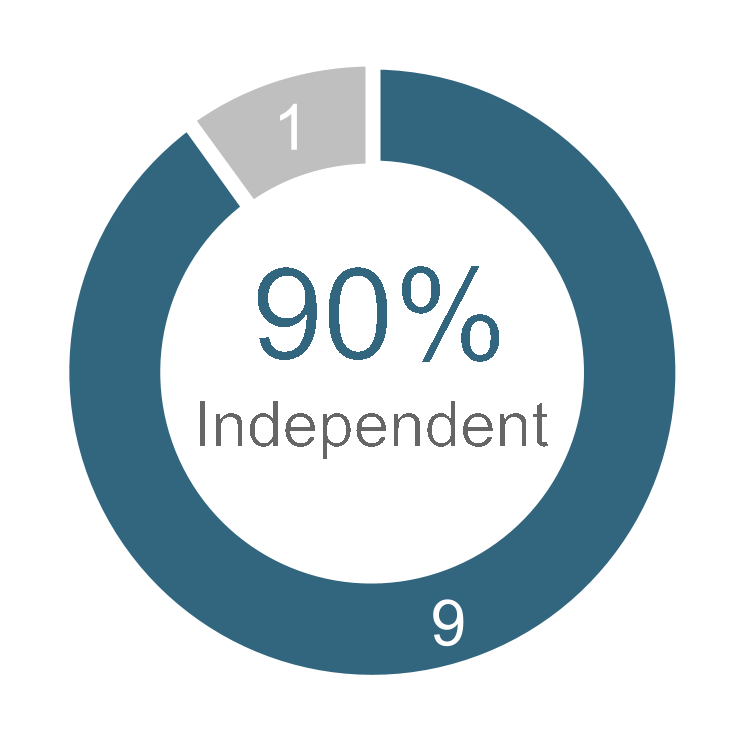
Online access for the 2026 Annual Meeting will begin at 8:45 a.m. ET on May 20, 2026. We encourage you to
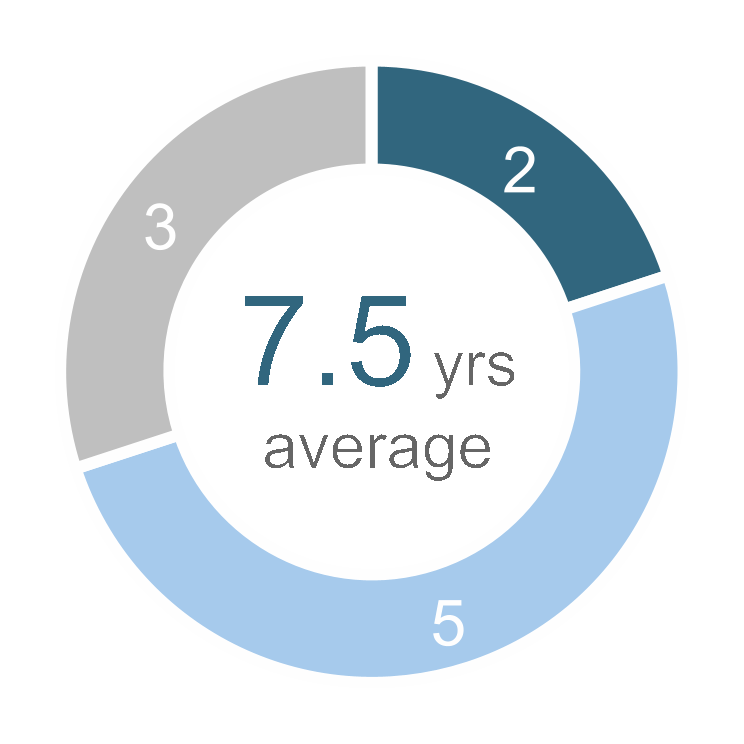
access the meeting website prior to the start time so that technical difficulties may be addressed by the time
the 2026 Annual Meeting begins.
What if I need technical assistance?
If you encounter any technical difficulties in accessing the 2026 Annual Meeting, the technical support number
will be available on the 2026 Annual Meeting log in page 15 minutes before the start of the meeting.
2026 Proxy Statement
121
Questions and Answers about the 2026 Annual Meeting and Voting
Voting
What matters are to be voted on at the 2026 Annual Meeting, and what is the recommendation of the
Board with respect to each proposal?
Agenda
Item
Proposal
Page
Number
Board
Recommendation
1.
To elect ten directors to serve until the next annual
meeting
FOR the ten nominees
of the Board
2.
To approve, on an advisory basis, the compensation of
our named executive officers
FOR
3.
To approve the 2026 Genworth Financial, Inc. Associate
Stock Purchase Plan
FOR
4.
To ratify the selection of KPMG as our independent
registered public accounting firm for 2026
FOR
Will any other matters be presented for a vote at the 2026 Annual Meeting?
At this time, we are not aware of any other matters that will be presented for a vote at the 2026 Annual
Meeting. However, if another matter were to be properly presented, the proxies would use their own judgment
in how to vote on that matter.
In February 2026, we received a letter from a stockholder stating his intent to submit four proposals for
consideration at the 2026 Annual Meeting pursuant to our Bylaws (rather than pursuant to Rule 14a-8 under
the Exchange Act). Our Board determined that the stockholder's letter did not comply with the requirements
contained in our Bylaws for the submission of business proposals because it omitted information required to
be included in a notice submitted pursuant to our Bylaws. Therefore, none of the stockholder's proposals will
be presented for a vote at the 2026 Annual Meeting.
Who is entitled to vote at the 2026 Annual Meeting?
All holders of our common stock, par value $0.001 (our “common stock”), issued and outstanding at the close
of business on March 23, 2026 (the “record date”) are entitled to vote at the 2026 Annual Meeting. As of the
record date, there were 385,207,174 shares of our common stock issued and outstanding. Each share
outstanding on the record date will be entitled to one vote.
How do I vote my shares before the 2026 Annual Meeting?
Record Holders.
Stockholders of record may submit a proxy to cause their shares to be represented and voted at the 2026
Annual Meeting. Stockholders of record may grant a proxy with respect to their shares by mail, by telephone
or by internet. Granting a proxy by telephone or internet will be available through 11:59 p.m. Eastern time on
May 19, 2026. Voting instructions appear on your WHITE proxy card. If you grant a proxy by telephone or by
internet, please have your WHITE proxy card available.
Beneficial Holders.
If you are the beneficial owner, but not the record owner, of our common stock, you will receive instructions
about voting from the bank, broker or other nominee that is the stockholder of record of your shares. Your
ability to vote over the internet or by telephone depends on the voting procedures of your bank, broker or
other nominee.
122
Genworth Financial, Inc.
Questions and Answers about the 2026 Annual Meeting and Voting
Retirement Plan Holders.
If you hold shares of our common stock through the Genworth Retirement and Savings Plan, you will receive
instructions about how to direct the trustee of your plan to vote your shares. Please review these voting
instructions to determine your ability to vote over the internet or by telephone.
Proxies or voting instruction forms submitted by mail, telephone or internet will be voted in the manner
indicated by the individuals named on the WHITE proxy card or voting instruction form.
Canada Stock Savings Plan Holders:
If you hold shares of our common stock through the Genworth Financial Canada Stock Savings Plan, you will
receive instructions about how to direct the trustee of your plan to vote your shares. Please review these
voting instructions to determine your ability to vote over the internet or by telephone.
Proxies or voting instruction forms submitted by mail, telephone or internet will be voted in the manner
indicated by the individuals named on the WHITE proxy card or voting instruction form.
How do I vote my shares during the 2026 Annual Meeting?
Record Holders.
Stockholders of record may vote their shares at the 2026 Annual Meeting by attending the 2026 Annual
Meeting. See “How do I attend the 2026 Annual Meeting?” above for information about how to attend the
2026 Annual Meeting.
Beneficial Holders.
Beneficial holders of our common stock as of the record date may vote their shares at the 2026 Annual
Meeting by attending the 2026 Annual Meeting. See “How do I attend the 2026 Annual Meeting?” above for
information about how to attend the 2026 Annual Meeting.
Retirement Plan Holders.
If you hold shares of our common stock through the Genworth Retirement and Savings Plan, please refer to
the instructions you receive about how to direct the trustee of your plan to vote your shares. You must return
your voting instructions with respect to any shares held through the Genworth Retirement and Savings Plan
no later than 11:59 p.m. ET on May 17, 2026. You may not vote any shares held through the Genworth
Retirement and Savings Plan during the 2026 Annual Meeting, as such shares may only be voted through
the trustee.
Canada Stock Savings Plan Holders:
If you hold shares of our common stock through the Genworth Financial Canada Stock Savings Plan, please
refer to the instructions you receive about how to direct the trustee of your plan to vote your shares. You must
return your voting instructions with respect to any shares held through the Genworth Financial Canada Stock
Savings Plan no later than 11:59 p.m. ET on May 18, 2026. You may not vote any shares held through the
Genworth Financial Canada Stock Savings Plan during the 2026 Annual Meeting, as such shares may only
be voted through the trustee.
2026 Proxy Statement
123
Questions and Answers about the 2026 Annual Meeting and Voting
What if I sign and return my WHITE proxy card or voting instructions but do not specify how to vote
my shares?
Record Holders.
If you submit a WHITE proxy card but do not specify how your shares are to be voted, the proxies will vote
your shares:
FOR the election of the ten nominees of the Board, who are named in this Proxy Statement, as directors;
FOR the approval, on an advisory basis, of the compensation of our named executive officers;
FOR the approval of the ASPP; and
FOR the ratification of the selection of KPMG as our independent registered public accounting firm
for 2026.
Beneficial Holders.
If your shares are registered in the name of a broker, the NYSE rules applicable to brokers determine whether
your broker may vote your share in its discretion even if it does not receive voting instructions from you.
At the 2026 Annual Meeting, the only “routine” matter proposed to be presented is the ratification of the
selection of KPMG as our independent registered public accounting firm for 2026 (Proposal No. 4).
Accordingly, we anticipate that if you do not provide your broker with timely voting instructions, your broker will
only be able to exercise discretionary authority on Proposal No. 4, and broker non-votes will occur as to each
of the other proposals presented at the 2026 Annual Meeting, which are considered “non-routine” matters.
Such broker non-votes will not affect the approval of these matters. In the event that you receive a competing
proxy statement from a stockholder, your broker will not be able to exercise discretionary voting authority on
any of the proposals at the 2026 Annual Meeting and no broker non-votes will be registered with respect to
any of the proposals.
Retirement Plan Holders.
If you hold your shares through the Genworth Retirement and Savings Plan and submit your voting instruction
form but do not specify how to vote your shares, the shares credited to your account will be voted by the
trustee in the same proportion that it votes shares in other accounts for which it received timely instructions.

Canada Stock Savings Plan Holders:
If you hold your shares through the Genworth Financial Canada Stock Savings Plan and submit your voting
instruction form but do not specify how to vote your shares, the shares credited to your account will be voted
by the trustee in the same proportion that it votes shares in other accounts for which it received
timely instructions.

May I change or revoke my proxy after it is submitted?
Yes, you may change or revoke your proxy before the 2026 Annual Meeting by:
subsequently granting a proxy by telephone or by internet;
returning a later-dated proxy card;
sending your notice of revocation to our Corporate Secretary; or
attending the 2026 Annual Meeting and voting electronically.
If you submit your changed proxy or revocation by telephone or by internet, it must be received by 11:59 p.m.
Eastern time on May 19, 2026. If you submit your changed proxy or revocation by another method specified
above, it must be received before the polls close for voting. Attendance at the meeting alone will not revoke a
previously submitted proxy.
124
Genworth Financial, Inc.
Questions and Answers about the 2026 Annual Meeting and Voting
Quorum and Vote Requirements
What is a quorum?
In order for business to be conducted at the 2026 Annual Meeting, a quorum must be present. A quorum will
be present if stockholders of record holding a majority in voting power of the outstanding shares of stock
entitled to vote at the meeting are present or are represented by proxies. Abstentions and broker non-votes
will be counted as shares present for purposes of determining whether a quorum is present.
What vote is required for the items of business at the 2026 Annual Meeting, and how are abstentions
and broker non-votes counted?
Holders of our common stock will vote as a single class and will be entitled to one vote per share with respect
to each matter to be presented at the 2026 Annual Meeting.
Proposal
Voting Options
Vote Required to Adopt
the Proposal
Effect of
Abstentions
Effect of Broker
Non-Votes
Election of ten directors
For, against or
abstain for
each nominee
Affirmative vote of a majority
of votes cast for each
nominee
No effect
No effect
Approval, on an advisory basis, of
the compensation of our named
executive officers
For, against
or abstain
Affirmative vote of a majority
of shares of common stock
present in person or
represented by proxy and
entitled to vote thereon*
Treated as
votes against
No effect
Approval of the 2026 Genworth
Financial, Inc. Associate Stock
Purchase Plan
For, against or
abstain
Affirmative vote of a majority
of shares of common stock
present in person or
represented by proxy and
entitled to vote thereon
Treated as
votes against
No effect
Ratification of the appointment of
KPMG as our independent
registered public accounting firm
for 2026
For, against
or abstain
Affirmative vote of a majority
of shares of common stock
present in person or
represented by proxy and
entitled to vote thereon
Treated as
votes against
N/A**
*The vote is advisory, and therefore not binding on the company, the Compensation Committee or our Board of Directors. However,
the Compensation Committee will review the voting results and take them into consideration when making future decisions regarding
executive compensation as it deems appropriate.
**Because this proposal is considered a routine proposal, banks, brokers, trustees and other nominees may vote our stockholders’
shares on this proposal without their instructions (except for any beneficial owner who receives a competing proxy from a
stockholder), and we anticipate there will be no broker non-votes with respect to this proposal.
Who counts the votes?
The Board will continue, as it has in past years, to retain an independent tabulator to receive and tabulate the
proxies and appoint an independent inspector of election to certify the results.
Where can I find the voting results of the 2026 Annual Meeting?
The preliminary voting results are expected to be announced at the 2026 Annual Meeting. In addition, within
four business days following the 2026 Annual Meeting, we intend to file the final voting results with the SEC
on a Form 8-K. If the final voting results have not been certified within that four-day period, we will report the
preliminary voting results on a Form 8-K at that time and will file an amendment to the Form 8-K to report the
final voting results within four business days of the date that the final results are certified. The final voting
results will also be posted in the corporate governance section of our website. To view the results, go to our
website: investor.genworth.com/news-events/annual-meeting-of-stockholders.
2026 Proxy Statement
125
Questions and Answers about the 2026 Annual Meeting and Voting
Other Annual Meeting Matters
What are the costs for soliciting proxies for the 2026 Annual Meeting?
Proxies will be solicited on behalf of the Board of Directors by mail, telephone, or other electronic means and
we will pay the solicitation costs. In addition to soliciting proxies by mail, our directors, the Board’s director
nominees, certain executive officers, and certain regular associates may solicit proxies on behalf of the Board,
without additional compensation, personally or by telephone. The regular associates will be administrative
personnel. Copies of proxy materials and of the 2025 Annual Report (as defined below) will be supplied to
brokers, dealers, banks and voting trustees, or their nominees, for the purpose of soliciting proxies from
beneficial owners, and we will reimburse such record holders for their reasonable expenses. Georgeson Inc.
has been retained to assist in soliciting proxies at a fee of $24,000, plus distribution costs and other costs and
expenses.
What are the deadlines for submission of stockholder proposals and director nominations for the
2027 Annual Meeting?
The rules of the SEC establish the eligibility requirements and the procedures that must be followed for a
stockholder’s proposal to be included in a public company’s proxy materials. Pursuant to those rules, any
proposal for inclusion in Genworth’s proxy materials for an annual meeting held in 2027 (the “2027 Annual
Meeting”) must be received at our principal executive offices on or before December [•], 2026.
In addition, our Bylaws establish an advance notice procedure with regard to director nominations and other
business proposals by stockholders intended to be presented at our 2027 Annual Meeting. For these
nominations or other business proposals to be properly brought before the meeting by a stockholder,
assuming the 2027 Annual Meeting occurs on a date that is not more than 30 days before or 70 days after the
anniversary of the 2026 Annual Meeting, the stockholder must deliver written notice to us not later than
February 19, 2027 nor earlier than the close of business on January 20, 2027. Such nominations and other
business proposals must comply with all requirements set forth in our Bylaws.
In order to comply with the SEC's universal proxy card rules, stockholders who intend to solicit proxies in
support of director nominees other than the Board's nominees must provide notice that sets forth information
required by Rule 14a-19(b) under the Exchange Act no later than March 21, 2027, in addition to complying
with the advance notice procedures of our Bylaws.
All notices of intention to present director nominations or other business proposals at the 2027 Annual
Meeting, whether or not intended to be included in our proxy materials, should be addressed to: Corporate
Secretary, Genworth Financial, Inc., 11011 West Broad Street, Glen Allen, Virginia 23060.
126
Genworth Financial, Inc.
Questions and Answers about the 2026 Annual Meeting and Voting
SEC Filings and Reports
May I request electronic delivery of proxy statements and annual reports in the future?
Stockholders of record may elect to receive future proxy statements and annual reports electronically by
providing consent to electronic delivery online at www.proxyvote.com. Should you choose to receive your
proxy materials electronically, your choice will remain in effect until you notify Genworth or Broadridge
Financial Solutions, Inc., in accordance with applicable law, that you wish to resume mail delivery of these
documents. If you hold your Genworth common stock through a bank, broker or other nominee, refer to the
information provided by that entity for instructions on how to receive your proxy materials electronically.
Where can I view this Proxy Statement and Genworth’s 2025 Annual Report electronically?
This Proxy Statement and Genworth’s 2025 Annual Report may be viewed online at www.proxyvote.com.
How can I get a copy of Genworth’s Annual Report on Form 10-K?
To obtain a copy of Genworth’s 2025 Annual Report, which includes our Form 10-K for the fiscal year ended
December 31, 2025, without charge, address your request to Investor Relations, Genworth Financial, Inc.,
11011 West Broad Street, Glen Allen, Virginia 23060. In addition, the 2025 Annual Report may be accessed at
our website: https://investor.genworth.com/sec-filings/annual-reports. Our Form 10-K for the fiscal year ended
December 31, 2025 also may be accessed at the SEC’s website at www.sec.gov.
2026 Proxy Statement
127
Other Information
Voting
Your vote is important. We encourage you to participate in the 2026 Annual Meeting, either by attending
and voting or by voting through other acceptable means. Whether or not you plan to attend the 2026 Annual

Meeting, please take the time to vote your shares as soon as possible. You can ensure that your shares are
voted at the meeting by submitting your proxy by telephone, by internet or by completing, signing, dating and
returning the WHITE proxy card (or voting instruction form, if you hold your shares through a broker, bank or
other nominee). Submitting your proxy by any of these methods will not affect your right to attend the meeting
and vote. A stockholder who gives a proxy may revoke it by voting at the 2026 Annual Meeting, by delivering a
subsequent proxy or by notifying Genworth’s Corporate Secretary in writing of such revocation. Attendance at
the meeting alone will not revoke a previously submitted proxy.
Each share of Common Stock issued and outstanding as of the record date is entitled to one vote for each
director nominee and one vote for each of the other proposals properly presented at the meeting. Your vote is
important, and we urge you to vote.
Meeting Admission
If you plan to attend the 2026 Annual Meeting, please follow the instructions beginning on page 120 of the
accompanying Proxy Statement.
2025 Annual Report
A copy of our Annual Report on Form 10-K for the fiscal year ended December 31, 2025 (the “2025 Annual
Report”) accompanies this Proxy Statement.
Date of Distribution
This Proxy Statement is furnished in connection with the solicitation of proxies by Genworth on behalf of the
Board for the 2026 Annual Meeting. The Notice of 2026 Annual Meeting of Stockholders, the Proxy Statement
and WHITE proxy card are first being made available or mailed to stockholders on or about April [], 2026.
128
Genworth Financial, Inc.
Other Information
Internet Availability of Proxy Materials
We are making this Proxy Statement and our 2025 Annual Report available to our stockholders on the
internet. We mailed to many of our stockholders a Notice of Internet Availability of Proxy Materials containing
instructions on how to access our proxy materials, including this Proxy Statement and our 2025 Annual
Report. The Notice of Internet Availability of Proxy Materials also provides instructions on how to vote online,
by mail or by telephone. If you received a Notice of Internet Availability of Proxy Materials by mail, you will not
receive a printed copy of the proxy materials in the mail unless you specifically request these materials.

Other stockholders, in accordance with their prior requests, have received e-mail notification of how to access
our proxy materials and vote online, or have been mailed paper copies of our proxy materials and a WHITE
proxy card (or a voting instruction form from their broker, bank or other nominee).

Internet distribution of proxy materials is designed to expedite receipt by stockholders, lower the costs
associated with our 2026 Annual Meeting, and reduce the environmental impact of our 2026 Annual Meeting.
However, if you received a Notice of Internet Availability of Proxy Materials by mail and would like to receive a
printed copy of our proxy materials, please follow the instructions for requesting such materials contained on
the Notice of Internet Availability of Proxy Materials. If you have previously elected to receive our proxy
materials electronically, you will continue to receive these materials via e-mail unless you elect otherwise.
05_GNW_PXY_2026_Appx A.jpg
2026 Proxy Statement
129
130
Genworth Financial, Inc.
Appendix A
GENWORTH FINANCIAL, INC.
ASSOCIATE STOCK PURCHASE PLAN
(Approved by Stockholders on May __, 2026)
1. Purpose. The purpose of the Plan is to provide associates of the Company and its Designated
Subsidiaries and Designated Affiliates with an opportunity to purchase shares of Common Stock through
accumulated Payroll Deductions and Matching Contributions. The Plan is not intended to qualify as an
“employee stock purchase plan” under Section 423 of the Code.
2. Definitions.
(a) “Administrator” means the Committee or, subject to Applicable Laws, one or more of the
Company’s officers or management team appointed by the Board or Committee to administer the day-to-day
operations of the Plan.
(b) “Affiliate” means (a) any entity that, directly or indirectly, is controlled by, controls or is
under common control with, the Company and (b) any entity in which the Company has a significant equity
interest, in either case as determined by the Committee, whether now or hereafter existing.
(c) “Applicable Laws” means the requirements relating to the administration of equity-based
awards and the related issuance of shares of Common Stock under U.S. state corporate laws, U.S. federal
and state securities laws, the Code, the rules of any Exchange or quotation system on which the Common
Stock is listed or quoted and the applicable laws of any non-U.S. jurisdiction where options to purchase
shares of Common Stock are, or will be, granted under the Plan.
(d) “Board” means the Board of Directors of the Company.
(e) “Code” means the U.S. Internal Revenue Code of 1986, as amended. Reference to a
specific section of the Code or U.S. Treasury Regulation thereunder will include such section or regulation,
any valid regulation or other official applicable guidance promulgated under such section, and any
comparable provision of any future legislation or regulation amending, supplementing or superseding such
section or regulation.
(f) “Committee” means the Management Development and Compensation Committee of the
Board, or any subcommittee referred to in Section 14(d).
(g) “Common Stock” means the common stock of the Company.
(h) “Company” means Genworth Financial, Inc., a Delaware corporation, or any successor
thereto.
(i) “Compensation” shall be defined from time to time by the Committee in its sole discretion
with respect to any Offering Period. Except as otherwise defined by the Committee from time to time in its
sole discretion, “Compensation” means wages and salary. Except as otherwise determined by the Committee,
“Compensation” does not include: (1) any bonuses or commissions, (2) overtime pay and regularly paid wage
premiums (such as evening or shift premiums), (3) any amounts contributed by the Company or a Designated
Subsidiary or Designated Affiliate to any pension plan, (4) any automobile or relocation allowances (or
reimbursement for any such expenses), (5) any amounts realized from the exercise of any stock options or
other equity incentive awards, (6) any amounts paid by the Company or a Designated Subsidiary or
Designated Affiliate for other fringe benefits, such as health and welfare, hospitalization and group life
insurance benefits, or perquisites, or paid in lieu of such benefits, or (7) other similar forms of extraordinary
compensation. The Administrator shall have the discretion to determine the application of this definition to
employees outside the United States.
(j) “Designated Affiliate” means any Affiliate that has been designated by the Administrator
from time to time in its sole discretion as eligible to participate in the Plan.
2026 Proxy Statement
131
Appendix A
(k) “Designated Subsidiary” means any Subsidiary that has been designated by the
Administrator from time to time in its sole discretion as eligible to participate in the Plan.
(l) “Effective Date” means the date that the Company’s stockholders approve the Plan.
(m) “Eligible Employee” means any individual who is an employee providing services to the
Company or a Designated Subsidiary or a Designated Affiliate, unless any such employee is either specifically
excluded from participation or is a member of a group or class of employees that is excluded from
participation by the Administrator in its sole discretion. For purposes of the Plan, the employment relationship
shall be treated as continuing intact while the individual is on military or sick leave or other bona fide leave of
absence approved by the Company or the Designated Subsidiary so long as the leave does not exceed three
(3) months or if longer than three (3) months, the individual’s right to reemployment is provided by statute or
has been agreed to by contract or in a written policy of the Company which provides for a right of
reemployment following the leave of absence. The employment relationship shall be treated as continuing
intact where an Eligible Employee transfers employment between the Company, Designated Subsidiaries
and/or Designated Affiliates.
(n) “Exchange” means any national securities exchange or national market system on which
the Stock may from time to time be listed or traded.
(o) “Exchange Act” means the U.S. Securities Exchange Act of 1934, as amended, including
the rules and regulations promulgated thereunder.
(p) “Exercise Date” means the last Trading Day of the Offering Period.
(q) “Fair Market Value” means, as of any date and unless the Administrator determines
otherwise, (i) if the Common Stock is listed or traded on any Exchange, the closing price for such Common
Stock (or the closing bid, if no sales were reported) as quoted on such Exchange (or the Exchange with the
greatest volume of trading in the Common Stock) for the last market trading day prior to the day of
determination, as reported by Bloomberg L.P. or such other source as the Administrator deems reliable.
(r) “Matching Contributions” means the additional credit to a Participant’s account under the
Plan pursuant to Section 7(b).
(s) “Maximum Share Amount” means the maximum number of shares of Common Stock that
a Participant may purchase on any given Exercise Date, as determined by the Committee in its sole discretion
prior to the commencement of the Offering Period.
(t) “New Exercise Date” means a new Exercise Date if the Administrator shortens any
Offering Period then in progress.
(u) “Offering” means an offer under the Plan of an option that may be exercised during an
Offering Period. For purposes of this Plan, the Committee may designate separate Offerings under the Plan
(the terms of which need not be identical) in which Eligible Employees of one or more Designated
Subsidiaries or Designated Affiliates will participate, even if the dates of the applicable Offering Periods of
each such Offering are identical.
(v) “Offering Date” means the first Trading Day of each Offering Period.
(w) “Offering Periods” means the period of time during which offers to purchase shares of
Common Stock are outstanding under the Plan. The Committee shall determine the length of each Offering
Period, which need not be uniform. Until specified otherwise by the Committee, the first Offering Period will be
the 6-month period beginning January 1, 2027 and ending June 30, 2027; thereafter Offering Periods will be
the six-month periods beginning January 1 and July 1 of each year, commencing July 1, 2027.
(x) “Parent” means a “parent corporation,” whether now or hereafter existing, as defined in
Section 424(e) of the Code.
132
Genworth Financial, Inc.
Appendix A
(y) “Participant” means an Eligible Employee that participates in the Plan.
(z) “Payroll Deductions” means the payroll deductions credited to a Participant’s account
under the Plan pursuant to Section 7(a) and used to fund the exercise of options granted pursuant to
the Plan.
(aa) “Plan” means this Genworth Financial, Inc. Associate Stock Purchase Plan.
(bb) “Purchase Price” means the Fair Market Value of a share of Common Stock on the
Exercise Date.
(cc) “Securities Act” means the Securities Act of 1933, as amended from time to time.
(dd) “Subsidiary” means a “subsidiary corporation,” whether now or hereafter existing, as
defined in Section 424(f) of the Code.
(ee) “Trading Day” means a day on which the New York Stock Exchange is open for trading.
(ff) “U.S.” means United States.
(gg) “U.S. Treasury Regulations” means the Treasury regulations of the Code. Reference to a
specific Treasury Regulation or Section of the Code shall include such Treasury Regulation or Section, any
valid regulation promulgated under such Section, and any comparable provision of any future legislation or
regulation amending, supplementing or superseding such Section or regulation.
3. Eligibility. Any Eligible Employee on a given Offering Date will be eligible to participate in the Plan,
subject to the requirements of Section 6, provided, however, that employees who are citizens or residents of a
non-U.S. jurisdiction may be excluded from participation in the Plan or an Offering if the participation of such
Employees is prohibited under the laws of the applicable jurisdiction.
4. Stock. Subject to adjustment as provided in Section 19 hereof, the maximum number of shares of
Common Stock that will be made available for sale under the Plan will be 6,000,000 shares of
Common Stock.
5. Offering Periods. Within the limitations set forth in Section 2(w), the Administrator will have the
power to change the duration of Offering Periods (including the commencement dates thereof) without
stockholder approval. Any such change shall be announced prior to the scheduled beginning of the first
Offering Period to be affected thereafter.
6. Participation. An Eligible Employee may become a participant in the Plan by following an electronic
or other enrollment procedure as may be established by the Administrator from time to time.
7. Payroll Deductions and Matching Contributions.
(a) At the time a Participant enrolls in the Plan pursuant to Section 6, he or she will elect to
have Payroll Deductions made on each payday during the Offering Period in an amount not exceeding ten
percent (10%) of the Compensation which he or she receives on each payday during the Offering Period. In
addition, the aggregate amount of Payroll Deductions for any Participant for all Offering Periods during any
calendar year shall not exceed the sum of fifteen thousand dollars ($15,000). Payroll Deductions for a
Participant will commence on the first payday following the Offering Date and will end on the last payday prior
to the Exercise Date of such Offering Period to which such authorization is applicable, unless sooner
terminated by the Participant as provided in Section 11 hereof. A Participant’s election to participant in the
Plan will remain in effect for successive Offering Periods unless terminated as provided in Section 11 hereof.
(b) In addition to Payroll Deductions, a Participant’s account under the plan shall be credited
on each payday during an Offering Period with a Matching Contribution equal to 10% of the amount of the
Participant’s Payroll Deduction.
2026 Proxy Statement
133
Appendix A
8. Grant of Option. On the Offering Date of each Offering Period, each Eligible Employee participating
in such Offering Period will be granted an option to purchase on each Exercise Date during such Offering
Period (at the applicable Purchase Price) up to a number of shares of Common Stock determined by dividing
such Eligible Employee’s Payroll Deductions and Matching Contributions accumulated during such Offering
Period prior to such Exercise Date and retained in the Eligible Employee’s account as of the Exercise Date by
the applicable Purchase Price; provided that in no event will an Eligible Employee be permitted to purchase
during each Offering Period more than the Maximum Share Amount, if any, subject to adjustment pursuant to
Section 19(a), and provided further that such purchase will be subject to the limitations set forth in Section 4.
The Eligible Employee may accept the grant of such option by electing to participate in the Plan in
accordance with the requirements of Section 6. The Administrator may, for future Offering Periods, increase or
decrease, in its absolute discretion, the maximum number of shares of Common Stock that an Eligible
Employee may purchase during each Offering Period. Exercise of the option will occur as provided in Section
9, unless the Participant has withdrawn pursuant to Section 11. The option will expire on the last day of the
Offering Period.
9. Exercise of Option.
(a) Unless a Participant withdraws from the Plan as provided in Section 11, his or her option
for the purchase of shares of Common Stock will be exercised automatically on the Exercise Date, and the
maximum number of full shares subject to the option will be purchased for such Participant at the applicable
Purchase Price with the accumulated Payroll Deductions and Matching Contributions from his or her account;
provided that in no event will an Eligible Employee be permitted to purchase during each Offering Period more
than the Maximum Share Amount, subject to adjustment pursuant to Section 19(a), and provided further that
such purchase will be subject to the limitations set forth in Section 4. No fractional shares of Common Stock
will be purchased. Any Payroll Deductions and Matching Contributions accumulated in a Participant’s account
which are not sufficient to purchase a full share will be retained in the Participant’s account for the subsequent
Offering Period. During a Participant’s lifetime, a Participant’s option to purchase shares hereunder is
exercisable only by him or her.
(b) In the event that the number of shares of Common Stock to be purchased by all
Participants in any Offering Period exceeds the number of shares of Common Stock then available for
issuance under the Plan, (i) the Company shall make a pro rata allocation of the remaining shares of
Common Stock in as uniform a manner as shall be practicable and as the Committee shall, in its sole
discretion, determine to be equitable and (ii) all funds not used to purchase shares of Common Stock on the
Exercise Date shall be returned, without interest to the Participants.
10. Delivery. By enrolling in the Plan, each Participant shall be deemed to have authorized the
establishment of a brokerage account on his or her behalf at a securities brokerage firm selected by the
Company. As soon as reasonably practicable after each Exercise Date on which a purchase of shares of
Common Stock occurs, the Company shall arrange for the delivery to each Participant of the shares of
Common Stock purchased upon exercise of his or her option to the Participant’s brokerage or Plan share
account in a form determined by the Company. Notwithstanding any other provision of the Plan, unless
otherwise determined by the Administrator or required by any applicable law, rule or regulation, the Company
shall not deliver to any Participant certificates evidencing shares of Common Stock issued in connection with
any purchase under the Plan, and instead such shares of Common Stock shall be recorded in the books of
the brokerage firm or, as applicable, the Company, its transfer agent, stock plan administrator or such other
outside entity which is not a brokerage firm.
134
Genworth Financial, Inc.
Appendix A
11. Withdrawal.
(a) A Participant may withdraw all but not less than all the Payroll Deductions (but not
Matching Contributions) credited to his or her account and not yet used to exercise his or her option under the
Plan at any time by following an electronic or other withdrawal procedure determined by the Administrator
from time to time. All of the Participant’s Payroll Deductions (but not Matching Contributions, which shall be
forfeited) credited to his or her account will be paid to such Participant as soon as reasonably practicable after
receipt of notice of withdrawal and such Participant’s options for the Offering Period shall be terminated
automatically, and no further Payroll Deductions or Matching Contributions for the purchase of shares of
Common Stock shall be made for such Offering Period. If a Participant withdraws from an Offering Period,
Payroll Deductions and Matching Contributions will not resume at the beginning of the succeeding Offering
Period, unless the Participant re-enrolls in the Plan as prescribed by the Administrator from time to time.
(b) A Participant’s withdrawal from an Offering Period will not have any effect upon his or her
eligibility to participate in any similar plan that may hereafter be adopted by the Company or in succeeding
Offering Periods that commence after the termination of the Offering Period from which the
Participant withdraws.
12. Termination of Employment. Unless otherwise determined by the Administrator, upon a
Participant’s ceasing to be an Eligible Employee for any reason, he or she will be deemed to have elected to
withdraw from the Plan and the Payroll Deductions (but not Matching Contributions, which shall be forfeited)
credited to such Participant’s account during the Offering Period but not yet used to purchase shares of
Common Stock under the Plan will be returned to such Participant or, in the case of his or her death, to the
person or persons entitled thereto under Section 15, and such Participant’s option will be automatically
terminated. Unless determined otherwise by the Administrator, a Participant whose employment transfers
between entities through a termination with an immediate rehire (with no break in service) by the Company or
a Designated Subsidiary or Designated Affiliate shall not be treated as terminated under the Plan.
13. Interest. No interest will accrue on the Payroll Deductions and Matching Contributions of a
Participant in the Plan, except as may be required by Applicable Law, as determined by the Administrator.
14. Administration.
(a) Unless otherwise designated by the Board, the Committee shall serve as the
Administrator. The Administrator will have full and exclusive discretionary authority to construe, interpret and
apply the terms of the Plan, to designate separate Offerings under the Plan, to designate Subsidiaries or
Affiliates as participating in the Plan, to determine eligibility and adjudicate all disputed claims filed under the
Plan, including which entities shall be Designated Subsidiaries or Designated Affiliates, and to establish such
procedures that it deems necessary for the administration of the Plan. Notwithstanding any provision to the
contrary in this Plan, the Administrator may adopt rules or procedures relating to the operation and
administration of the Plan to accommodate the specific requirements of local laws and procedures for
jurisdictions outside of the United States. Without limiting the generality of the foregoing, the Committee is
specifically authorized to adopt rules, procedures and subplans regarding, without limitation, eligibility to
participate, the definition of Compensation, handling of Payroll Deductions and Matching Contributions,
making of Payroll Deductions and Matching Contributions to the Plan (including, without limitation, in forms
other than payroll deductions), establishment of bank or trust accounts to hold Payroll Deductions and/or
Matching Contributions, payment of interest, conversion of local currency, obligations to pay payroll tax,
determination of beneficiary designation requirements, withholding procedures and handling of stock
certificates that vary with applicable local requirements.
(b) Every finding, decision and determination made by the Administrator will, to the full extent
permitted by law, be final and binding upon all parties, including the Company, Designated Subsidiary,
Designated Affiliate, Participant, Eligible Employee, or any beneficiary of such person, as applicable.
2026 Proxy Statement
135
Appendix A
(c) To the extent allowable pursuant to Applicable Law, each member of the Board, the
Committee, the Administrator or any employee of the Company, a Designated Subsidiary, or a Designated
Affiliate (each such person, a “Covered Person”) shall be indemnified and held harmless by the Company
from any loss, cost, liability, or expense that may be imposed upon or reasonably incurred by such Covered
Person in connection with or resulting from any claim, action, suit, or proceeding to which he or she may be a
party or in which he or she may be involved by reason of any action or failure to act pursuant to the Plan and
against and from any and all amounts paid by him or her in satisfaction of judgment in such action, suit, or
proceeding against him or her; provided, however, that he or she has acted in accordance with his or her
duties and responsibilities to the Company under Applicable Law, and provided that he or she gives the
Company an opportunity, at its own expense, to handle and defend any claim, action, suit, or proceeding to
which he or she is a party before he or she undertakes to handle and defend it on his or her own behalf. The
foregoing right of indemnification shall not be exclusive of any other rights of indemnification to which such
Covered Persons may be entitled pursuant to the Company’s Certificate of Incorporation or Bylaws, as a
matter of law, or otherwise, or any power that the Company may have to indemnify them or hold
them harmless.
(d) To the extent not prohibited by Applicable Law, the Committee may, from time to time,
delegate some or all of its authority under the Plan to a subcommittee or subcommittees of the Committee,
the Administrator or other persons or groups of persons as it deems necessary, appropriate or advisable
under conditions or limitations that it may set at or after the time of the delegation. For purposes of the Plan,
reference to the Committee will be deemed to refer to any subcommittee, subcommittees, or other persons or
groups of persons to whom the Committee delegates authority pursuant to this Section 14(d).
15. Designation of Beneficiary.
(a) If permitted by the Administrator, a Participant may file a designation of a beneficiary who
is to receive any shares of Common Stock and cash, if any, from the Participant’s account under the Plan in
the event of such Participant’s death subsequent to an Exercise Date on which the option is exercised but
prior to delivery to such Participant of such shares and cash. In addition, if permitted by the Administrator, a
Participant may file a designation of a beneficiary who is to receive any cash from the Participant’s account
under the Plan in the event of such Participant’s death prior to exercise of the option. If a Participant is
married and the designated beneficiary is not the spouse, spousal consent will be required for such
designation to be effective.
(b) Such designation of beneficiary, if permitted, may be changed by the Participant at any
time by notice in a form determined by the Administrator. In the event of the death of a Participant and in the
absence of a beneficiary validly designated under the Plan who is living at the time of such Participant’s
death, the Company will deliver such shares and/or cash to the executor or administrator of the estate of the
Participant, or if no such executor or administrator has been appointed (to the knowledge of the Company),
the Company, in its discretion, may deliver such shares and/or cash to the spouse or to any one or more
dependents or relatives of the Participant, or if no spouse, dependent or relative is known to the Company,
then to such other person as the Company may designate.
(c) All beneficiary designations will be in such form and manner as the Administrator may
designate from time to time.
16. Transferability. Neither Payroll Deductions or Matching Contributions credited to a Participant’s
account nor any rights with regard to the exercise of an option or to receive shares of Common Stock under
the Plan may be assigned, transferred, pledged or otherwise disposed of in any way (other than by will, the
laws of descent and distribution or as provided in Section 15 hereof) by the Participant. Any such attempt at
assignment, transfer, pledge or other disposition will be without effect, except that the Company may treat
such act as an election to withdraw funds from an Offering Period in accordance with Section 11 hereof.
136
Genworth Financial, Inc.
Appendix A
17. Use of Funds. The Company may use all Payroll Deductions received or held by it under the Plan
for any corporate purpose, and the Company will not be obligated to segregate such Payroll Deductions,
except as may be required by applicable local law, as determined by the Administrator. Until shares of
Common Stock are issued, Participants will only have the rights of an unsecured creditor with respect to the
Plan, although Participants in specified Offerings may have additional rights where required under local law,
as determined by the Administrator.
18. Reports. Individual accounts will be maintained for each Participant in the Plan. Statements of
account will be given to participating Eligible Employees at least annually, which statements will set forth the
amounts of Payroll Deductions and Matching Contributions, the Purchase Price, the number of shares of
Common Stock purchased and the remaining cash balance, if any.
19. Adjustments; Dissolution or Liquidation; Corporate Transactions.
(a) Adjustments. Subject to any required action by the stockholders of the Company, the
maximum number of shares of Common Stock that shall be made available for sale under the Plan, the
maximum number of shares of Common Stock that each Participant may purchase during the Offering Period
pursuant to the Maximum Share Amount and the per share price used to determine the Purchase Price shall
be proportionately adjusted for any increase or decrease in the number of issued shares of Common Stock
resulting from any nonreciprocal transaction between the Company and its stockholders, (such as a stock
dividend, stock split, spin-off, rights offering or recapitalization through a large, nonrecurring cash dividend),
that affects the Common Stock (or other securities of the Company) or the price of shares of Common Stock
(or other securities) and causes a change in the per share value of the Common Stock underlying outstanding
options. Such adjustment shall be made by the Administrator, whose determination in that respect shall be
final, binding and conclusive. Except as expressly provided herein, no issuance by the Company of shares of
stock of any class, or securities convertible into shares of stock of any class, shall affect, and no adjustment
by reason thereof shall be made with respect to, the number or price of shares of Common Stock subject to
an option.
(b) Dissolution or Liquidation. In the event of the proposed dissolution or liquidation of the
Company, any Offering Period then in progress will be shortened by setting a New Exercise Date, and will
terminate immediately prior to the consummation of such proposed dissolution or liquidation, unless provided
otherwise by the Administrator. The New Exercise Date will be before the date of the Company’s proposed
dissolution or liquidation. The Administrator will notify each Participant in writing or electronically, prior to the
New Exercise Date, that the Exercise Date for the Participant’s option has been changed to the New Exercise
Date and that the Participant’s option will be exercised automatically on the New Exercise Date, unless prior
to such date the Participant has withdrawn from the Offering Period as provided in Section 11 hereof.
(c) Certain Corporate Transactions. In the event of a reorganization, merger, or consolidation
of the Company with one or more corporations in which the Company is not the surviving corporation (or
survives as a direct or indirect subsidiary of such other constituent corporation or its parent), or upon a sale of
substantially all of the property or stock of the Company to another corporation, each outstanding option will
be assumed or an equivalent option substituted by the successor corporation or a Parent or Subsidiary of the
successor corporation. In the event that the successor corporation refuses to assume or substitute for the
option, the Offering Period with respect to which such option relates will be shortened by setting a New
Exercise Date on which such Offering Period shall end. The New Exercise Date will occur before the date of
the Company’s proposed merger or Change in Control. The Administrator will notify each Participant in writing
or electronically prior to the New Exercise Date, that the Exercise Date for the Participant’s option has been
changed to the New Exercise Date and that the Participant’s option will be exercised automatically on the
New Exercise Date, unless prior to such date the Participant has withdrawn from the Offering Period as
provided in Section 11 hereof.
2026 Proxy Statement
137
Appendix A
20. Amendment or Termination.
(a) Subject to any Applicable Law or government regulation and to the rules of any Exchange
or quotation system on which the shares of Common Stock may be listed or quoted, the Plan may be
amended, modified, suspended or terminated by the Board without the approval of the stockholders of the
Company. Except as provided in Section 19, no amendment may make any change in any option previously
granted which adversely affects the rights of any Participant or any beneficiary (as applicable) without the
consent of the affected Participant or beneficiary.
(b) Without stockholder approval and without regard to whether any Participant rights may be
considered to have been “adversely affected,” the Administrator or its delegate, to the extent permitted under
the terms of the Plan, Applicable Law, the Bylaws of the Company and under the Committee charter, may
change the Offering Periods, limit the frequency or number of changes in the amount withheld during an
Offering Period, establish the exchange rate applicable to amounts withheld in a currency other than U.S.
dollars, permit payroll withholding in excess of the amount designated by a Participant to adjust for delays or
mistakes in the Company’s processing of properly completed Contribution elections, establish reasonable
waiting and adjustment periods and/or accounting and crediting procedures to ensure that amounts applied
toward the purchase of shares of Common Stock for each Participant properly correspond with amounts
withheld from the Participant’s Compensation, and establish such other limitations or procedures as the
Committee deems appropriate.
21. Notices. All notices or other communications by a Participant to the Company under or in
connection with the Plan will be deemed to have been duly given when received in the form and manner
specified by the Company at the location, or by the person, designated by the Company for the
receipt thereof.
22. Conditions Upon Issuance of Shares. Shares of Common Stock will not be issued with respect to
an option unless the exercise of such option and the issuance and delivery of such shares pursuant thereto
will comply with all applicable provisions of U.S. and non-U.S. law, including, without limitation, the Securities
Act, the Exchange Act, the rules and regulations promulgated thereunder, and the requirements of any
Exchange, and will be further subject to the approval of counsel for the Company with respect to such
compliance. As a condition to the exercise of an option, the Company may require the person exercising such
option to represent and warrant at the time of any such exercise that the shares are being purchased only for
investment and without any present intention to sell or distribute such shares if, in the opinion of counsel for
the Company, such a representation is required by any of the aforementioned applicable provisions of law.
23. Clawback/Recoupment Policy. Notwithstanding anything contained herein to the contrary, all
shares of Common Stock acquired pursuant to the Plan shall be and remain subject to any incentive
compensation clawback or recoupment policy currently in effect or as may be adopted by the Board and, in
each case, as may be amended from time to time. No such policy adoption or amendment shall in any event
require the prior consent of any Participant.
24. Tax Withholding and Code Section 409A.
(a) Each Participant must make adequate provision for federal, state, or other tax withholding
obligations, if any, which arise in connection with participation in the Plan. By electing to participate in the
Plan, a Participant authorizes the Company to withhold from the Participant’s compensation, or other amounts
payable to the Participant, the amounts necessary to satisfy any such applicable tax withholding obligations.
At any time, the Company may, but shall not be obligated to, withhold from the Participant’s compensation, or
other amounts payable to the Participant, the amount necessary for the Company to satisfy any applicable tax
withholding obligations.
138
Genworth Financial, Inc.
Appendix A
(b) Options granted under the Plan to U.S. taxpayers are intended to be exempt from the
application of Section 409A under the short-term deferral exception and any ambiguities shall be construed
and interpreted in accordance with such intent. Subject to Section 24(b), options granted to U.S. taxpayers
under the Plan are subject to such terms and conditions that will permit such options to satisfy the
requirements of the short-term deferral exception available under Section 409A of the Code, including the
requirement that the shares of Common Stock subject to an option be delivered within the short-term deferral
period. To the extent the Company determines that an option or the exercise, payment, settlement or deferral
is subject to Section 409A of the Code, the option shall be granted, exercised, paid, settled or deferred in a
manner that will comply with Section 409A of the Code, including Department of Treasury regulations and
other interpretive guidance issued thereunder, including without limitation any such regulations or other
guidance that may be issued after the Effective Date. Anything in the foregoing to the contrary
notwithstanding, the Company shall have no liability to a Participant or any other party if the option that is
intended to be exempt from, or compliant with Section 409A of the Code is not so exempt or compliant or for
any action taken by the Company with respect thereto.
(c) Although the Company may endeavor to avoid adverse tax treatment under Section 409A
of the Code, the Company makes no representation to that effect and expressly disavows any covenant to
avoid unfavorable tax treatment, notwithstanding anything to the contrary in this Plan. The Company is not
constrained in its corporate activities by any potential negative tax impact on Participants under the Plan.
25. Term of Plan. The Plan will be effective as of the Effective Date and will continue in effect through
the tenth (10th) anniversary thereof, unless sooner terminated under Section 20.
26. Governing Law and Jurisdiction. The Plan shall be governed by, and construed in accordance
with, the laws of the U.S. State of Delaware (except its choice-of-law provisions). The jurisdiction and venue
for any disputes arising under, or any action brought to enforce (or otherwise relating to) this Plan shall be
exclusively in the courts in the U.S. State of Delaware, including the U.S. federal courts located therein
(should federal jurisdiction exist).
27. No Right to Employment. Participation in the Plan by a Participant shall not be construed as giving
a Participant the right to be retained as an employee of the Company, a Subsidiary or an Affiliate, as
applicable. Furthermore, the Company, a Subsidiary or an Affiliate may dismiss a Participant from
employment at any time, free from any liability or any claim under the Plan.
28. Severability. If any provision of the Plan is or becomes or is deemed to be invalid, illegal, or
unenforceable for any reason in any jurisdiction or as to any Participant, such invalidity, illegality or
unenforceability shall not affect the remaining parts of the Plan, and the Plan shall be construed and enforced
as to such jurisdiction or Participant as if the invalid, illegal or unenforceable provision had not been included.
29. Compliance with Applicable Laws. The terms of this Plan are intended to comply with all
Applicable Laws and will be construed accordingly.
Image_0.jpg
01 PRO014489_Gemworth_BC.jpg
PRELIMINARY COPY SUBJECT TO COMPLETION-MARCH 24, 2026
pc_1.jpg
GENWORTH FINANCIAL, INC.
C/O CORPORATE SECRETARY
11011 WEST BROAD STREET
GLEN ALLEN, VA 23060
 
pc_2.jpg
VOTE BY INTERNET
Before The Meeting - Go to www.proxyvote.com or scan the QR Barcode above
Use the Internet to transmit your voting instructions and for electronic delivery of information:
Stockholders:
You must vote these shares no later than 11:59 p.m. ET on May 19, 2026.
Participants in the Genworth Financial, Inc. Retirement and Savings Plan:
You must vote these shares no later than 11:59 p.m. ET on May 17, 2026.
Members in the Genworth Financial Canada Stock Savings Plan:
You must vote these shares no later than 5:00 p.m. ET on May 18, 2026.
Have your WHITE proxy card in hand when you access the website and follow the instructions to obtain your
records and to create an electronic voting instruction form.
During The Meeting - Go to www.virtualshareholdermeeting.com/GNW2026
You may attend the meeting via the Internet and vote during the meeting. Have the information that is printed in
the box marked by the arrow available and follow the instructions.
VOTE BY PHONE - 1-800-690-6903
Use any touch-tone telephone to transmit your voting instructions:
Stockholders:
You must vote these shares no later than 11:59 p.m. ET on May 19, 2026.
Participants in the Genworth Financial, Inc. Retirement and Savings Plan:
You must vote these shares no later than 11:59 p.m. ET on May 17, 2026.
Members in the Genworth Financial Canada Stock Savings Plan:
You must vote these shares no later than 5:00 p.m. ET on May 18, 2026.
Have your WHITE proxy card in hand when you call, and then follow the instructions.
VOTE BY MAIL
Mark, sign and date your WHITE proxy card and return it in the postage-paid envelope we have provided or return
it to Vote Processing, c/o Broadridge, 51 Mercedes Way, Edgewood, NY 11717.
TO VOTE, MARK BLOCKS BELOW IN BLUE OR BLACK INK AS FOLLOWS:
V85810-P44609
KEEP THIS PORTION FOR YOUR RECORDS
 
pc_rule.jpg
THIS PROXY CARD IS VALID ONLY WHEN SIGNED AND DATED.
DETACH AND RETURN THIS PORTION ONLY
pc_4.jpg
GENWORTH FINANCIAL, INC.
THE BOARD OF DIRECTORS RECOMMENDS A VOTE "FOR"
EACH NOMINEE IN PROPOSAL 1 BELOW AND "FOR"
PROPOSALS 2, 3, AND 4.
1.
Election of Ten Directors.
Nominees:
For
Against
Abstain
1a.
G. Kent Conrad
 
pc_3.jpg
 
pc_3.jpg
 
pc_3.jpg
1b.
Karen E. Dyson
 
pc_3.jpg
 
pc_3.jpg
 
pc_3.jpg
1c.
Jill R. Goodman
 
pc_3.jpg
 
pc_3.jpg
 
pc_3.jpg
1d.
Melina E. Higgins
 
pc_3.jpg
 
pc_3.jpg
 
pc_3.jpg
1e.
Thomas J. McInerney
 
pc_3.jpg
 
pc_3.jpg
 
pc_3.jpg
1f.
Howard D. Mills, III
 
pc_3.jpg
 
pc_3.jpg
 
pc_3.jpg
1g.
Robert P. Restrepo Jr.
 
pc_3.jpg
 
pc_3.jpg
 
pc_3.jpg
1h.
Elaine A. Sarsynski
 
pc_3.jpg
 
pc_3.jpg
 
pc_3.jpg
1i.
Ramsey D. Smith
 
pc_3.jpg
 
pc_3.jpg
 
pc_3.jpg
1j.
Steven C. Van Wyk
 
pc_3.jpg
 
pc_3.jpg
 
pc_3.jpg
For
Against
Abstain
2.
Advisory vote to approve named executive
officer compensation.
 
pc_3.jpg
 
pc_3.jpg
 
pc_3.jpg
3.
Approval of the 2026 Genworth Financial, Inc.
Associate Stock Purchase Plan.
 
pc_3.jpg
 
pc_3.jpg
 
pc_3.jpg
4.
Ratification of the selection of KPMG LLP as
the independent registered public accounting
firm for 2026.
 
pc_3.jpg
 
pc_3.jpg
 
pc_3.jpg
NOTE: Please sign exactly as your name appears hereon. When signing as attorney, executor, administrator, or trustee, please give your full title.
For joint accounts each owner must sign. Please Sign, Date and Return the WHITE Proxy Card Promptly Using the Enclosed Envelope.
Signature [PLEASE SIGN WITHIN BOX]
Date
Signature (Joint Owners)
Date
Important Notice Regarding the Availability of Proxy Materials
for the Annual Meeting of Stockholders to Be Held on May 20, 2026:
Genworth's proxy statement and annual report to stockholders are available at www.proxyvote.com.
q  IF YOU HAVE NOT VOTED VIA THE INTERNET OR TELEPHONE, FOLD ALONG THE PERFORATION, DETACH AND RETURN THE BOTTOM PORTION IN THE ENCLOSED ENVELOPE.  q
pc_rule.jpg
V85811-P44609
pc_5a.jpg
GENWORTH FINANCIAL, INC.
WHITE PROXY SOLICITED ON BEHALF OF THE BOARD OF DIRECTORS
FOR THE ANNUAL MEETING OF STOCKHOLDERS ON MAY 20, 2026
Stockholder:
The undersigned stockholder of Genworth Financial, Inc. hereby appoints Thomas J. McInerney, Jerome T. Upton, and Michael J. McCullough, and each of them jointly
and severally, proxies, with full power of substitution, to represent and to vote all shares of Common Stock of Genworth Financial, Inc. that the undersigned is entitled to
vote at the 2026 Annual Meeting of Stockholders to be held on Wednesday, May 20, 2026, at 9:00 a.m. ET and at any adjournment thereof, upon such business as may
properly come before the meeting, including the proposals described in the Proxy Statement dated April [•], 2026, a copy of which has been received by the undersigned,
and on matters incidental to the conduct of the meeting.
THIS WHITE PROXY WHEN PROPERLY EXECUTED WILL BE VOTED IN THE MANNER DIRECTED HEREIN BY THE UNDERSIGNED STOCKHOLDER. IF NO
DIRECTION IS MADE, THIS PROXY WILL BE VOTED "FOR" EACH NOMINEE LISTED IN PROPOSAL 1 AND "FOR" PROPOSALS 2, 3, AND 4. ON OTHER
MATTERS THAT MAY PROPERLY COME BEFORE THE ANNUAL MEETING, THE PROXIES SHALL VOTE IN ACCORDANCE WITH THEIR JUDGMENT.
Participant in the Genworth Financial, Inc. Retirement and Savings Plan (the "Plan"):
The undersigned participant in the Plan hereby directs Fidelity Management Trust Company (“Fidelity”) as Trustee for the Plan, to vote all shares of Common Stock of
Genworth Financial, Inc. allocated to the undersigned's account under the Plan at the 2026 Annual Meeting of Stockholders to be held on Wednesday, May 20, 2026, at
9:00 a.m. ET and at any adjournment thereof, upon such business as may properly come before the meeting, including the proposals described in the Proxy Statement
dated April [•], 2026, a copy of which has been received by the undersigned, and on matters incidental to the conduct of the meeting.
THIS WHITE PROXY VOTING INSTRUCTION CARD WHEN PROPERLY EXECUTED WILL BE VOTED IN THE MANNER DIRECTED HEREIN BY THE
UNDERSIGNED PLAN PARTICIPANT. IF THIS PROXY VOTING INSTRUCTION CARD IS NOT PROPERLY COMPLETED AND SIGNED, OR IF IT IS NOT TIMELY
RECEIVED BY THE DESIGNATED TABULATOR, SHARES OF GENWORTH'S COMMON STOCK HELD IN THE UNDERSIGNED'S ACCOUNT UNDER THE PLAN
WILL BE VOTED IN THE SAME PROPORTION AS SHARES OF GENWORTH'S COMMON STOCK FOR WHICH DIRECTIONS HAVE BEEN RECEIVED FROM
OTHER PLAN PARTICIPANTS, UNLESS FIDELITY DETERMINES TO VOTE OTHERWISE, CONSISTENT WITH ITS OBLIGATIONS UNDER ERISA. ALL
INSTRUCTIONS RECEIVED BY FIDELITY FROM INDIVIDUAL PARTICIPANTS WILL BE HELD IN CONFIDENCE.
Member in the Genworth Financial Canada Stock Savings Plan (the "Canadian Plan"):
The undersigned member in the Canadian Plan hereby directs Sun Life Financial, as Trustee for the Canadian Plan, to vote all shares of Common Stock of Genworth
Financial, Inc. allocated to the undersigned's account under the Canadian Plan at the 2026 Annual Meeting of Stockholders to be held on Wednesday, May 20, 2026, at
9:00 a.m. ET and at any adjournment thereof, upon such business as may properly come before the meeting, including the proposals described in the Proxy Statement
dated April [•], 2026, a copy of which has been received by the undersigned, and on matters incidental to the conduct of the meeting.
THIS WHITE PROXY VOTING INSTRUCTION FORM WHEN PROPERLY COMPLETED AND SIGNED WILL BE VOTED IN THE MANNER DIRECTED HEREIN BY
THE UNDERSIGNED MEMBER. IF THIS PROXY VOTING INSTRUCTION FORM IS NOT PROPERLY COMPLETED AND SIGNED, OR IF IT IS NOT TIMELY
RECEIVED BY THE DESIGNATED TABULATOR, SHARES OF GENWORTH'S COMMON STOCK HELD IN THE UNDERSIGNED'S ACCOUNT UNDER THE PLAN
WILL NOT BE VOTED.
(PLEASE MARK, SIGN AND DATE ON REVERSE SIDE)